
NOTTINGHAMSHIRE SPRAY FOAM REMOVAL SPECIALISTS
Spray Foam Removal in Nottinghamshire
Has spray foam in your loft stalled a sale, blocked a remortgage or been flagged on a survey? Our specialist teams remove it safely right across Nottinghamshire, from Nottingham and West Bridgford to Mansfield, Newark and Worksop, with the independent survey and lender ready documentation you need to move forward.
or call 07846 196539, or message us on WhatsApp.
WHO WE ARE
Nottinghamshire’s Spray Foam Removal Specialists
We’re spray foam removal specialists covering every part of Nottinghamshire, and our own teams handle your job from first enquiry through to finished loft. Whether you’re in a Nottingham city terrace, a former colliery-estate semi in Mansfield or Ashfield, a West Bridgford suburb or a Newark period home, you get a straight, independent assessment and the foam removed properly.
What was once sold as an energy saving upgrade now causes mortgage refusals, failed sales and blocked equity release across the county. We take that problem off your hands, safely, and with the paperwork your lender and surveyor need to sign the property off.

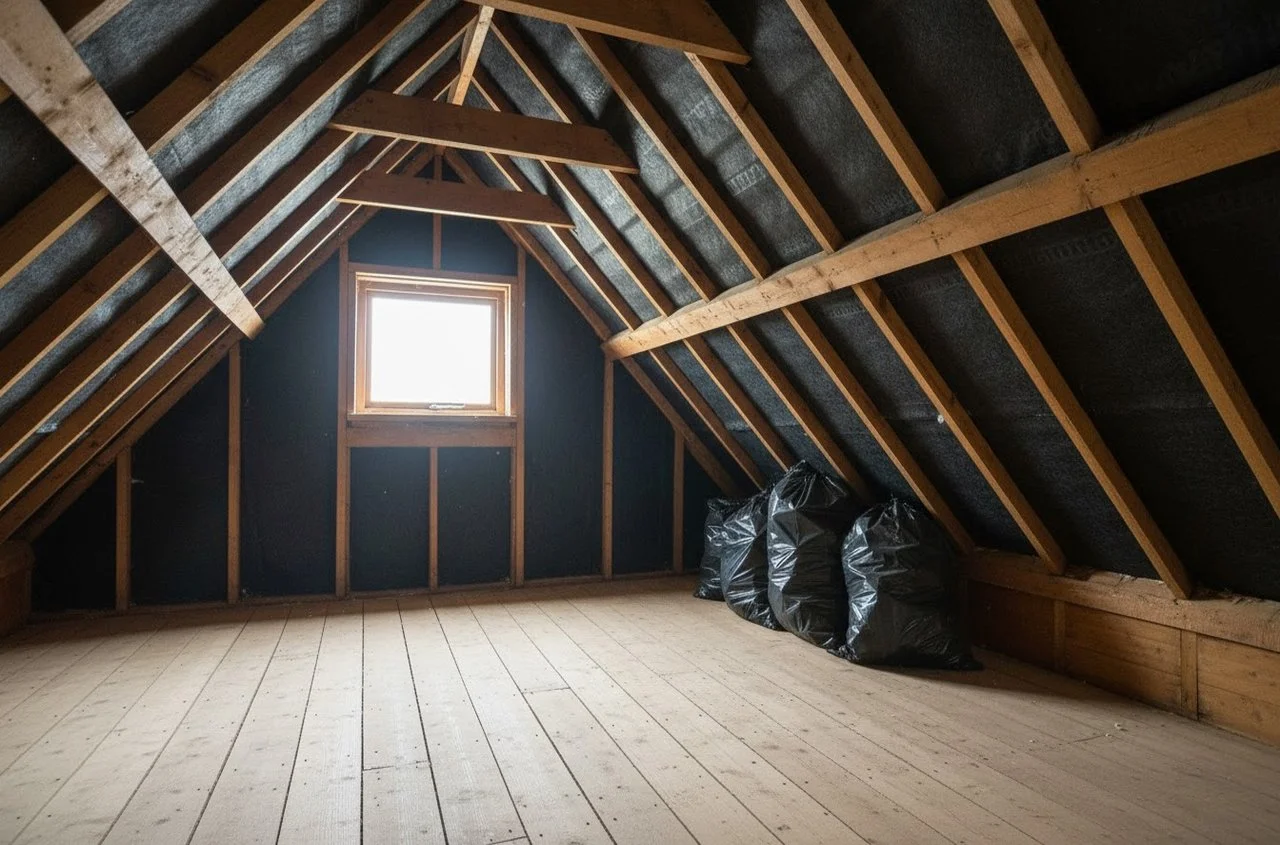
Why Spray Foam Removal Matters
Spray foam insulation sounds energy-efficient… but often leads to BIG problems.
Many UK homeowners only discover these issues when they try to sell, remortgage or release equity on their home.
Common Spray Foam Issues:
- Mortgage Refusals & Buying/Selling Delays:
- Most lenders now flag spray foam in lofts as a valuation risk, and many will refuse mortgages entirely if the foam blocks access to roof timbers.
- Equity Release Blocked:
- Equity release lenders are extremely cautious and often decline applications on homes with spray foam insulation.
- Hidden Moisture & Timber Damage:
- Foam can trap moisture and stop natural ventilation, creating conditions for mould and rot that surveyors can’t assess without removal.
- Resale Value Falls:
- A property with spray foam becomes harder to sell and may fetch lower offers if the issue isn’t addressed.
This isn’t just theoretical-thousands of UK homeowners have seen sales fall through and mortgages refused because of spray foam.
Our Principles
Clear standards. Professional accountability. Trusted results.
Our service is guided by a commitment to technical excellence, regulatory awareness, and protecting the long-term value and mortgage integrity of every property we work on.
Our Vision
To set the benchmark for professional spray foam removal in the UK, ensuring homes remain structurally sound, surveyor-approved, and fully mortgage-ready.
Our Mission
To arrange meticulous, compliant spray foam removal that protects property value, satisfies lender requirements, and provides homeowners with absolute clarity and confidence at every stage.
Our Commitment
To operate with integrity, technical precision, and accountability, providing homeowners, surveyors, and lenders with complete assurance in every project we coordinate.
What we offer
Our teams work across Nottinghamshire providing honest advice, clear pricing, and full documentation and a removal certificate as standard, so you can move forward with confidence.
WHY homeowners CHOOSE US
Our mission is simple: to help Nottinghamshire homeowners regain control of their property, protect its structure, and restore its mortgage-ability.
Every removal is carried out by our specialist teams with lenders and surveyors front of mind. We know exactly what they need to see to sign a property off, so the work is done to satisfy their requirements first time, clearing the path to your sale, remortgage or equity release.
We tell you what your roof actually needs, not what’s easiest to sell. If the timber underneath is sound, we’ll say so. If there’s more to it, you’ll hear that too. Straight answers, a clear recommendation, and no pressure to go ahead.
Every job is completed with full professional documentation and a removal certificate as standard, never an optional extra. It confirms the foam is gone and records the condition of your roof, giving your surveyor, lender and solicitor the evidence they need to move forward with confidence.
Protected Work. Trusted Professionals.
Our specialist teams are accredited by the Confederation of Roofing Contractors and vetted by Checkatrade, so every spray foam removal is completed in line with established industry standards. Work is protected by a 10-Year Insurance-Backed Guarantee, giving reassurance not only to homeowners, but also to surveyors and mortgage lenders.
How It Works — Our Process
Whether you’re dealing with surveyor red flags, lender requirements or structural concerns, we make the process simple:
Tell us about your loft or spray foam issue and we’ll provide an estimate of the likely cost and time.
2. Detailed Removal Plan.
We explain the safest way the foam can be removed without damaging your roof structure.

3. Professional Removal & Clean-Up.
Our specialist teams remove all traces of spray foam efficiently and responsibly.
Every job finishes with full documentation and a removal certificate, confirming your loft’s condition to surveyors and lenders.
TESTIMONIAL
Client Feedback & Reviews
See what our customer say about us.
I was quite nervous about the process of removing loft insulation, but I’m glad I chose this company. From the first phone call to the final sweep up at our home in Nottinghamshire, they were very polite. The team worked incredibly hard in a tight space and made sure everything was bagged up and removed properly. It’s a relief to see the roof breathing again. Very trustworthy!

I was having issues with my mortgage approval because of the spray foam in my loft. I contacted the team, they were absolute lifesavers. They came to Surrey, explained the whole process, and did the spray foam removal without any fuss. The surveyor is now happy and my mortgage is sorted. Professional, on time, and highly recommended!
📍 Areas We Cover Across Nottinghamshire
We provide spray foam surveys and removal across the whole of Nottinghamshire. Our teams regularly work across:
- Arnold
- Beeston
- Bottesford
- Bulwell
- Clipstone
- Eastwood
- Keyworth
- Kirkby in Ashfield
- Long Eaton
- Mansfield
- Market Warsop
- New Basford
- Newark-on-Trent
- Radcliffe-on-Trent
- Retford
- Shirebrook
- Stapleford
- Tuxford
- Worksop
- Aspley
- Bingham
- Bramcote
- Carlton
- Cotgrave
- Hucknall
- Kimberley
- Langley Mill
- Longeaton
- Mansfield Woodhouse
- New Balderton
- New Ollerton
- Nottingham
- Ravenshead
- Ruddington
- Southwell
- Sutton-in-Ashfield
- West Bridgford
If your town or village is not listed, please get in touch. Our service covers the full county of Nottinghamshire.
FAQ's
Questions Nottinghamshire Homeowners Ask Us Most
This is the most common question we receive from homeowners in Nottinghamshire's former mining communities. Unfortunately, in most cases the legal position is that responsibility for spray foam sits with the current owner of the property regardless of when or by whom it was installed. If the foam was not disclosed in the property information forms when you purchased, there may be a legal route to explore with your conveyancer — but the practical priority is always the same: removal needs to happen to unblock the transaction, and you need independent documentation of that removal for your lender. Our survey provides the evidence base that any legal discussions may also need. Contact your conveyancer about non-disclosure in parallel if you believe it applies.
Nottinghamshire is an inland county without the coastal moisture exposure of the southern counties, which means timber decay rates behind spray foam are generally lower here than in coastal areas. That said, spray foam installed fifteen or more years ago in a Victorian terrace will almost certainly show some degree of moisture staining on the rafter surfaces beneath — this is very common and does not necessarily indicate structural failure. Our survey will give you an accurate assessment of current timber condition. In the majority of Nottingham Victorian terrace cases we encounter, the timbers are sound once the foam is removed, though we will always be honest if the findings are more serious.
The lender response to spray foam is the same in West Bridgford as anywhere else in Nottinghamshire — a nil valuation and a declined application until the issue is resolved. The higher property values in West Bridgford do mean the financial consequences of a delayed or collapsed sale are greater than in other parts of the county, which is why West Bridgford homeowners who discover spray foam mid-transaction typically act very quickly to resolve it. We can usually arrange a survey within a week and complete removal for a standard West Bridgford semi within two to three days of the survey being confirmed.
Significantly more likely, yes. Former housing association and council properties in Nottinghamshire — particularly those in Mansfield, Kirkby in Ashfield, Sutton-in-Ashfield, Hucknall, Worksop, and the former colliery communities — were the primary targets of the spray foam insulation programmes carried out in the 2000s. If your property was a former housing association home before you purchased it, a loft inspection before any mortgage application or property sale is strongly advisable. In our experience, the majority of former housing association properties in these areas have some form of spray foam insulation in the loft.
Costs vary depending on property size, foam type, and extent of coverage. For the typical former mining community semi-detached with standard closed-cell foam coverage — which is the most common property type in our Nottinghamshire workload — costs usually fall in the lower-to-mid range of our estimate tool, reflecting these properties' relatively smaller loft spaces. Nottingham Victorian terraces are similarly priced. West Bridgford and larger detached properties will be costed somewhat higher. Our free online estimate tool gives you a realistic early indication before you commit to a survey. Full, itemised pricing is confirmed following the survey with no hidden charges.
Start with a Free Online Estimate for Your Nottinghamshire Property
If spray foam is affecting your Nottinghamshire property, wherever you are in the county, the quickest way to understand your options and likely costs is our free online estimate. Prefer to talk it through? Call us on 07846 196539 or message us on WhatsApp, and you can send loft photos straight from your phone.