
Spray Foam Removal in Bedfordshire
Spray Foam Removal in Bedfordshire — Independent Surveys & Professional Removal
LUTON, BEDFORD & GREENSAND RIDGE SPECIALISTS
Specialist Spray Foam Surveys & Removal Across Bedfordshire
We provide independent spray foam surveys, professional removal, and full remedial solutions across Bedfordshire — from Luton and Dunstable to Bedford, Biggleswade, Leighton Buzzard, and the rural Greensand Ridge villages. If spray foam insulation is blocking your mortgage, remortgage, or equity release, our specialist teams can help.
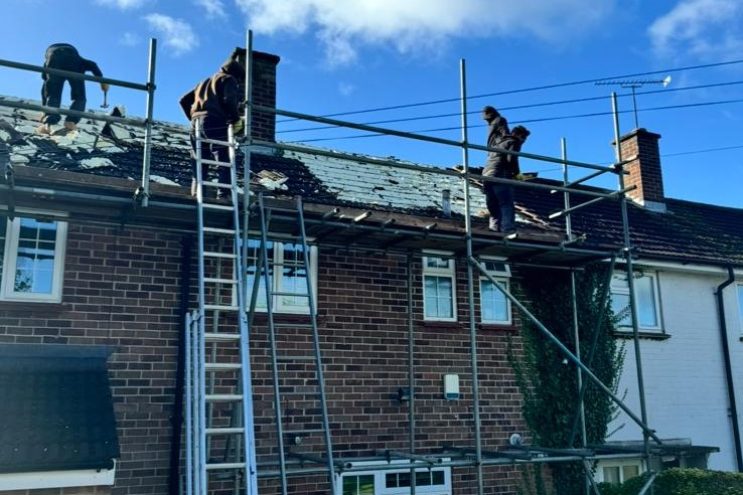
Luton's Manufacturing Heritage and Why Bedfordshire Has One of the South East's Highest Spray Foam Prevalence Rates
Luton is unlike any other town in Bedfordshire — and unlike most towns in the South East of England. Its rapid industrial growth in the twentieth century, driven first by the hat-making industry and then by Vauxhall Motors, the airport, and a substantial manufacturing and logistics base, created a dense, working-class housing stock that was built quickly, managed centrally by the local authority, and improved systematically over the decades that followed.
During the energy efficiency push of the 2000s, Luton Borough Council and its housing partners applied spray foam insulation to significant numbers of properties across the town’s post-war estates — particularly in Farley Hill, Lewsey, Marsh Farm, and Leagrave — on a street-by-street basis. The scale of these programmes, and the pace at which they were delivered, means that spray foam prevalence in Luton is disproportionately high relative to its size. And because Luton’s housing market has high transactional activity — driven by the airport economy, logistics employment, and proximity to London — these properties are changing hands and triggering lender refusals at a significant rate.
Dunstable — Luton’s immediate neighbour to the west — shares much of this housing stock character: post-war council-era semis and terraces, high insulation scheme activity during the 2000s, and a property market driven by the same economic forces. Together, Luton and Dunstable represent the highest concentration of spray foam-affected properties in Bedfordshire.
A Recent Bedfordshire Case: Bedford Homeowner, Sale Blocked by Halifax — Foam Unknown to Current Owner
Last year, a homeowner in Bedford’s Kempston area contacted us after their property sale was halted mid-conveyancing. The buyer’s lender — Halifax — had instructed a survey on the 1970s semi-detached and identified open-cell spray foam covering the loft floor and lower rafter sections. The foam had been applied in 2011 during a Bedford Borough Council-coordinated energy improvement scheme that covered a number of streets in the Kempston area. The homeowner had purchased the property nine years earlier and had no knowledge of the foam — it was not disclosed in any documentation at sale.
We surveyed within four days of the homeowner’s call. The report confirmed open-cell foam throughout, with elevated moisture readings in the upper foam layer consistent with thirteen years of installation. The underlying timbers were in structurally acceptable condition — no significant decay despite the moisture in the foam body. The survey gave Halifax’s valuer the specific structural evidence they needed and confirmed that removal was the straightforward resolution.
Removal was completed over two days. The completion report was issued the same afternoon and transmitted to Halifax via the homeowner’s solicitor. Halifax accepted the report and the sale resumed. The Bedford sale completed three weeks later.
The homeowner subsequently raised the non-disclosure of the foam with their conveyancer — a conversation our survey report was able to support with its independent documentation of the foam’s age and origin. This is a pattern we see regularly in Bedfordshire: foam applied during a council scheme before a property changes hands, not recorded in property information forms at the point of sale, and discovered by the next buyer at their own lender’s valuation.
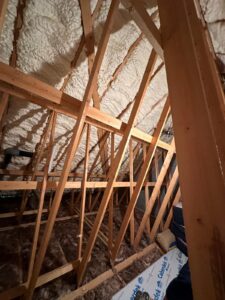
Spray foam insulation sealing the roof rafters in this Bedfordshire loft. Creating a warm roof space for maximum energy efficiency and year-round comfort.
Bedford, the A1 Corridor, and Rural Bedfordshire: A Different Spray Foam Picture to Luton
Bedford’s character is markedly different to Luton’s. The county town has a traditional market town and administrative character — Victorian and Edwardian suburban housing, a riverside setting on the Great Ouse, and a significant commuter population drawn to its rail connection to London. Bedford’s spray foam profile is shaped by its 1950s–1970s suburban expansion: semi-detached estates across Kempston, Queens Park, Brickhill, and Goldington that were targeted by local authority energy schemes during the 2000s.
The A1 corridor towns of Sandy, Biggleswade, and Shefford have their own housing character — market town cores with Victorian and inter-war stock surrounded by 1960s–1980s suburban expansion. The A1’s role as a logistics artery has brought distribution and warehousing employment that has sustained housing demand across this part of the county, and spray foam discovered at remortgage or sale is a regular feature of our workload along this corridor.
Leighton Buzzard and Ampthill — the county’s western market towns — have a distinctly different character again. Leighton Buzzard’s canal-side setting and inter-war housing stock, and Ampthill’s Georgian market town centre with surrounding Victorian and post-war development, both present their own spray foam contexts. Ampthill’s relatively high property values for a Bedfordshire market town mean that spray foam-related nil valuations carry more significant financial consequences here than in the county’s lower-value areas.
TESTIMONIAL
Client Feedback & Reviews
See what our customers say about us.
I was struggling to get a equity release approved on our bungalow in Leighton Buzzard because of the insulation. The surveyor wouldn't even look at the rafters. I used the Free online tool for a quick quote and the lads were out here within the week. They did a sterling job clearing it all out and provided the certificate I needed for the bank. Truly a massive relief.

No nonsense, just good honest work. I used the free online estimate tool on their site first to get a rough idea of the costs for our place in Dunstable, and it was spot on. I then arranged an independent survey to check for damp, and the team was very upfront about what needed doing. They didn't push for any extras, just got the foam out and cleared the debris. The roof is breathing again and I can finally stop worrying about it. Cheers.

Bedfordshire's Housing Stock: Where Spray Foam Is Most Commonly Found
Bedfordshire’s housing divides along fairly clear geographic lines, each with its own spray foam prevalence and lender risk characteristics:
- Luton post-war council and former council housing (Farley Hill, Lewsey, Marsh Farm, Leagrave, Luton central): The highest spray foam prevalence of any area in Bedfordshire. Council-era semis and terraces where systematic insulation programmes covered entire estates. High transaction volumes from the airport and logistics economy mean spray foam discoveries during sales are routine.
- Dunstable post-war and 1960s–1980s housing: Shares Luton's housing stock character and insulation scheme history. Houghton Regis — between Luton and Dunstable — has similar characteristics and is equally affected.
- Bedford Victorian, Edwardian, and 1950s–1970s suburban housing (Kempston, Queens Park, Brickhill, Goldington): Bedford's inner suburbs contain Victorian and Edwardian terraced housing alongside the post-war estate expansion that received most insulation scheme attention. Spray foam is found regularly in both eras of housing in the Bedford area.
- A1 corridor market town housing (Sandy, Biggleswade, Shefford): Victorian and inter-war town centres with 1960s–1980s suburban expansion. Commuter demand along the A1 and the East Midlands Rail route keeps transaction volumes high and spray foam mid-sale discoveries a regular occurrence.
- Western market towns and rural Bedfordshire (Leighton Buzzard, Ampthill, Flitwick, the Greensand Ridge villages): Older and more rural property stock where spray foam from private installations and smaller local schemes is found in period and traditional construction. Ampthill's higher property values mean nil valuations here carry greater financial consequences than in the county's lower-value areas.
What Bedfordshire Lenders Require After a Spray Foam Nil Valuation
The RICS guidance that underpins spray foam policy at Halifax, Nationwide, Barclays, Santander, NatWest, and all mainstream building societies applies uniformly across Bedfordshire — whether the property is a Luton post-war semi, a Bedford Victorian terrace, or an Ampthill period market town home. The lender requires professional removal confirmed by a specialist contractor, an independent completion report documenting the scope of works and post-removal findings, and evidence of any remedial works where structural issues are found.
Our survey report and completion report are written to provide this evidence in the specific format and level of detail that lenders require. For Bedfordshire properties where foam was applied during a council scheme and there is a non-disclosure question to address, the survey report’s independent documentation of the foam’s characteristics and likely installation period can also support any legal discussions the homeowner may need to have with their conveyancer.
Our Bedfordshire Services: Survey, Removal, and the Completion Report
- Independent Spray Foam Survey
Every project begins with a thorough independent inspection of the loft space by one of our vetted specialist contractors. We identify the foam type — open-cell or closed-cell — assess the full extent of coverage, and examine the condition of the underlying roof timbers. For Luton and Dunstable council-scheme properties, we note the foam characteristics and age in a way that supports both the lender reassessment and any non-disclosure legal discussions. For Greensand Ridge rural and period properties, we assess the construction type and foam adhesion before confirming any removal approach. The survey report is written specifically to address the questions your mortgage lender or equity release provider will ask.
- Professional Spray Foam Removal
Our removal teams use specialist equipment to detach spray foam from roof timbers with minimum structural disruption. For standard Bedfordshire post-war semis and terraces — the most common property type in our Bedfordshire workload — removal of typical foam coverage is usually achievable within one to two working days on site. On completion, all debris is cleared, the structure is inspected, and the formal completion report is issued the same day.
- Remedial Works and Roof Replacement
Where removal reveals underlying damage — decayed rafters, deteriorated felt, or structural issues the foam had been concealing — we provide honest, itemised guidance on the remedial works needed before the lender will reinstate the valuation. For standard Bedfordshire suburban properties, structural complications are less common than in coastal counties. Where they do occur, all qualifying works are supported by a 10-Year Insurance-Backed Guarantee.
📍 Areas We Cover Across Bedfordshire
We provide spray foam surveys and removal across the whole of Bedfordshire. Our teams regularly work across:
- Ampthill
- Bedford
- Biggleswade
- Dunstable
- Henlow
- Kempston
- Luton
- Sharnbrook
- Wixams
- Barton-le-Clay
- Harrold
- Arlesey
- Biggles
- Cranfield
- Flitwick
- Houghton Regis
- Leighton Buzzard
- Sandy
- Shefford
- Wootton
- Potton
If your town or village is not listed, please contact us — our service covers the full county of Bedfordshire.
Why Bedfordshire Homeowners Choose Spray Foam Removal UK
Bedfordshire’s internal diversity — from Luton’s high-density airport economy housing to Bedford’s market town suburbs to the rural Greensand Ridge villages — means that spray foam presents different challenges in different parts of the county. Our survey-first process ensures every Bedfordshire property is individually assessed, with the removal approach confirmed before work begins. The completion report is written specifically around what your lender needs to see — and where non-disclosure is a relevant issue, around the detail that legal discussions may also need.
- Specialist focus — spray foam surveys and removal is our entire operation
- Vetted contractors — all field teams are Checkatrade-approved
- CORC members — contractors hold membership of the Confederation of Roofing Contractors
- Lender-aware documentation — survey and completion reports structured around the specific requirements of mainstream lenders and equity release providers
- Bedfordshire experience — our teams understand Luton's council scheme history, Bedford's suburban expansion housing, and the Greensand Ridge's rural construction
- Non-disclosure support — our survey reports document foam age, type, and likely origin in a way that can support any legal discussions about non-disclosure at purchase
- 10-Year Insurance-Backed Guarantee — available on qualifying removal and roof replacement projects
- Free online estimate — understand indicative costs before committing to a survey
Get a Free Online Estimate for Your Bedfordshire Property
Whether you are in Luton with a mid-conveyancing sale halted, a Bedford remortgage blocked, a Dunstable property where foam has just been flagged for the first time, or an Ampthill home where an equity release has been refused — the starting point is always the same: an independent survey and a clear, honest picture of what you are dealing with.
Use our free online estimate tool for an early indication of costs and timescales, or contact us directly to arrange a survey. We cover the whole of Bedfordshire and understand both the pace of Luton’s airport economy property market and the more traditional character of Bedford and the county’s rural market towns.
FAQ's
Questions Bedfordshire Homeowners Ask Us Most
Yes — significantly so. Luton's post-war housing stock was managed at scale by the local authority and its housing partners, and energy improvement schemes during the 2000s applied spray foam systematically across entire estates in Farley Hill, Lewsey, Marsh Farm, Leagrave, and surrounding areas. The pace and scale of these programmes means spray foam prevalence in Luton is among the highest of any town in the South East relative to its size. If you own or are buying a property in a Luton post-war estate built before 1985, a loft inspection before any mortgage application or transaction is strongly advisable.
This is one of the most common situations we encounter in Bedfordshire, particularly in properties that passed through council or housing association management before private sale. Your practical priority is resolving the lender issue — our survey and removal process gives you the documentation to do that. In parallel, our survey report documents the foam's characteristics, age, and likely installation period in a way that can support any non-disclosure claim you may wish to raise with your conveyancer. If you believe foam was not disclosed in the property information forms at purchase, speak to your conveyancer about whether a legal avenue exists — our report can be used to evidence the foam's presence and characteristics.
Immediately. The Bedford case above shows what is achievable when you act on the same day as the nil valuation — survey in four days, removal in two, completion report same afternoon, sale completed in three weeks. The key variable is not the removal timeline — that is largely predictable. The key variable is how much lead time you give us before your buyer's deadline. Contact us as soon as the lender's nil valuation notice arrives.
Luton Airport and the logistics, distribution, and manufacturing economy around it creates high transactional velocity in the Luton property market — properties change hands frequently and the buyer profile is diverse. This creates two relevant dynamics: spray foam installed during a previous ownership is discovered by buyers who have no prior knowledge of it, and the pace of transactions means the mid-conveyancing pressure when foam is flagged is often acute. We are experienced in working around the specific pace and dynamics of the Luton market.
Standard Luton and Bedford post-war semi-detacheds with typical open-cell or closed-cell foam coverage usually fall towards the lower-to-mid range of our estimate tool — these are typically smaller loft spaces with relatively straightforward access. Larger Bedford detacheds, Ampthill period properties, and Greensand Ridge rural homes with more complex construction may be costed differently. Our free online estimate gives you a realistic early indication before you commit to a survey. Full itemised pricing is confirmed following the survey with no hidden charges.
Start with a Free Online Estimate for Your Bedfordshire Property
If spray foam insulation is affecting your Bedfordshire property — whether you are in Luton, Bedford, Dunstable, Biggleswade, Leighton Buzzard, or anywhere across the county — the quickest way to understand your options and likely costs is through our free online estimate tool. You can also call or email us directly to arrange an independent spray foam survey anywhere across Bedfordshire.