
Spray Foam Removal in Derbyshire
Spray Foam Removal in Derbyshire — Independent Surveys & Professional Removal
PEAK DISTRICT, DALES & DERBYSHIRE COALFIELD SPECIALISTS
Spray Foam Surveys & Removal Across Derbyshire
Derbyshire’s Peak District gritstone properties, its former coalfield community housing, Derby’s Victorian terraces, and the Dales market towns each create distinct spray foam challenges. Our vetted contractors produce the lender-aware documentation that resolves these problems and gets Derbyshire transactions moving again.
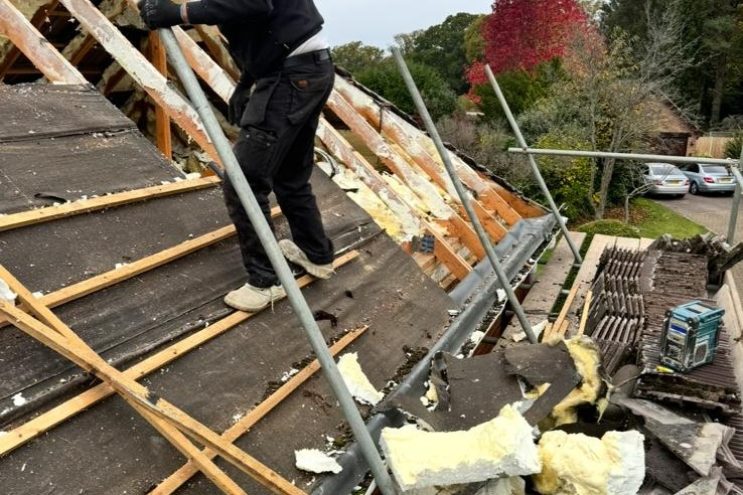
The Peak District and Why Derbyshire's Upland Properties Face the Most Complex Spray Foam Removal Challenges in the County
More of the Peak District National Park falls within Derbyshire than within any other English county. The High Peak — the gritstone moorland landscape around Buxton, Glossop, Chapel-en-le-Frith, Whaley Bridge, and the Hope Valley — and the White Peak limestone Dales around Matlock, Bakewell, Wirksworth, and Ashbourne represent a housing stock unlike that found anywhere else in England. Gritstone farmhouses, limestone cottages, converted lead miners’ dwellings, and the distinctive stone terraces of the Dales villages have construction methods that span centuries and materials that behave very differently to standard brick.
When spray foam insulation is applied within these properties — and it has been, in significant numbers, during the energy efficiency schemes of the 2000s and through private installation — the consequences are more complex than in standard suburban housing. Gritstone and limestone construction is breathable by nature: moisture moves through the fabric of the building, and the roof void plays a critical role in managing that movement. Spray foam sealing the roof void of a Peak District stone property disrupts this process more severely than it would in a standard brick property, and the removal process requires specialist assessment of the construction before any method is agreed.
The Peak District National Park designation adds a further dimension: any external remedial works to the roof following removal — tile or slate replacement, ridge repairs, new breathable felt — may require planning consent within the Park that would not be needed elsewhere. Our survey process identifies these planning considerations upfront for Peak District properties so there are no unexpected complications after removal.
A Recent Derbyshire Case: Chesterfield Homeowner, Sale Blocked by NatWest — Rescued in Three Weeks
Earlier this year, a homeowner in Chesterfield’s Brampton area contacted us after their property sale was halted mid-conveyancing. The buyer’s lender — NatWest — had instructed a survey on the 1960s semi-detached and identified closed-cell spray foam covering the full rafter span. The foam had been applied in 2014 by a local contractor as part of an energy improvement initiative in the area. NatWest issued a nil valuation and declined to lend. The buyer had set a deadline of three weeks before they would consider withdrawing and accepting a refund of their survey fee.
We surveyed the Chesterfield property within four days. The report confirmed rigid closed-cell foam throughout the rafter span, with no evidence of structural timber decay — Chesterfield’s relatively sheltered inland position and the foam’s 2014 installation date meant the timbers had remained in good condition over ten years. The removal scope was clear and predictable. The report gave NatWest’s valuer the specific structural evidence they needed.
Removal was completed over two days. The completion report was issued the same afternoon and transmitted to NatWest via the homeowner’s solicitor. NatWest accepted the report, conveyancing resumed, and the Chesterfield sale completed within seventeen days of our initial survey — inside the buyer’s deadline.
Chesterfield’s significant stock of 1950s–1970s family housing — built during the town’s post-war expansion across Brampton, Whittington Moor, Brimington, and Staveley — was widely targeted by energy improvement schemes. Spray foam discovery during sales in the Chesterfield area is a regular feature of our Derbyshire workload. Acting on the same day as the nil valuation — as the homeowner here did — is what makes the difference between a sale saved and a sale lost.
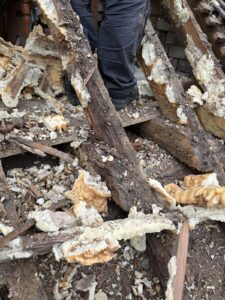
Stripping out severely rotted and damaged roof timbers to clear the way for structural renewal. Essential demolition work ensuring a solid foundation for the new roof installation in Derbyshire.
Derbyshire's Former Coalfield Communities: A Different Spray Foam Problem to the Peak District
While the Peak District presents the county’s most technically complex spray foam removal challenges, Derbyshire’s former coalfield communities — in the Amber, Rother, and Erewash valleys — present the highest volume. The colliery towns and villages of Alfreton, Ripley, Heanor, Ilkeston, Somercotes, Pinxton, and Kirkby-in-Ashfield-fringe communities share the same story as Nottinghamshire’s coal communities: housing stock built and managed for mining families, improvement schemes applied systematically during the tenure of housing associations, and spray foam installed in thousands of properties without occupants always having a full understanding of what was put in place.
Many of these properties passed into private ownership through right-to-buy during the 1980s and 1990s, and have since changed hands one or more times. Buyers of former colliery community housing in Derbyshire’s Amber and Erewash valleys should treat a pre-purchase loft inspection as routine — the probability of spray foam being present is higher here than in any other part of the county.
Swadlincote and the south Derbyshire coalfield communities — centred on the former coal and clay industries of the National Forest fringe — have similar housing characteristics. Post-war council-era terraces and semis in this area were also targeted by insulation schemes, and spray foam discovery at survey is consistently higher here than in the market towns of the Dales or in Derby’s suburban fringe.
TESTIMONIAL
Client Feedback & Reviews
See what our customers say about us.
Sorted us out big time. We were trying to sell our house in Heanor and the survey came back bad because of the foam. These guys came over, gave us a fair price, and had it all bagged up and gone in a day. No messing about and no hidden costs. If you need it gone for a mortgage, these are the ones to call.

Spot on service. Got a free estimate off the website and the price was fair so we went for it. They did our bungalow in Long Eaton last week. Tidy, polite, and they even showed me the clean rafters before they left. Hard to find honest tradesmen these days, so I’m glad we found this lot. Cheers.

Derbyshire's Housing Stock: Where Spray Foam Is Most Commonly Found and What It Means for Lenders
Derbyshire’s housing divides into four distinct zones, each with its own spray foam profile and lender risk characteristics:
- Derby city Victorian and Edwardian suburbs (Allestree, Mickleover, Sinfin, Alvaston, Normanton): Derby's inner suburbs contain dense Victorian and Edwardian terraced housing built for natural roof ventilation. Spray foam in these properties creates standard cold-roof moisture problems. Derby's significant student and rental population — driven by two universities — means properties in these areas change hands frequently, and foam installed during a previous tenancy may be unknown to the current owner.
- Chesterfield and north Derbyshire post-war housing: Chesterfield's substantial stock of 1950s–1970s family housing across Brampton, Whittington Moor, Brimington, and Staveley was widely targeted by energy improvement schemes. Survey discoveries during sales and remortgages in these areas are consistently among the highest in the county.
- Amber, Rother, and Erewash valley former coalfield communities (Alfreton, Ripley, Heanor, Ilkeston): As described above — high spray foam prevalence from systematic housing association improvement programmes, with many properties having passed through multiple ownerships since the original installation. Former housing association and council properties in these areas carry the highest probability of spray foam of any property type in Derbyshire.
- White Peak and Dales market towns (Matlock, Wirksworth, Ashbourne, Bakewell): Period limestone and gritstone construction with high property values relative to the wider county. Lender scrutiny at valuation is heightened in these historic market towns, and the traditional construction requires specialist assessment before any removal approach is agreed.
- High Peak new-town and suburban housing (Buxton, Glossop, Chapel-en-le-Frith, New Mills): The High Peak towns have a mix of Victorian industrial workers' terraces and post-war suburban expansion. Buxton's spa town character and Glossop's mill-town heritage both produce period housing where spray foam's disruption of natural ventilation creates genuine structural risk.
What Derbyshire Lenders Need After a Spray Foam Nil Valuation
Whether the lender is Halifax, Nationwide, Barclays, Santander, or NatWest, the requirements following a spray foam nil valuation in Derbyshire are consistent with RICS guidance. The lender needs professional removal confirmed by a specialist contractor, an independent completion report documenting the scope of works and post-removal findings, and — where structural issues are found — evidence that remedial works have been completed. For Peak District properties where the traditional construction creates specific complexities, the survey documentation is particularly important in giving the lender’s surveyor confidence about the structural context of the removal.
Our survey report and completion report are written to provide this evidence in the specific format that lenders require. The physical removal resolves the structural problem. The documentation resolves the lender’s concern. Both are required — and both are what we deliver.
Our Derbyshire Services: Survey, Removal, and the Completion Report
- Independent Spray Foam Survey
Every project begins with a thorough independent inspection of the loft space by one of our vetted specialist contractors. We identify the foam type — open-cell or closed-cell — assess the full extent of coverage, and examine the condition of the underlying roof timbers. For Peak District gritstone and limestone properties, we document the construction type specifically and assess the foam’s interaction with the traditional building fabric. For former coalfield community housing, we assess the adhesion characteristics of closed-cell foam common in these properties. The survey report is written to address the questions your mortgage lender or equity release provider will ask — not a generic building survey.
- Professional Spray Foam Removal
Our removal teams use specialist equipment to detach spray foam from roof timbers with minimum structural disruption. For Peak District traditional construction properties, the removal approach is confirmed individually at survey stage. For standard Derbyshire suburban and former coalfield properties, removal of typical foam coverage is usually achievable within one to two working days on site. On completion, all debris is cleared, the structure is inspected, and the formal completion report is issued the same day.
- Remedial Works and Roof Replacement
Where removal reveals underlying damage — decayed rafters, deteriorated felt, or structural issues the foam had been concealing — we provide honest, itemised guidance on the remedial works needed. For Peak District National Park properties, any external works will be planned with the relevant planning constraints in mind. All qualifying works are supported by a 10-Year Insurance-Backed Guarantee.
📍 Areas We Cover Across Derbyshire
We provide spray foam surveys and removal across the whole of Derbyshire. Our teams regularly work across:
- Alfreton
- Allestree
- Ambergate
- Ashover
- Bakewell
- Bolsover
- Buxton
- Chesterfield
- Clay Cross
- Glossop
- Heanor
- Hope Valley
- Long Eaton
- Matlock
- Ockbrook
- Ripley
- Swadlincote
- Wilmorton
- Allenton
- Alvaston
- Ashbourne
- Bourne End
- Belper
- Borrowash
- Chapel-en-le-Frith
- Chinley
- Clowne
- Dronfield
- Hadfield
- High Peak
- Ilkeston
- New Mills
- Repton
- Staveley
- Whaley Bridge
- Wirksworth
If your town or village is not listed, please contact us — our service covers the full county of Derbyshire.
Why Derbyshire Homeowners Choose Spray Foam Removal UK
Derbyshire’s internal diversity — from Peak District gritstone farmhouses to former coalfield semi-detacheds to Derby city Victorian terraces to Dales limestone market town properties — means that a single standard removal approach does not serve the county well. Our survey-first process ensures every Derbyshire property is individually assessed. The completion report that follows is written specifically around what your lender needs to see — not as a generic description of what was done on site.
- Specialist focus — spray foam surveys and removal is our entire operation
- Vetted contractors — all field teams are Checkatrade-approved
- CORC members — contractors hold membership of the Confederation of Roofing Contractors
- Lender-aware documentation — every survey and completion report is structured around the specific requirements of mainstream lenders and equity release providers
- Derbyshire experience — our teams understand Peak District traditional construction, former coalfield housing association history, and Derby city's rental-market property dynamics
- Peak District National Park planning awareness — external remedial works within the National Park are planned with the relevant planning context identified at survey stage
- 10-Year Insurance-Backed Guarantee — available on qualifying removal and roof replacement projects
- Free online estimate — understand indicative costs before committing to a survey
Get a Free Online Estimate for Your Derbyshire Property
Whether you are dealing with a Chesterfield sale blocked mid-conveyancing, a Derby remortgage declined, a Peak District property where a survey has flagged foam for the first time, or a former coalfield community home where spray foam was discovered at purchase — the starting point is always the same: an independent survey and a clear, honest picture of what you are dealing with.
Use our free online estimate tool for an early indication of costs and timescales, or contact us directly to arrange a survey. We cover the whole of Derbyshire — from the Peak District National Park to the coalfield communities, from Derby city to the Dales market towns.
FAQ's
Questions Derbyshire Homeowners Ask Us Most
The Peak District National Park designation does not restrict spray foam removal from inside the loft space — that is internal work requiring no planning consent. Where it becomes relevant is if external remedial works are needed following removal: replacing roof slates or gritstone coping tiles, repairing ridges, installing breathable felt. Within the National Park, permitted development rights for roofing works are more restricted than elsewhere in Derbyshire, and some works that would be permitted development outside the Park may require a planning application within it. Our survey will identify whether any external works are likely and flag the specific planning considerations for your property's location within the Park. Our contractors have experience working on Peak District properties within the National Park planning framework.
Yes, significantly so. The former coalfield communities of the Amber, Rother, and Erewash valleys — Alfreton, Ripley, Heanor, Ilkeston, Somercotes, and surrounding villages — have a high concentration of former housing association and council properties where spray foam was applied during systematic energy improvement programmes in the 2000s. If your property in one of these communities was managed by a housing association before you or a previous owner purchased it, the probability of spray foam being present is higher than in most other property types in Derbyshire. A loft inspection before any mortgage application or property transaction is strongly advisable.
It requires more specialist assessment than standard brick construction. Gritstone and limestone properties often have older, more irregular roof structures — non-standard rafter spacings, original gritstone or slate boarding, and sometimes close-boarded roofs — where spray foam has bonded differently to how it bonds on standard suburban rafters. Our survey assesses the specific construction and foam adhesion characteristics before any removal method is confirmed. We have experience with the range of traditional construction types found across the Derbyshire Dales and High Peak.
Contact us immediately. The Chesterfield case above shows what is achievable — survey in four days, removal in two, completion report same afternoon, sale completed in seventeen days from first survey. For a standard Chesterfield semi-detached with typical closed-cell foam coverage, this timeline is realistic. We do not give optimistic timelines to win instructions — we give accurate ones because the transaction deadline depends on it. The sooner you contact us after the nil valuation, the more scheduling options we have.
Costs vary across Derbyshire depending on property type and foam type. A standard former coalfield community semi-detached with typical closed-cell foam coverage usually falls towards the lower end of our estimate tool — these are typically smaller loft spaces with straightforward access. A Chesterfield or Derby suburban detached will be costed differently. Peak District gritstone or limestone properties requiring specialist assessment and potentially more complex removal will be costed individually following the survey. Our free online estimate gives you a realistic early indication before you commit. Full itemised pricing is confirmed following the survey with no hidden charges.
Start with a Free Online Estimate for Your Derbyshire Property
If spray foam insulation is affecting your Derbyshire property — whether you are in Derby, Chesterfield, Matlock, Buxton, Ilkeston, or anywhere across the county — the quickest way to understand your options and likely costs is through our free online estimate tool. You can also call or email us directly to arrange an independent spray foam survey anywhere across Derbyshire.