
Spray Foam Removal in Essex
Spray Foam Removal in Essex — Independent Surveys & Professional Removal
THAMES ESTUARY, COMMUTER CORRIDOR & NORTH ESSEX SPECIALISTS
Spray Foam Surveys & Removal Across Essex
We provide independent spray foam surveys, professional removal, and full remedial solutions across Essex — from Chelmsford and Brentwood to Southend-on-Sea, Colchester, Basildon, Harlow, and the Thames Estuary coast. If spray foam insulation is blocking your mortgage, remortgage, or equity release, our specialist teams can help.
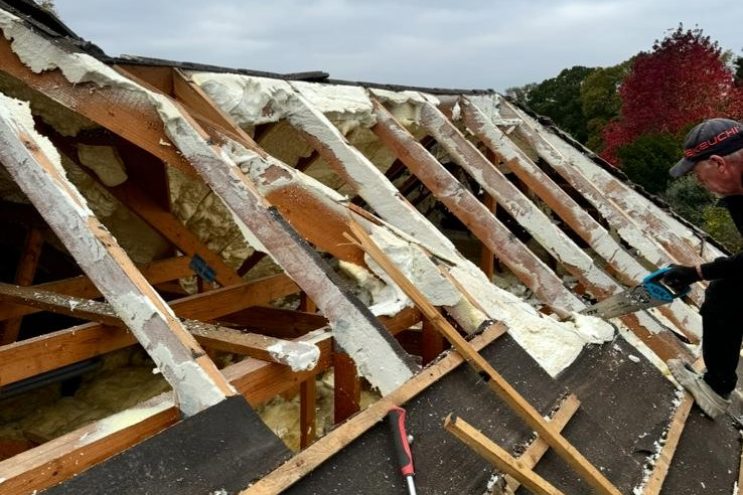
The Thames Estuary and Why It Makes Spray Foam More Urgent in South Essex Than Almost Anywhere Inland
Essex has the longest Thames Estuary coastline of any English county. From Grays and Tilbury in the west, through Canvey Island, Leigh-on-Sea, and Southend-on-Sea, to the more exposed Dengie Peninsula and the north Essex coast approaching Mersea Island and Clacton — a significant proportion of Essex’s residential properties sit within a few miles of the estuary or the coast. And in those properties, spray foam insulation carries a level of urgency that is genuinely higher than in most inland locations.
The Thames Estuary environment creates specific moisture conditions that interact with spray foam in ways that accelerate the structural consequences. The estuary’s combination of salt-laden tidal air, above-average ambient humidity, and temperature cycling — warm damp air from the water meeting cooler roof structures — means that moisture trapped by spray foam against roof timbers in a south Essex property can cause meaningful deterioration significantly faster than in a sheltered inland county. Lenders are aware of this. Coastal exposure is frequently noted as an additional risk factor in nil valuation notices for Essex estuary properties.
This does not mean that every south Essex coastal property with spray foam has significant timber decay — our survey will tell you accurately what the current condition is. But it does mean that leaving the issue unaddressed in a Thames Estuary property carries more risk, and the problem compounds more quickly, than the same scenario would in an inland county.
A Recent Essex Case: Chelmsford Homeowner, Remortgage Blocked by Santander — SVR Cost Mounting Weekly
Earlier this year, a homeowner in Chelmsford’s Springfield area contacted us after their remortgage application was declined by Santander. The 1970s semi-detached — purchased five years earlier when the previous owner moved out — had closed-cell spray foam applied to the full rafter span in 2012 during a Chelmsford City Council energy improvement initiative that targeted a number of streets in the area. Santander’s valuer identified the foam at inspection and issued a nil valuation. The homeowner had been on a standard variable rate for six weeks by the time they called us and was paying significantly more than their target fixed rate every month.
We surveyed within four days. The report confirmed rigid closed-cell foam throughout the rafter span, with no evidence of structural timber decay — Chelmsford’s inland position meant the timbers had been well-protected compared to comparable properties on the estuary coast. The removal scope was clear, the timescale was predictable, and the survey gave Santander’s valuer the specific structural information they needed to understand the risk had been overstated by the foam’s presence alone.
Removal was completed over two days. The completion report was issued the same afternoon and submitted to Santander via the homeowner’s broker the following morning. Santander accepted the report and the remortgage was approved within three weeks of the survey.
The homeowner calculated that at the SVR they were paying, every additional week of delay had cost them over £80 relative to their target rate. Over the full eight weeks from initial decline to remortgage approval, that represented a meaningful avoidable cost — and one that could have been avoided entirely had the foam been identified and removed before the application was submitted. The lesson for Chelmsford and Essex commuter belt homeowners is consistent: check the loft before you apply, not after you are declined.
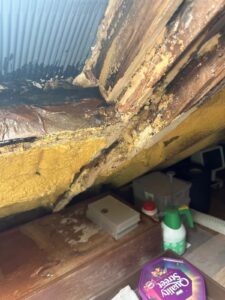
Discovering severe timber rot and structural decay on the roof rafters. Essential repairs and replacements are required to restore the integrity of this loft in Essex.
Basildon and Harlow: New-Town Heritage and a High Concentration of Spray Foam Cases
Essex is home to two of England’s post-war new towns — Basildon and Harlow — each built under the New Towns Act to accommodate London overspill population and create self-sufficient communities with their own employment and services. Both towns were built quickly, managed centrally, and improved systematically over the subsequent decades. During the energy efficiency push of the 2000s, the housing associations and local authorities managing much of this stock applied spray foam insulation to properties on a street-by-street and estate-by-estate basis.
The consequence is that spray foam prevalence in Basildon and Harlow is disproportionately high compared to other Essex towns of similar size. Properties across Vange, Pitsea, Laindon, Wickford, and the surrounding Basildon districts — and across Mark Hall, Staple Tye, Netteswell, and the Harlow estates — have a higher-than-average rate of spray foam discovery at survey. Homeowners purchasing former housing association or council properties in these towns should treat a loft inspection as routine rather than optional before any mortgage application is submitted.
Canvey Island deserves specific mention. Situated in the Thames Estuary with all the tidal humidity and salt air exposure that brings, Canvey Island’s housing stock is predominantly post-war and subject to the same insulation scheme history as the mainland new towns — but with the additional coastal moisture risk that makes the consequences of spray foam there more acute. Canvey Island equity release applications involving spray foam are among the most consistently urgent cases we deal with in Essex.
TESTIMONIAL
Client Feedback & Reviews
See what our customers say about us.
Spot on service. They turned up at our place in Billericay exactly when they said they would and just got on with the job. No messing about, very polite crew, and the loft looks 100% better now the foam is gone. Would definitely recommend them to anyone in the area looking for a reliable outfit.

A massive weight off my shoulders. We were having a nightmare with our mortgage survey in Saffron Walden because of the spray foam, but these guys sorted it in no time. They even provided all the necessary paperwork our lender was asking for. Efficient, tidy, and very easy to deal with. Can’t thank them enough.

Essex's Housing Stock: Where Spray Foam Creates the Most Problems
Essex’s diversity — geographically and economically — means spray foam affects different parts of the county in different ways:
- The A12 and A127 commuter corridor (Chelmsford, Brentwood, Billericay, Wickford, Rayleigh): The primary London commuter towns of mid-Essex have a high proportion of 1950s–1980s family housing and active mortgage and remortgage markets. Chelmsford's role as Essex's county city means it generates the highest volume of spray foam remortgage enquiries of any single Essex location. The pace of the commuter market means mid-transaction spray foam discoveries are particularly disruptive and costly.
- Thames Estuary coastal towns (Southend-on-Sea, Leigh-on-Sea, Canvey Island, Grays, Tilbury): The estuary coast carries elevated moisture risk. Properties within two to three miles of the Thames shore face salt-laden tidal air and above-average humidity. Open-cell foam in these properties absorbs moisture faster than inland equivalents, and equity release refusals are more common here than in any other part of Essex.
- Basildon and Harlow new-town estates: As described above — high spray foam prevalence from systematic insulation programmes, with Canvey Island's coastal exposure adding additional urgency for properties there. Former housing association and council properties in Basildon, Harlow, and the surrounding Epping Forest district estates are the highest-risk property type in the county.
- North Essex market towns (Colchester, Braintree, Witham, Saffron Walden, Dunmow): Older market town housing stock with Victorian and Edwardian cores and post-war suburban expansion. Colchester's Roman heritage makes it one of England's oldest continuously inhabited cities, and its Victorian inner suburbs have significant terraced housing where spray foam is found regularly. Saffron Walden's affluent rural market town character means spray foam nil valuations here carry significant financial consequences.
- The M11 corridor and west Essex (Harlow, Epping, Loughton, Chigwell): High-value London commuter territory where properties transact competitively and spray foam discovered mid-conveyancing creates acute pressure. Loughton and Chigwell in particular have high property values where the financial consequences of a blocked transaction are significant.
What Essex Lenders Require After a Spray Foam Nil Valuation
Whether the lender is Halifax, Nationwide, Barclays, Santander, or NatWest, and whether the property is in Chelmsford or Canvey Island, the requirements following a spray foam nil valuation are consistent with RICS guidance. The lender needs professional removal confirmed by a specialist contractor, an independent completion report documenting the scope of works and post-removal findings, and — where structural issues are found — evidence that remedial works have been completed.
For Thames Estuary coastal properties where moisture findings are more commonly elevated, the completion report’s moisture reading documentation is particularly important — lenders for these properties apply additional scrutiny to the post-removal condition evidence. Our survey and completion reports are structured with this in mind, providing the level of detail that estuary-facing Essex properties require.
Our Essex Services: Survey, Removal, and the Completion Report
- Independent Spray Foam Survey
Every project begins with a thorough independent inspection of the loft space by one of our vetted specialist contractors. We identify the foam type — open-cell or closed-cell — assess the full extent of coverage, and examine the condition of the underlying roof timbers. For Thames Estuary and coastal Essex properties, we take specific moisture readings and document any salt-air-related deterioration. For Basildon and Harlow new-town properties, we assess the adhesion characteristics of the closed-cell foam commonly found in these locations. The survey report is written to address the specific questions your lender will ask — not a generic building survey.
- Professional Spray Foam Removal
Our removal teams use specialist equipment to detach spray foam from roof timbers with minimum structural disruption. The approach is confirmed at survey stage — reflecting the foam type, adhesion, and the specific construction of the property. For Thames Estuary properties where moisture complications require additional care, this assessment is conducted individually. On completion, all debris is cleared, the structure is inspected, and the formal completion report is issued the same day.
- Remedial Works and Roof Replacement
Where removal reveals underlying damage — decayed rafters, deteriorated felt, or structural issues — we provide honest, itemised guidance on the remedial works needed. For Thames Estuary coastal properties where moisture has had extended time to affect timbers behind sealed foam, remedial works are more commonly needed than in inland Essex properties. All qualifying works are supported by a 10-Year Insurance-Backed Guarantee.
📍 Areas We Cover Across Essex
We provide spray foam surveys and removal across the whole of Essex. Our teams regularly work across:
- Chelmsford
- Colchester
- Brentwood
- Basildon
- Braintree
- Witham
- Maldon
- Southend-on-Sea
- Leigh-on-Sea
- Rayleigh
- Wickford
- Harlow
- Epping
- Loughton
- Chigwell
- Saffron Walden
- Dunmow
- Clacton-on-Sea
- Frinton-on-Sea
- Walton-on-the-Naze
- Canvey Island
If your town or village is not listed, please contact us — our service covers the full county of Essex.
Why Essex Homeowners Choose Spray Foam Removal UK
Essex’s internal diversity — from the Thames Estuary’s elevated coastal moisture environment to Basildon’s new-town housing stock to the M11 corridor’s high-value commuter market to north Essex’s rural market towns — means that a uniform approach does not serve the county well. Our survey-first process ensures every Essex property is individually assessed, with the removal approach confirmed before work begins and the completion report written specifically around what your lender needs to see.
- Specialist focus — spray foam surveys and removal is our entire operation
- Vetted contractors — all field teams are Checkatrade-approved
- CORC members — contractors hold membership of the Confederation of Roofing Contractors
- Lender-aware documentation — survey and completion reports structured to meet mainstream lender requirements, including the enhanced moisture documentation needed for Thames Estuary properties
- Essex experience — our teams understand estuary coastal moisture risk, Basildon and Harlow new-town housing, and the pace of the commuter corridor's property market
- 10-Year Insurance-Backed Guarantee — available on qualifying removal and roof replacement projects
- Free online estimate — understand indicative costs before committing to a survey
- Transaction-aware scheduling — works planned around your mortgage or conveyancing deadline from the first call
Get a Free Online Estimate for Your Essex Property
Whether you are dealing with a blocked remortgage in Chelmsford, an equity release refused on Canvey Island, a Basildon sale halted mid-conveyancing, or a Southend property where a survey has just flagged foam for the first time — the starting point is always the same: an independent survey and a clear, honest picture of what you are dealing with.
Use our free online estimate tool for an early indication of costs and timescales, or contact us directly to arrange a survey. We cover the whole of Essex and understand both the pace of the commuter corridor’s mortgage market and the specific moisture risks of the Thames Estuary coast.
FAQ's
Questions Essex Homeowners Ask Us Most
In practical terms, yes. The Thames Estuary environment — particularly within two to three miles of the river — creates moisture conditions that accelerate the deterioration spray foam causes to roof timbers. Salt-laden tidal air, persistent estuary humidity, and temperature cycling create conditions where open-cell foam absorbs moisture faster and where moisture trapped by closed-cell foam against timbers acts more aggressively than in sheltered inland Essex. This does not mean every estuary property has significant damage — our survey will give you an accurate picture — but it does mean that acting promptly is more important in a south Essex coastal property than it would be in, for example, a Chelmsford or Braintree suburban semi.
Yes — significantly so in the older parts of both towns. Basildon and Harlow were built under the New Towns Act and their housing stock was managed by development corporations and subsequently housing associations. Systematic energy improvement programmes in the 2000s applied spray foam to many properties on an estate-by-estate basis, often without occupants having a full understanding of what was installed or the long-term implications. If you own a property in the Basildon or Harlow new-town estates built before 1985, a loft inspection before any mortgage application or property transaction is strongly advisable.
Contact us immediately. The longer you remain on a standard variable rate, the more the delay costs you — particularly in the commuter belt where outstanding mortgage balances tend to be higher than the national average. For a standard Essex commuter belt semi-detached with typical closed-cell foam coverage, our expectation is: survey within four to five working days, removal within one to two weeks of survey confirmation, completion report issued on the day removal finishes. The Chelmsford case above went from our first survey to remortgage approval in three weeks. We do not give optimistic timelines — we give accurate ones.
Canvey Island's flood risk designation affects how some lenders assess properties there — some apply additional scrutiny or use specialist flood risk assessors alongside standard valuations. Spray foam compounds this by adding a further structural concern on top of the flood risk flagging. Our survey and removal process for Canvey Island properties takes into account the estuary moisture environment and produces documentation that directly addresses the combination of concerns a lender is likely to have. We have experience working on Canvey Island properties and understand the specific risk profile lenders apply to them.
Costs vary across Essex depending on property type, location, and foam type. A standard Basildon or Harlow new-town semi-detached with typical closed-cell foam coverage usually falls in the lower-to-mid range of our estimate tool. A Chelmsford or Brentwood commuter belt detached, a Thames Estuary coastal property where moisture assessment is more detailed, or a Colchester Victorian terrace with older construction will be costed differently. Our free online estimate gives you a realistic early indication before you commit to a survey. Full itemised pricing is confirmed following the survey with no hidden charges.
Start with a Free Online Estimate for Your Essex Property
If spray foam insulation is affecting your Essex property — whether you are in Chelmsford, Basildon, Southend-on-Sea, Colchester, Harlow, or anywhere across the county — the quickest way to understand your options and likely costs is through our free online estimate tool. You can also call or email us directly to arrange an independent spray foam survey across Essex.