
Spray Foam Removal in Cornwall
Spray Foam Removal in Cornwall — Independent Surveys & Professional Removal
ATLANTIC PENINSULA — CORNWALL'S SPRAY FOAM SPECIALISTS
Spray Foam Surveys & Removal Across Cornwall
We provide independent spray foam surveys, professional removal, and full remedial solutions across Cornwall — from Truro and Falmouth to Penzance, Newquay, St Austell, Bodmin, Launceston, and the peninsula’s coastal villages. If spray foam is blocking your mortgage, remortgage, or equity release, our specialist teams can help.
Why Cornwall Has the Most Urgent Spray Foam Problem of Any English County
Cornwall is not simply a coastal county. It is a peninsula surrounded by the Atlantic Ocean on three sides — the north coast facing the Celtic Sea and Atlantic swell, the south coast facing Mount’s Bay and the English Channel, and Land’s End and the Lizard pointing directly into the prevailing south-westerly weather systems that arrive off the Atlantic with nothing to slow them between the Cornish coast and the coast of North America. The marine weather environment here is categorically more extreme than anywhere else in mainland England.
This matters for spray foam in the most direct way possible. Salt-laden Atlantic air, wind-driven rain arriving at exposed angles that other counties simply do not experience, above-average annual rainfall, high ambient humidity throughout the year, and the specific way Atlantic weather drives moisture into building structures under pressure — all of these act on spray foam in a Cornish property in ways that accelerate the damage beyond what the same installation would produce in any other English county. Open-cell foam absorbs Atlantic moisture rapidly. Closed-cell foam traps it against structural timbers that cannot dry out. Both scenarios, given sufficient time, produce timber deterioration at rates that can genuinely shock homeowners when the foam is finally removed.
Lenders know this. The RICS guidance on spray foam was written with coastal exposure firmly in mind, and Cornwall properties receive the most intensive scrutiny at valuation of any county we work in. A nil valuation notice for a Cornish coastal property will almost always reference the combination of foam presence and coastal exposure as a compound risk — because that combination is genuinely more serious here than anywhere else in our coverage area.
A Recent Cornwall Case: Falmouth Homeowner, Sale Collapsed and Revived — Atlantic-Exposed Terrace, Significant Timber Findings
Last year, a homeowner in Falmouth contacted us after their property sale had already collapsed once. A first buyer had walked away when their lender — Halifax — issued a nil valuation on the Victorian terrace, citing closed-cell spray foam applied to the full rafter span. The homeowner had relaunched the sale to a cash buyer to avoid the lender issue, but the cash buyer’s surveyor had then recommended a specialist structural report, which had effectively stalled the cash sale too. The homeowner came to us having lost months and both buyers.
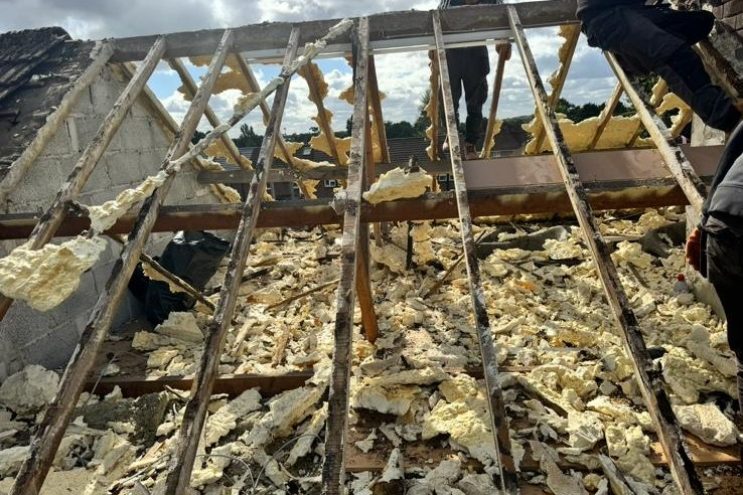
We surveyed the Falmouth property within four days. The findings were more significant than the homeowner had anticipated: the closed-cell foam, applied in 2009, had been trapping moisture against the north-facing rafters for fifteen years in Falmouth’s direct Atlantic exposure. The survey found meaningful surface decay on three rafter sections — not structural failure, but genuine deterioration that needed to be documented honestly and addressed. This was the information the cash buyer’s surveyor had suspected but could not confirm without the foam being removed.
Removal was completed over three days. The affected rafter sections were repaired during the same visit. A detailed completion report was produced documenting the pre-removal findings, the removal scope, the rafter repair works, and the post-repair structural condition — specifically addressing both Halifax’s original nil valuation concerns and the cash buyer’s surveyor’s structural questions.
The original mortgage buyer returned with a new application. Halifax accepted the comprehensive completion report. The Falmouth sale completed seven weeks after our initial survey. The homeowner told us that having a single document that addressed both the lender’s concerns and the structural surveyor’s questions simultaneously had been the key to moving forward.
This case is not unusual for Cornwall’s north-facing or directly exposed coastal properties. Fifteen-year-old foam in an Atlantic-exposed Falmouth terrace is not the same risk profile as fifteen-year-old foam in a Bedfordshire semi. The survey findings reflect that reality — and honest findings, however unwelcome initially, allow the resolution to be planned properly.
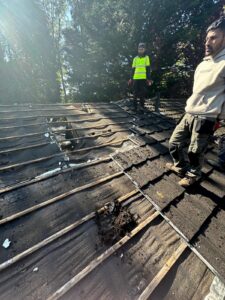
Stripping the roof down to the battens to check the structure. Essential preparation for a secure and long-lasting installation in Cornwall.
Cornish Granite and Why Traditional Construction Makes Spray Foam Removal More Complex Here
Much of Cornwall’s traditional building stock is constructed from local granite — a dense, impermeable stone that has been quarried across the county for centuries. Cornish granite cottages, terraces, and farmhouses have roof structures built with the specific moisture management characteristics of a granite building in mind: the dense walls manage temperature differentials differently to brick, and the roof void plays a critical role in maintaining the overall moisture balance of the structure.
Spray foam applied within a Cornish granite building disrupts this moisture management at the roof level, sealing a void that the building’s construction depends on being ventilated. The combination of granite construction and Atlantic moisture creates conditions where spray foam consequences develop faster than in virtually any other property type we survey across England. Lenders applying heritage or traditional construction scrutiny to Cornish granite properties are applying it for sound structural reasons.
Older Cornish properties also frequently have irregular roof structures — non-standard rafter spacings, original slate boarding, and in some cases the distinctive Cornish hipped or catslide roof configurations that differ from standard pitched roofs. These require specialist assessment before any removal approach is agreed. Our survey process for Cornish granite and traditional slate-construction properties addresses these characteristics specifically.
Second Homes, Holiday Lets, and Why Absentee Ownership Creates a Hidden Spray Foam Problem Across Cornwall
Cornwall has one of the highest concentrations of second homes and holiday let properties in England. In some coastal parishes, second homes and short-term lets account for a significant proportion of the total housing stock — St Ives, Padstow, Rock, Fowey, and parts of the Lizard and Land’s End peninsula have been among the most widely cited examples. This creates a specific spray foam problem that is largely unique to Cornwall and a small number of similarly affected coastal areas.
Absentee second home owners — many of whom purchased their Cornish property a decade or more ago and visit only during summer months — may have had spray foam applied by a local contractor during the energy improvement schemes of the 2000s, often recommended by a local letting agent or property manager. Many of these owners have had no reason to inspect the loft since. When they come to sell — either as a primary investment decision or following a change in personal circumstances — the foam surfaces at valuation, often as a genuine surprise.
For holiday let properties specifically, there is an additional consideration: the combination of Atlantic moisture, high occupancy rates (which increase internal moisture from cooking, washing, and occupant activity), and absentee management means that foam in a Cornish holiday let may have been exposed to more cumulative moisture loading than equivalent foam in a lightly occupied retirement property. Our survey process for holiday let and second home properties takes the occupancy history into account where this information is available.
Cornwall's Housing Stock: Where Spray Foam Creates the Most Serious Problems
Cornwall’s housing stock varies considerably across the peninsula, but the underlying thread is consistent: Atlantic moisture exposure, traditional construction, and a property market driven by a complex mix of permanent residents, retirees, second home buyers, and holiday let investors.
- Falmouth, Penryn, and the Fal Estuary: Victorian and Edwardian terraced housing climbing the hillsides above the estuary. Direct Atlantic exposure on the Falmouth waterfront properties, with the estuary's own tidal humidity adding a further moisture layer. High transaction volumes from the university, marine industry, and second home market. Spray foam discoveries during sales are consistently high in this area.
- Truro and the inland towns (Bodmin, Liskeard, Launceston): More sheltered than the coast but still within Cornwall's elevated moisture environment. Victorian and post-war housing where spray foam from 2000s improvement schemes is found regularly. Truro's cathedral city character creates conservation area and heritage planning considerations for external remedial works.
- The north coast (Newquay, Padstow, Bude, Wadebridge, Perranporth): The north coast faces the Atlantic and Celtic Sea directly, with no shelter from south-westerly and north-westerly weather systems. Properties here receive the most severe Atlantic moisture exposure in the county. Spray foam in a north coast property carries the highest structural urgency of any location in our national coverage area.
- The south coast and Lizard peninsula (Penzance, Helston, St Ives, Hayle, Porthleven): The south-west tip of England, directly in the path of Atlantic weather systems arriving from the south-west. St Ives has among the highest second home concentrations of any English town. Spray foam here, in both residential and holiday let properties, creates the same acute risk as the north coast in a slightly more sheltered but still profoundly exposed Atlantic environment.
- The Camborne-Redruth mining corridor and St Austell: Former tin and copper mining communities with a distinctive housing stock of miners' cottages and Victorian terraces built of granite and local stone. The Cornish Mining World Heritage Site designation covers much of this landscape, and properties within the designation may face additional planning considerations for external remedial works. Housing association improvement scheme foam is found at higher rates here than in most of Cornwall's rural areas.
What Cornwall Lenders and Equity Release Providers Require — and Why Honesty About Findings Matters Here
The RICS guidance applies uniformly across Cornwall as it does everywhere — professional removal, an independent completion report, and evidence of any remedial works. But Cornwall is the county where we most commonly encounter completion reports that need to go beyond the standard format. The Falmouth case above illustrates why: where Atlantic exposure has created actual timber deterioration behind the foam, a completion report that simply confirms removal without addressing the structural findings will not satisfy a lender who has seen the original nil valuation referencing coastal exposure as a compound risk.
Our survey and completion reports for Cornwall properties address the coastal exposure context directly. Where structural findings are more significant than anticipated, we document them honestly and completely — and we provide a clear account of the remedial works carried out and the post-repair condition. A comprehensive, honest report that addresses difficult findings is more valuable than a reassuring one that leaves questions unanswered.
Our Cornwall Services: Survey, Removal, and Specialist Coastal Documentation
- Independent Spray Foam Survey
Every Cornwall project begins with a thorough independent inspection. We identify the foam type, assess extent, and examine the timber condition specifically in the context of the property’s coastal exposure profile. For Cornish granite properties, we document the traditional construction specifically. For north coast properties with full Atlantic exposure, we assess moisture readings with the environmental context documented. For second home and holiday let properties, we note the occupancy history where available. The survey report is written to address the specific questions your lender will ask — including the coastal exposure concerns that distinguish Cornwall’s nil valuations from those in inland counties.
- Professional Spray Foam Removal
Our removal teams use specialist equipment appropriate to the foam type and the Cornish construction they are working within. For granite properties with irregular roof structures, the approach is confirmed individually at survey stage. For standard Cornwall period and post-war properties, removal of typical foam coverage is usually achievable within one to two working days on site. Given Cornwall’s remoteness, scheduling logistics are confirmed at survey stage to ensure continuity of works.
- Remedial Works and Roof Replacement
In Cornwall, remedial works following removal are more commonly needed than in any other county we cover. Atlantic moisture is the reason. When remedial works are needed — rafter repairs, felt replacement, or full roof replacement — we provide honest, itemised guidance and our contractors carry out the works with the same attention to the specific construction and planning context as the removal. For properties within the Cornish Mining World Heritage Site or in conservation areas, external works are planned with the relevant planning requirements in mind. All qualifying works are supported by a 10-Year Insurance-Backed Guarantee.
📍 Areas We Cover Across Cornwall
We provide spray foam surveys and removal across the whole of Cornwall. Our teams regularly work across:
- Truro
- Falmouth
- Penzance
- St Austell
- Newquay
- Bodmin
- Redruth
- Camborne
- Hayle
- Helston
- Liskeard
- Launceston
- Padstow
- Wadebridge
- Bude
- Saltash
- St Ives
If your town, village, or coastal location is not listed, please contact us — our service covers the whole of Cornwall including remote coastal and rural properties.
Why Cornwall Homeowners Choose Spray Foam Removal UK
Cornwall demands more from a spray foam specialist than any other county in our coverage area. The Atlantic moisture environment, the traditional granite construction, the second home and holiday let market complexity, the remote access logistics, and the likelihood of structural findings behind older foam all require a genuine specialist approach — not a standard removal team applying a standard method. Our survey-first process, specialist coastal documentation, and honest reporting are built around Cornwall’s specific demands.
- Specialist focus — spray foam surveys and removal is our entire operation
- Vetted contractors — all field teams are Checkatrade-approved
- CORC members — contractors hold membership of the Confederation of Roofing Contractors
- Coastal survey expertise — our survey process for Cornwall properties specifically documents Atlantic exposure profile and its relevance to timber condition assessment
- Cornish granite and traditional slate construction experience — specialist assessment of non-standard roof structures including hipped, catslide, and original slate-boarding configurations
- Honest structural reporting — where Atlantic exposure has caused structural findings behind foam, we document them completely and address them as part of the project
- Second home and holiday let experience — we understand the absentee ownership and occupancy history context that characterises much of Cornwall's coastal property market
- 10-Year Insurance-Backed Guarantee — available on qualifying removal and roof replacement projects
- Free online estimate — understand indicative costs before committing to a survey
Get a Free Online Estimate for Your Cornwall Property
Whether you are a permanent Cornwall resident whose sale or remortgage has been blocked, a second home owner who has just discovered foam in a property you have owned for years, or a holiday let owner whose equity release application has been refused — the starting point is always the same: an independent survey and an honest picture of what you are dealing with.
Use our free online estimate tool for an early indication of costs and timescales, or contact us directly to arrange a survey. We cover the whole of Cornwall — from the Tamar to Land’s End — and our teams understand the Atlantic exposure, the traditional construction, and the specific lender requirements that make Cornwall the most demanding spray foam environment in England.
TESTIMONIAL
Client Feedback & Reviews
See what our customers say about us.
Was a bit worried about the damp getting into the timbers with that foam up there, especially being so close to the coast in Penzance. The team who came out were brilliant—they just got on with the job despite the weather and left the loft rafters looking brand new. No faffing about and they cleared every bit of mess before they left. Proper job.

Massive relief to have this sorted. We were stuck in a right rut with a survey for our place in St Austell and needed the spray foam gone fast to keep the buyers happy. These guys didn't let us down. They were punctual, efficient, and provided the paperwork we needed for the bank straight away. Absolute life-savers in a stressful week.

FAQ's
Questions Cornwall Homeowners Ask Us Most
It depends on how long the foam has been in place and the property's coastal exposure. Atlantic-exposed properties with foam installed more than ten years ago should be treated as a priority — the longer it has been there, the more time moisture has had to act on the timbers behind it. Our survey will give you an accurate picture of the current timber condition, whatever the installation age. For a second home that has been let regularly, the moisture loading from occupancy may be higher than in a lightly used property. The survey is the essential first step — it establishes what you are dealing with before you make any decisions about selling, remortgaging, or continuing to hold the property.
Yes — the Falmouth case above shows exactly this scenario. A sale that has collapsed because of spray foam can be rescued if the foam is professionally removed, the structural condition honestly assessed and documented, and a completion report produced that specifically addresses the concerns that caused the original nil valuation. If the original buyer's lender is willing to reconsider on receipt of the report, the original transaction can be revived. If not, a new buyer with a different lender can proceed on the basis of the completion report. Contact us immediately — the sooner the process starts, the sooner the resolution is in your hands.
It affects the assessment stage more than the removal itself. Cornish granite properties often have non-standard roof structures — irregular rafter spacings, original slate boarding, catslide roof configurations — where the foam's adhesion characteristics need to be assessed specifically before any removal method is confirmed. The removal process then reflects those characteristics. For very old granite construction with original roof boarding, we take particular care to avoid unnecessary disruption to intact historic fabric. Our survey will confirm the approach and cost before any works begin.
No — not always. Sheltered inland Cornwall properties with south-facing roof aspects and foam installed relatively recently may have structural timbers that remain in good condition. What we can say honestly is that Cornwall has the highest probability of significant structural findings behind foam of any English county we survey, particularly for north-facing, directly coastal, or older installations. Our survey gives you an accurate picture rather than a reassuring one — and honest findings, even when they reveal complications, allow you to plan the resolution properly and present lenders with a complete and credible picture of the property's condition.
Costs in Cornwall reflect the specific demands of the county. The remoteness of many Cornish properties means travel logistics are a factor for some locations. Properties with non-standard granite construction requiring specialist assessment may be costed differently to standard period or post-war properties. Where the survey reveals structural findings that require remedial works alongside removal, the combined cost will be higher — but for a Cornish property where the alternative is an unmortgageable asset, the investment is almost always straightforward to justify. Our free online estimate gives you a realistic early indication before you commit to a survey. Full itemised pricing is confirmed following the survey with no hidden charges.
Start with a Free Online Estimate for Your Cornwall Property
If spray foam insulation is affecting your Cornwall property — whether you are in Truro, Falmouth, Penzance, Newquay, St Ives, or anywhere else across the peninsula — the quickest way to understand your options and likely costs is through our free online estimate tool. You can also call or email us directly to arrange an independent spray foam survey anywhere across Cornwall.