
Spray Foam Removal in East Riding of Yorkshire
Spray Foam Removal in East Riding of Yorkshire — Independent Surveys & Professional Removal
BEVERLEY, THE YORKSHIRE WOLDS & HUMBER ESTUARY SPECIALISTS
Spray Foam Surveys & Removal Across East Riding of Yorkshire
We provide independent spray foam surveys, professional removal, and full remedial solutions across the East Riding of Yorkshire — from Beverley and Driffield to Bridlington, Hornsea, Withernsea, Goole, Hessle, and the Yorkshire Wolds villages. If spray foam is blocking your mortgage, remortgage, or equity release, our specialist teams can help.

The Yorkshire Wolds: England's Northernmost Chalk Uplands and a Building Tradition That Creates Specific Spray Foam Challenges
The Yorkshire Wolds — the broad chalk upland running from the Humber north-westwards towards the North York Moors — are England’s most northerly chalk landscape. Unlike the southern chalk counties of Wiltshire, Dorset, and Hampshire, where chalk is ubiquitous in building material and construction tradition, the Wolds sit further north than any other chalk formation of comparable scale in England, and the building tradition they have produced is specific to this part of Yorkshire. The wolds-edge market towns of Beverley, Driffield, Market Weighton, and Pocklington, and the agricultural villages of the wolds plateau, were built using the local chalk, brick, and pantile combinations that define the East Riding’s vernacular architecture.
Pantile roofing — the distinctive curved clay tiles of Dutch origin that arrived in East Yorkshire through the North Sea trade — is found across the Wolds and Holderness coast more than anywhere else in England. Pantiled roofs have specific ventilation characteristics and specific removal considerations when spray foam is present: the adhesion patterns beneath pantile boarding differ from standard plain tile or slate construction, and removal requires assessment of the boarding condition as well as the foam itself. Our survey process for pantile-roofed East Riding properties documents this specifically.
The Yorkshire Wolds AONB designation covers much of this landscape, and the many listed farmhouses, estate cottages, and historic village properties within it attract the same heightened lender heritage scrutiny that listed buildings receive throughout the country — alongside the additional AONB planning constraints that may apply to any external remedial works following removal.
A Recent East Riding Case: Beverley Homeowner, Sale Halted by Halifax — Georgian Townhouse, Foam From Landlord Period
Earlier this year, a homeowner in Beverley contacted us after their property sale was halted mid-conveyancing. The buyer’s lender — Halifax — had instructed a survey on the Georgian townhouse in the North Bar area and identified open-cell spray foam across the full loft floor and lower rafter sections. The foam had been applied in 2010 during a period when the property was let, through an East Riding of Yorkshire Council energy scheme targeting privately rented stock in the town. The homeowner had purchased from the landlord six years later with no mention of the foam in the property information forms. Halifax issued a nil valuation. The buyer had a three-week deadline.
We surveyed within five days. The report confirmed open-cell foam throughout with moderate moisture absorption. Beverley’s sheltered inland position — the town sits in a shallow depression west of the Wolds, protected from North Sea exposure — had preserved the timber structure in sound condition despite fourteen years of foam. The survey addressed both the standard lender concerns and specifically noted that the Georgian North Bar conservation area designation did not create external works requirements arising from the internal removal.
Removal was completed over two days. The completion report was issued the same afternoon. Halifax accepted the report and the Beverley sale completed inside the buyer’s deadline.
Beverley’s North Bar, Saturday Market, and Newbegin conservation areas contain a high concentration of Georgian and Victorian townhouses where landlord-installed foam from the 2000s privately rented sector is the dominant discovery pattern. The town’s active property market — Beverley is consistently ranked among Yorkshire’s most desirable places to live — means mid-sale nil valuations require an urgent response.
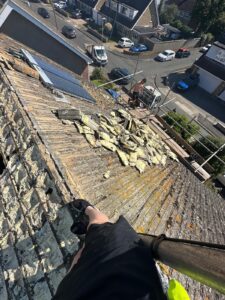
Mid-stripping phase: clearing old debris and preparing the roof deck around existing solar panels. Every layer removed gets us closer to a solid, weatherproof finish in East Riding of Yorkshire.
Holderness and the North Sea Coast: England's Most Rapidly Eroding Coastline and Why It Matters for Spray Foam
The Holderness coast — from Bridlington south through Hornsea, Mappleton, Withernsea, and down to Spurn Point — is England’s most rapidly eroding coastline. The soft boulder clay cliffs of Holderness retreat by an average of one to two metres per year, and the cumulative effect over centuries has consumed dozens of medieval settlements that once stood on what is now the North Sea floor. This geological reality creates a specific lender risk context for Holderness coastal properties that has nothing to do with spray foam — flood risk, coastal erosion risk, and long-term insurability concerns all feature in how lenders assess these properties.
When spray foam is present on top of these existing coastal risk concerns — as it regularly is in the Victorian and inter-war housing of Bridlington, Hornsea, and Withernsea — a lender’s nil valuation notice may reference both the foam and the coastal exposure as compound risk factors. Our survey process for Holderness coastal properties specifically documents the North Sea exposure context and its relevance to timber condition assessment, providing the lender with evidence that addresses both dimensions of their concern.
TESTIMONIAL
Client Feedback & Reviews
See what our customers say about us.
A very straightforward and honest experience. We had the spray foam cleared from our bungalow in Pocklington and I couldn't be more satisfied with the outcome. The workers were polite, respected our home, and stuck exactly to the price they quoted without any hidden surprises. They even took the time to tidy up the landing before they left. Excellent service.

Had to get the spray foam stripped out of our house in Bridlington after it was flagged during a structural survey. I was expecting a massive headache, but this crew made short work of it. They arrived on time, worked with great care to minimize dust, and sorted all the paperwork for the mortgage lender within 24 hours. A very reliable outfit for anyone in the East Riding of Yorkshire.

East Riding of Yorkshire's Housing Stock: Where Spray Foam Is Most Commonly Found
- Beverley — Georgian and Victorian townhouses (North Bar, Saturday Market, Newbegin): Beverley is East Yorkshire's most sought-after town — a prosperous minster town with one of England's finest Gothic churches, outstanding Georgian and Victorian townhouse stock, and a property market that consistently attracts buyers relocating from Hull and further afield. Conservation area and listed building coverage is extensive. Landlord-era foam from privately rented stock is the dominant discovery pattern. Nil valuations here are financially significant and time-sensitive.
- Yorkshire Wolds market towns (Driffield, Market Weighton, Pocklington): Wolds-edge market towns with Georgian, Victorian, and inter-war housing stock built using local chalk, brick, and pantile combinations. Rural energy improvement scheme foam is found in the surrounding villages. Pantile-roofed properties require specialist survey assessment as described above.
- Bridlington and the north Holderness coast: Bridlington's Victorian and Edwardian seaside resort character produced dense terraced housing facing the North Sea. Holiday and second home ownership is significant. The combination of North Sea coastal exposure and spray foam creates compound risk concerns for lenders. The town's resident population also has a significant retired demographic where equity release is a common transaction trigger.
- Hornsea, Withernsea, and the Holderness coast: As described above — England's most rapidly eroding coastline creates specific lender risk context. Holiday properties, retirement homes, and long-term owner-occupied terraces where energy improvement scheme foam has been in place for over a decade combine with the coastal erosion backdrop to make these among the most complex lender conversations we have in the East Riding.
- Hessle, Cottingham, and the Humber corridor: The western towns of the East Riding on the north bank of the Humber serve as Hull's commuter suburbs. Cottingham is one of England's most populous villages with a large stock of 1930s–1980s family houses. Hessle's position at the north approach to the Humber Bridge gives it distinctive character. The Humber estuary creates its own tidal moisture environment — distinct from the open North Sea — that is relevant to spray foam assessment in low-lying and waterside properties.
- Goole and the western East Riding: Goole is a canal port town at the confluence of the Aire and Calder Navigation with the Humber. Its Victorian and Edwardian housing stock reflects its commercial port heritage, and local authority energy improvement scheme foam is found at higher rates here than in the county's more affluent market towns. The town's flat low-lying position above the Humber flood plain is relevant for lender flood risk assessments that accompany any valuation in the area.
What East Riding Lenders Require After a Spray Foam Flag
The RICS guidance applies uniformly across the East Riding — Halifax, Nationwide, Barclays, Santander, and NatWest all require professional removal confirmed in writing, an independent completion report, and evidence of any remedial works. For Holderness coastal properties where the nil valuation may reference both foam and coastal exposure as compound concerns, our surveys and completion reports address both dimensions. For Beverley and Wolds AONB listed buildings where heritage planning questions may arise, these are addressed explicitly. For standard East Riding market town and suburban properties, the process is efficient and well-understood.
Our East Riding Services: Survey, Removal, and the Completion Report
- Stage One: Independent Spray Foam Survey
Every project begins with a thorough independent inspection by one of our vetted specialist contractors. We identify foam type, assess extent, and examine timber condition. For pantile-roofed Wolds properties, boarding condition is assessed. For Holderness coastal properties, North Sea exposure is documented. For Beverley and Wolds AONB listed buildings, heritage planning implications for any external works are flagged. The survey report is written for your specific lender’s requirements.
- Stage Two: Professional Spray Foam Removal
Our removal teams use specialist equipment appropriate to the foam type and East Riding construction. For pantile-roofed properties, the approach accounts for the boarding condition identified at survey stage. For standard East Riding market town and suburban properties, removal of typical foam coverage is achievable within one to two working days. On completion, all debris is cleared and the completion report is issued the same day.
- Stage Three: Remedial Works & Roof Replacement Where Needed
Where removal reveals underlying damage — more likely in Holderness coastal properties and older Wolds farmhouses — we provide honest, itemised guidance. For Yorkshire Wolds AONB and Beverley conservation area properties, external works are planned with the relevant planning constraints in mind. All qualifying works are supported by a 10-Year Insurance-Backed Guarantee.
📍 Areas We Cover Across the East Riding of Yorkshire
We provide spray foam surveys and removal across the whole of the East Riding of Yorkshire. Our teams regularly work across:
- Beverley
- Bridlington
- Goole
- Hessle
- Hornsea
- Driffield
- Cottingham
- Pocklington
- Withernsea
- Market Weighton
- Hedon
- Brough
If your town or village is not listed, please contact us — our service covers the full East Riding of Yorkshire.
Why East Riding Homeowners Choose Spray Foam Removal UK
The East Riding’s internal diversity — from Beverley’s Georgian conservation area to the Holderness coast’s compound coastal risk context to the Yorkshire Wolds’ pantile and chalk construction to Goole’s port town housing — requires a survey-first approach where every property is assessed individually. Our completion reports address the specific concerns that lenders raise for each of these contexts.
- Specialist focus — spray foam surveys and removal is our entire operation
- Vetted contractors — all field teams are Checkatrade-approved
- CORC members — contractors hold membership of the Confederation of Roofing Contractors
- Lender-aware documentation — every survey and completion report is structured around the specific requirements of mainstream lenders and equity release providers
- Pantile roofing expertise — the Yorkshire Wolds' distinctive pantile construction is specifically assessed at survey stage, including boarding condition relevant to removal approach
- Holderness compound coastal risk experience — our surveys for Holderness properties document the North Sea exposure and its relevance to timber condition alongside the standard foam assessment
- Beverley and Yorkshire Wolds AONB heritage planning awareness — external works planning implications identified at survey stage
- 10-Year Insurance-Backed Guarantee — available on qualifying removal and roof replacement projects
- Free online estimate — understand indicative costs before committing to a survey
Get a Free Online Estimate for Your East Riding of Yorkshire Property
Whether you have a Beverley Georgian townhouse with a mid-sale nil valuation, a Bridlington coastal holiday property where spray foam has been discovered, a Holderness home where a lender has flagged both foam and coastal risk, a Wolds farmhouse with a pantile roof and landlord-era foam, or a Goole equity release refused — the starting point is always the same: an independent survey and a clear, honest picture of what you are dealing with.
Use our free online estimate tool for an early indication of costs and timescales, or contact us directly to arrange a survey. We cover the whole of the East Riding of Yorkshire and understand the county’s distinctive combination of Wolds chalk landscape, Holderness coastal character, Humber estuary moisture, and Beverley’s heritage townhouse market.
FAQ's
Questions East Riding Homeowners Ask Us Most
It affects the assessment stage. Pantile roofs in the East Riding are typically laid on timber boarding rather than on open rafters, and spray foam applied to the underside of this boarding bonds differently to foam applied directly to rafters. At survey stage, we assess the condition of the boarding as well as the foam itself — in older pantile properties where the boarding is original, we take particular care to understand the boarding's integrity before agreeing the removal approach. The removal process is then confirmed specifically for your property's construction rather than being applied as a standard method.
They are separate concerns requiring separate responses. The spray foam concern is fully resolvable through professional removal and a completion report — that is our scope. The coastal erosion and flood risk concerns are lender risk assessments about the property's location that exist independently of the foam and are addressed through insurers, flood risk reports, and the property's individual risk profile — these are outside our scope but are managed in parallel by your solicitor and the lender's risk team. Our completion report removes the spray foam concern from the equation entirely, allowing the lender to assess the coastal risk dimension on its own merits.
Yes — Beverley's Georgian and Victorian townhouses were widely bought as rental investments during the 2000s, driven by demand from Hull's professional commuter market and the town's own employment base. Energy improvement schemes operating through East Riding of Yorkshire Council at that time applied foam to a number of privately rented properties in the town's conservation area streets. If you purchased your Beverley property from a landlord owner and have not inspected the loft, a check before any significant transaction is advisable.
Yes — strongly recommended, and for Bridlington specifically it is more important than in many East Riding locations. Bridlington's buyer pool includes a mix of mortgage buyers and cash buyers from both the holiday property market and the permanent residential market. Going to market with spray foam present restricts you to cash buyers only. Given the North Sea coastal exposure that makes Holderness foam more urgent than inland foam, resolving it before marketing also means you can present a clean survey status at the outset rather than having to negotiate around a compound coastal and foam concern mid-transaction.
Costs vary across the East Riding. A standard Goole or Hessle Victorian terrace or post-war semi with typical foam coverage will generally fall towards the lower-to-mid range of our estimate tool. A Beverley Georgian townhouse, a pantile-roofed Wolds farmhouse requiring specialist boarding assessment, or a Holderness coastal property requiring enhanced moisture documentation may be costed differently. Our free online estimate gives you a realistic early indication before you commit. Full itemised pricing is confirmed following the survey with no hidden charges.
Start with a Free Online Estimate for Your East Riding of Yorkshire Property
If spray foam insulation is affecting your East Riding of Yorkshire property — whether you are in Beverley, Bridlington, Goole, Driffield, Hornsea, or anywhere across the county — the quickest way to understand your options and likely costs is through our free online estimate tool. You can also call or email us directly to arrange an independent spray foam survey anywhere across the East Riding.