
Spray Foam Removal in Devon
Spray Foam Removal in Devon — Independent Surveys & Professional Removal
DARTMOOR, THE ENGLISH RIVIERA & DEVON'S COB COUNTRY SPECIALISTS
Spray Foam Surveys & Removal Across Devon
We provide independent spray foam surveys, professional removal, and full remedial solutions across Devon — from Exeter and Plymouth to Torquay, Barnstaple, Tiverton, Tavistock, Okehampton, and the rural cob-built villages of the Devonshire countryside. If spray foam is blocking your mortgage, remortgage, or equity release, our specialist teams can help.
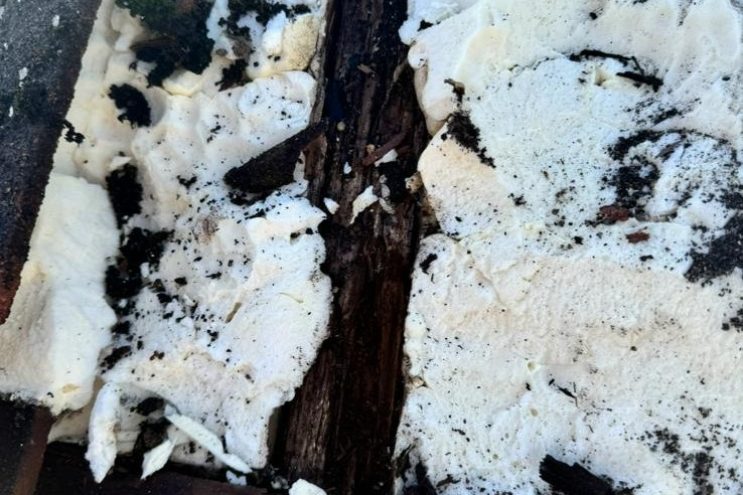
Devon's Cob Construction: The Most Moisture-Sensitive Traditional Building Type in England — and Why Spray Foam Is Particularly Serious Here
Cob — the traditional construction method of unfired earth mixed with straw, sand, and water — is Devon’s most distinctive building heritage. The cob-built longhouses, cottages, and farmhouses of the Devonshire countryside represent a building tradition that has existed in this county for at least a thousand years and that survives in occupied properties in greater concentration than anywhere else in England. The white-rendered cob walls that define the Devon village aesthetic are not merely picturesque — they are a structural system calibrated over centuries to manage moisture through the building fabric in a specific and carefully balanced way.
A cob building breathes. Moisture moves through the earth walls — absorbed in damp conditions, released as conditions dry — in a continuous cycle that keeps the building fabric in equilibrium and the structural integrity of the cob intact. This breathability is not optional; it is the mechanism by which cob buildings survive. Spray foam in the roof void of a cob building disrupts this breathability at the top of the building — sealing the roof junction and trapping moisture at the point where the wall plate meets the rafter feet, precisely where cob is most vulnerable to moisture damage. The consequences can include accelerated deterioration of the wall plate, damage to the historic fabric at the wall-roof junction, and structural concerns that go beyond a standard roof timber assessment.
Lenders assessing cob properties in Devon apply the same RICS guidance as elsewhere, but with awareness that spray foam in a cob building represents a more complex structural risk than in a standard brick property. Our survey process for Devon’s cob-built properties specifically assesses the wall-roof junction, the moisture characteristics of the cob at the point of contact with the roof structure, and the foam’s interaction with the historic earth fabric — giving lenders the specific technical information that a cob property requires.
A Recent Devon Case: Exeter Homeowner, Sale Blocked by Nationwide — Victorian Terrace, Foam from Student Rental Era
Last year, a homeowner in the St Thomas area of Exeter contacted us after their property sale was blocked by Nationwide. The property — a Victorian mid-terrace close to the University of Exeter’s St Thomas campus — had open-cell spray foam applied to the full loft floor and lower rafter sections in 2010 during a period when the property was let to students, through a scheme coordinated by the letting agent at the time. The homeowner had purchased from the landlord investor six years later, with no mention of the foam. Nationwide issued a nil valuation. The buyer had a three-week deadline.
We surveyed within four days. The report confirmed open-cell foam throughout with moderate moisture absorption. The timber structure was in sound condition. We surveyed and removed within the buyer’s deadline, with the completion report submitted to Nationwide the afternoon removal finished.
Nationwide accepted the report and the Exeter sale completed within the deadline.
Exeter’s student suburbs — St Thomas, Heavitree, Newtown, Pinhoe Road — have a landlord-installed foam pattern very similar to Oxford, Bristol, and Leeds. The University of Exeter’s significant student population has driven a strong rental market in the Victorian terraces surrounding the campus, and foam applied during tenancies in the 2000s is now surfacing at sale and remortgage as properties change hands to owner-occupiers.
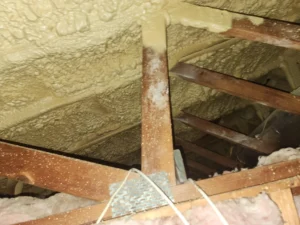
Spray foam insulation sealing the roof rafters while fiberglass fills the floor joists. Dual-layer insulation system maximizing thermal efficiency for this Devon property.
Dartmoor National Park and the English Riviera: Two Completely Different Devon Contexts
- Dartmoor National Park
Dartmoor is one of England’s most distinctive landscapes — a high granite moorland whose tors, bogs, and river valleys shelter some of the most isolated farm properties in southern England. The granite farmhouses and moorland cottages of Dartmoor are built of the local stone in a tradition as old as the Bronze Age settlements whose hut circles still mark the hillsides. Spray foam in a Dartmoor granite farmhouse creates the same disruption to a traditional breathable building system as in any stone-built rural property — but the Dartmoor National Park planning authority applies the strictest rural landscape protection criteria of any planning body in Devon, and any external remedial works following removal are assessed within that framework.
Remote access in Dartmoor is genuine. Some farms and moorland properties are at the end of single-track lanes with no passing places for miles. Our survey process for Dartmoor properties confirms the access logistics before any works are agreed, and remote location costs are reflected transparently at survey stage.
- The English Riviera — Torquay, Paignton, and Brixham
The English Riviera — the Torbay coast centred on Torquay, Paignton, and Brixham — is Devon’s largest tourism economy, a resort destination with a Victorian and Edwardian visitor architecture that has been substantially converted to residential use as the seaside holiday economy has shifted. Second home and holiday let ownership is significant along the Torbay coast and the surrounding South Hams area, creating the same absentee owner discovery patterns we see in Cornwall and the Suffolk coast. The Torbay coast faces the English Channel south-east, creating a marine coastal moisture environment that is less severe than Cornwall’s Atlantic exposure but still meaningfully more demanding than inland Devon.
Devon's Housing Stock: Where Spray Foam Creates the Most Problems
- Exeter — cathedral city and university town (St Thomas, Heavitree, Newtown, Pinhoe Road, Topsham): Exeter's Victorian and Edwardian inner suburbs have a student and professional rental market driven by the University of Exeter comparable to Oxford, Bristol, and Leeds. Landlord-installed foam from the 2000s is the dominant discovery pattern. Exeter's cathedral city conservation area creates heritage planning considerations for any external works in the historic core. The Exe Estuary's proximity adds a tidal moisture dimension for waterside and low-lying properties.
- Plymouth and the south-west (Plymouth, Tavistock, Ivybridge): Plymouth is England's largest coastal city and the Royal Navy's principal base at Devonport is one of the world's largest naval installations. The MOD-adjacent and private housing built for Devonport dockyard workers has specific housing turnover patterns similar to Barrow-in-Furness and the Wiltshire RAF communities. Plymouth's Victorian inner suburbs — Stoke, Keyham, St Budeaux — have improvement scheme foam from the city's extensive post-war council housing management.
- Cob-built rural Devon (mid-Devon villages, Crediton, South Molton, the Taw and Torridge valleys): As described above — cob construction creates the most specific spray foam challenge of any Devon building type. Rural energy improvement schemes in the 2000s targeted cob-built farmhouses and cottages as part of programmes addressing rural fuel poverty. Survey and completion reports for cob properties specifically assess the wall-roof junction and the foam's interaction with the cob fabric.
- English Riviera and South Devon coast (Torquay, Paignton, Brixham, Dartmouth, Salcombe, Kingsbridge): Second home and holiday let properties with English Channel coastal moisture exposure. Victorian and Edwardian resort architecture converted to residential use. Absentee owner discovery patterns similar to Cornwall's. High property values in Salcombe and the South Hams area make nil valuations here financially significant.
- North Devon coast and Exmoor fringe (Barnstaple, Bideford, Ilfracombe, South Molton): The North Devon coast faces the Bristol Channel and Atlantic south-westerlies — a more exposed coastal position than the English Riviera. Ilfracombe's Victorian resort architecture, Barnstaple's market town character, and the Exmoor National Park fringe (shared with Somerset) create a varied housing stock with above-average moisture considerations for any properties with spray foam.
- East Devon coast and the Jurassic Coast (Exmouth, Sidmouth, Seaton, Honiton): The East Devon AONB, the Jurassic Coast World Heritage Site coastal setting, and the affluent retirement and second home market of Sidmouth and Exmouth create a heritage and coastal planning environment similar to the Suffolk Coast AONB — high property values, significant conservation area coverage, and an active equity release market among long-term owner-occupiers.
What Devon Lenders Require After a Spray Foam Nil Valuation
The RICS guidance applies uniformly across Devon. For Exeter student suburb properties, the standard efficient process applies. For Devon cob properties, our completion reports specifically address the wall-roof junction assessment and the foam’s interaction with the cob fabric — standard completion reports that do not address cob-specific concerns will not fully satisfy lenders whose nil valuations reference traditional earth construction. For Dartmoor National Park properties, the planning authority context is flagged. For coastal properties, the moisture environment is documented. The report is always written for what your specific lender needs to see.
Our Devon Services: Survey, Removal, and the Completion Report
- Stage One: Independent Spray Foam Survey
Every project begins with a thorough independent inspection by one of our vetted specialist contractors. For cob-built Devon properties, the wall-roof junction and the foam’s interaction with the earth fabric are specifically assessed. For Dartmoor National Park properties, construction type and remote access logistics are confirmed, and planning implications for any external works are flagged. For English Riviera and East Devon coastal properties, the coastal moisture context is documented. For Exeter’s student suburb properties, the installation history is assessed from the foam characteristics.
- Stage Two: Professional Spray Foam Removal
Our removal teams use specialist equipment appropriate to the foam type and Devon construction. For cob properties, the removal approach accounts for the wall-roof junction characteristics confirmed at survey stage. For standard Devon Victorian and post-war properties, removal of typical foam coverage is achievable within one to two working days. For remote Dartmoor properties, access logistics are confirmed before scheduling.
- Stage Three: Remedial Works & Roof Replacement Where Needed
Where removal reveals underlying damage — more likely in coastal properties and in cob buildings where wall-plate deterioration may have occurred — we provide honest guidance on remedial works. For Dartmoor National Park and East Devon AONB properties, external works are planned with the relevant planning constraints confirmed. All qualifying works are supported by a 10-Year Insurance-Backed Guarantee.
📍Areas We Cover Across Devon
We provide spray foam surveys and removal across the whole of Devon, including National Park and rural locations. Our teams regularly work across:
- Exeter
- Plymouth
- Torquay
- Paignton
- Newton Abbot
- Barnstaple
- Bideford
- Tiverton
- Honiton
- Exmouth
- Sidmouth
- Teignmouth
- Dawlish
- Okehampton
- Tavistock
- Ilfracombe
- South Molton
If your town, village, or rural location is not listed, please contact us — our service covers the full county of Devon including National Park and remote rural properties.
Why Devon Homeowners Choose Spray Foam Removal UK
Devon’s range — cob-built rural cottages, Dartmoor granite farmhouses, Exeter’s student suburb Victorian terraces, the English Riviera’s second home coast, Plymouth’s naval heritage housing, and the East Devon AONB’s retirement property market — demands a survey-first approach where every property is individually assessed. For cob properties specifically, our surveys and completion reports go further than standard format to address the wall-roof junction and the cob fabric interaction that lenders dealing with traditional earth construction need to see.
- Specialist focus — spray foam surveys and removal is our entire operation
- Vetted contractors — all field teams are Checkatrade-approved
- CORC members — contractors hold membership of the Confederation of Roofing Contractors
- Lender-aware documentation — every survey and completion report is structured around the specific requirements of mainstream lenders and equity release providers
- Cob construction expertise — Devon's traditional unfired earth buildings are assessed with specific understanding of the wall-roof junction characteristics and the moisture management system that spray foam disrupts
- Dartmoor National Park planning awareness — National Park Authority planning requirements for external works identified at survey stage; remote access logistics confirmed before scheduling
- English Riviera and East Devon coastal survey capability — English Channel and Bristol Channel coastal exposure documented alongside standard foam assessment
- Plymouth naval and Devonport dockyard housing knowledge — MOD-adjacent housing turnover patterns understood
- Exeter student rental era foam pattern recognised — landlord-installed foam from the University of Exeter rental market identified and documented effectively
- 10-Year Insurance-Backed Guarantee — available on qualifying removal and roof replacement projects
- Free online estimate — understand indicative costs before committing to a survey
Get a Free Online Estimate for Your Devon Property
Whether you have an Exeter Victorian terrace with a mid-sale nil valuation, a cob cottage in mid-Devon where a remortgage has been declined, a Dartmoor farmhouse where equity release has been refused, an English Riviera holiday property where foam has been discovered, or a Plymouth Victorian terrace where a sale has stalled — the starting point is always the same: an independent survey and a clear, honest picture of what you are dealing with.
Use our free online estimate tool for an early indication of costs and timescales, or contact us directly to arrange a survey. We cover the whole of Devon — from the cob-built villages of the Devonshire countryside to the Dartmoor National Park to the English Riviera coast.
TESTIMONIAL
Client Feedback & Reviews
See what our customers say about us.
We had a real scare with our bungalow in Exmouth when the mortgage company refused to lend due to the spray foam in the roof. Living so close to the coast, we were worried about moisture levels too. This team was brilliant—they came out to Exeter, assessed the situation, and cleared the loft professionally. They provided a full certificate of removal which the bank accepted immediately. Saved our house sale!

Fantastic job removing the foam from our Victorian villa in Torquay. I was concerned about the heritage of the building, but the lads were incredibly respectful and took great care with the original timbers. They even managed the extraction at our second place in Paignton with the same level of detail. Tidy, efficient, and they really know their stuff when it comes to Devon properties.

FAQ's
Questions Devon Homeowners Ask Us Most
Cob's structural integrity depends on the earth walls being able to breathe — to absorb and release moisture continuously through the building fabric. This breathability is managed by the whole building as a system, and the roof void plays a critical role in the moisture balance at the top of the cob walls. Spray foam in the roof void seals this system at the point where the rafters sit on the wall plates — precisely where the cob wall fabric is most vulnerable to moisture accumulation. Wall-plate deterioration, damage to the historic cob at the wall-roof junction, and the beginnings of structural cob erosion can all result from spray foam that would be a purely mechanical concern in a brick property. Our survey specifically assesses this junction in cob properties.
Three things: construction, access, and planning. Dartmoor granite construction requires specialist survey assessment of the foam's interaction with the traditional stone building fabric. Remote access — single-track lanes, farm tracks, seasonal access restrictions — is confirmed at survey stage and built into the project plan. And if any external works are needed following removal, the Dartmoor National Park Authority applies strict landscape and heritage protection criteria that mean planning engagement may be required for works that would be straightforward elsewhere. Our survey addresses all three at the outset.
Yes — strongly recommended. The English Riviera's buyer pool includes mortgage buyers as well as cash buyers, and going to market with spray foam restricts you to cash buyers only. For a Torbay property where foam has been present for more than ten years in an English Channel-facing coastal location, pre-market resolution also removes a compound foam-and-coastal-moisture concern from any nil valuation before it can be raised. Our free online estimate gives you an early cost indication with no commitment required.
More than in comparable-sized cities without the naval dimension. The combination of MOD-adjacent worker housing — with typical defence industry turnover rates — and Plymouth City Council's extensive post-war housing improvement programmes means foam is found in Plymouth's Victorian inner suburbs at higher rates than in the city's more recently built areas. The Stoke, Keyham, and St Budeaux areas have above-average improvement scheme foam prevalence. If your Plymouth property was formerly council or housing association owned and built before 1985, a loft inspection before any transaction is advisable.
Costs vary considerably across Devon. A standard Exeter or Plymouth Victorian terrace with typical foam coverage will generally fall towards the lower-to-mid range. A cob-built rural cottage requiring specialist wall-roof junction assessment, a Dartmoor farmhouse with granite construction and remote access planning, or a coastal English Riviera property requiring elevated moisture documentation may be costed differently. Our free online estimate gives you a realistic early indication before you commit to a survey. Full itemised pricing is confirmed following the survey with no hidden charges.
Start with a Free Online Estimate for Your Devon Property
If spray foam insulation is affecting your Devon property — whether you are in Exeter, Plymouth, Torquay, Barnstaple, the Dartmoor National Park, or anywhere across the county — the quickest way to understand your options and likely costs is through our free online estimate tool. You can also call or email us directly to arrange an independent spray foam survey anywhere across Devon.