
Spray Foam Removal in Lancashire
Spray Foam Removal in Lancashire — Independent Surveys & Professional Removal
COTTON MILL TOWNS, THE FYLDE COAST & THE RIBBLE VALLEY SPECIALISTS
Spray Foam Surveys & Removal Across Lancashire
We provide independent spray foam surveys, professional removal, and full remedial solutions across Lancashire — from Preston and Blackburn to Burnley, Blackpool, Lancaster, Chorley, Accrington, Clitheroe, Lytham St Annes, and the rural Ribble Valley. If spray foam is blocking your mortgage, remortgage, or equity release, our specialist teams can help.
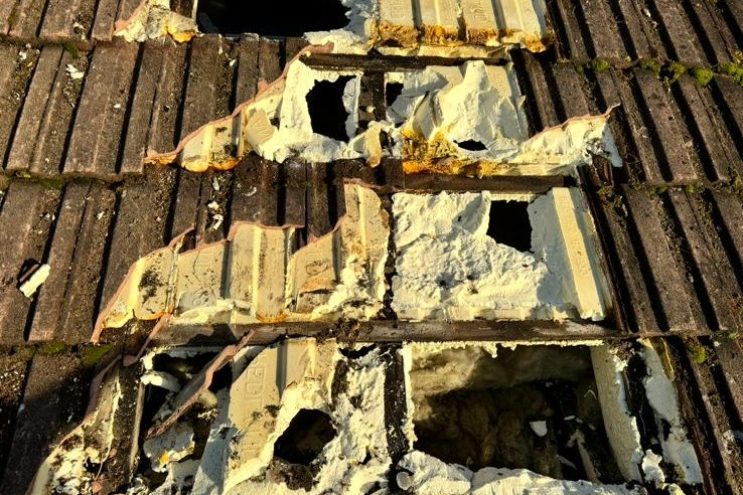
Lancashire's Cotton Weaver Terraces: The Housing the Industrial Revolution Built Here — and Why Spray Foam Is So Concentrated in the Mill Towns
Lancashire was the cotton capital of the world. Blackburn, Burnley, Accrington, Nelson, Colne, Darwen, and the dozens of mill towns threading along the Pennine valleys between the moorland and the plain were the engine rooms of Britain’s cotton textile industry from the late eighteenth century through to the mid-twentieth — spinning, weaving, finishing, and exporting cotton cloth to markets on every continent. The housing that the cotton industry built for its workers is as distinct and specific as any in England: dense terraced streets of weaver’s cottages and mill workers’ houses, set hard against the valley sides and the mill buildings they served, built of the local millstone grit and Accrington brick in a uniformity of scale and character that still defines the streetscape of the East Lancashire mill towns today.
This cotton worker housing stock was managed by Lancashire County Council and the various borough councils through the post-war decades, and was targeted by energy improvement schemes during the 2000s in precisely the same way as the West Yorkshire wool town terraces, the Tyneside shipbuilding worker streets, and the Black Country ironworking communities. Street by street through Blackburn’s Bastwell and Wensley Fold, Burnley’s Stoneyholme and Daneshouse, Accrington’s central terraces, and Nelson’s densely-packed Victorian streets, foam was applied systematically during Warm Front and Decent Homes improvement programmes — and subsequently many of these properties have changed hands through right-to-buy, with foam unknown to the current owners.
The difference between Lancashire’s cotton terraces and West Yorkshire’s wool terraces is meaningful for spray foam: the Lancashire mill towns are predominantly through-terrace rather than back-to-back, built of Accrington brick and millstone grit rather than West Riding stone, and set in narrower valleys with higher ambient rainfall from the Pennine uplands than the Yorkshire equivalent. The moisture environment in the East Lancashire valley towns is more demanding than in comparable inland English counties, making the foam’s consequences more acute over the same installation period.
A Recent Lancashire Case: Burnley Homeowner, Equity Release Refused by Halifax — Right-to-Buy Terrace, Warm Front Foam, Long-Term Owner
Last year, a homeowner in Burnley’s Stoneyholme area contacted us after their equity release application was refused by Halifax. The property — a 1930s council terrace purchased through right-to-buy in the early 1990s — had closed-cell spray foam applied to the full rafter span during a Burnley Borough Council Warm Front coordination programme in 2007, fifteen years before the homeowner had any reason to look in the loft. Halifax’s valuer issued a nil valuation citing the foam and the inaccessibility of the roof structure.
We surveyed within five days. The report confirmed rigid closed-cell foam throughout. Despite fifteen years of installation in Burnley’s higher-than-average East Lancashire rainfall environment, there was no evidence of structural timber decay — the property’s relatively sheltered valley position had moderated the moisture impact. The survey gave Halifax’s valuer the structural evidence they needed.
Removal was completed over two days. The completion report was submitted to Halifax. The equity release application was reinstated and approved within four weeks.
Burnley’s Stoneyholme, Daneshouse, Queensgate, and Bank Top areas — along with comparable neighbourhoods in Blackburn, Accrington, and Nelson — have among the highest right-to-buy equity release rates in Lancashire. Long-term owners who purchased their homes in the late 1980s and 1990s and who have been unaware of Warm Front foam installed in the late 2000s are the single most consistent source of Lancashire enquiries we receive.
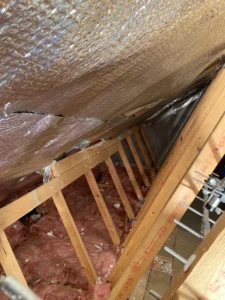
Installing high-performance fiberglass insulation between the joists with foil-backed membrane above. Essential thermal barrier for energy efficiency and warmth in Lancashire homes.
Beyond the Mill Towns: The Fylde Coast, the Ribble Valley, and the Forest of Bowland
- The Fylde Coast — Blackpool, Lytham St Annes, and Morecambe
Blackpool is Britain’s largest seaside resort — a Victorian and Edwardian visitor economy that at its peak welcomed over seventeen million visitors a year and that built a dense stock of guest houses, boarding houses, and converted residential properties along its promenades and in its residential streets. Much of this stock has transitioned from tourism to permanent residential use, and the combination of Irish Sea exposure, the physical conversion of former guest house properties to residential use, and the energy improvement schemes targeting deprived Blackpool residential areas has created a spray foam pattern in the town that is as concentrated as any coastal resort in England.
Lytham St Annes — the affluent southern end of the Fylde coast — presents a completely different picture: prosperous Victorian and Edwardian residential development where private foam installations from the 2000s are found in the larger properties, and nil valuations carry significant financial consequences. Morecambe, at the northern end of the Lancashire coast on the edge of Morecambe Bay, has a retirement and second home character, with the bay’s extensive tidal flats creating an atmospheric moisture environment for bay-facing properties.
- The Ribble Valley and the Forest of Bowland AONB
The Ribble Valley — the district stretching from Clitheroe north-west across Longridge Fell towards the Forest of Bowland — is consistently ranked as one of England’s most sought-after rural areas. The combination of attractive market towns (Clitheroe, Longridge, Whalley), excellent Preston and Manchester commuter access, and spectacular Lancashire moorland and river landscape has driven very high property values. Private spray foam installations in the Ribble Valley’s Georgian and Victorian farmhouses and converted barn properties carry the same high financial stakes as the Cheshire Golden Triangle. The Forest of Bowland AONB — one of England’s most remote designated landscapes — adds National Park-equivalent planning constraints to any external remedial works for properties within its boundary.
Lancashire's Housing Stock: Where Spray Foam Is Most Commonly Found
- East Lancashire cotton mill towns (Blackburn, Burnley, Accrington, Nelson, Colne, Darwen, Oswaldtwistle, Rawtenstall): The highest spray foam concentration in Lancashire. Victorian and Edwardian cotton weaver terraces where Warm Front and Decent Homes improvement scheme foam was applied systematically. Subsequent right-to-buy transfers mean many current owners have no knowledge of the foam. Equity release refusals from long-term right-to-buy owners are the dominant discovery trigger across the mill towns.
- Preston and central Lancashire (Preston, Chorley, Leyland, Bamber Bridge): Preston is Lancashire's county town and a significant administrative and commercial centre. Victorian and Edwardian inner suburbs with improvement scheme foam patterns. Chorley and Leyland have post-war family housing estates. Preston's large South Asian community — similar to Bradford's in its generational ownership patterns — creates a right-to-buy equity release profile comparable to the East Lancashire mill towns.
- The Fylde coast (Blackpool, Fleetwood, Thornton-Cleveleys): As described above — converted guest house and boarding house stock in Blackpool with Irish Sea exposure and improvement scheme foam concentration. Fleetwood's fishing community housing character creates its own distinct stock. The Irish Sea's prevailing south-westerlies create elevated coastal moisture conditions for Fylde coast properties with foam.
- Lytham St Annes and south Fylde: Affluent Victorian and Edwardian seaside residential character. Private foam installations from the 2000s in larger detached and semi-detached properties. High property values make nil valuations here financially significant. The golf course community character around Royal Lytham & St Annes has attracted significant premium residential development.
- Lancaster and north Lancashire (Lancaster, Morecambe, Heysham, Garstang): Lancaster is a Georgian city with a significant slave trade port heritage — the Custom House, the Slave Trade Arts Memorial, and the castle reflect a history as complex as any English county town. Lancaster's Georgian terraces and Victorian inner suburbs have private and improvement scheme foam patterns. Morecambe's Morecambe Bay coastal character and its Art Deco heritage (the Midland Hotel) create a distinct local identity.
- Ribble Valley and Forest of Bowland (Clitheroe, Longridge, Whalley, Sawley): As described above — one of England's most sought-after rural areas with high property values and private foam installations in period farmhouses and converted barns. Forest of Bowland AONB planning constraints for external works. Clitheroe's market town character and the surrounding village property market are driven by Preston and Manchester commuter demand.
- Skelmersdale and west Lancashire (Skelmersdale, Ormskirk, Southport fringe): Skelmersdale was designated a New Town in 1961 and built by the Skelmersdale Development Corporation to accommodate Liverpool and Manchester overspill. Development Corporation-era housing with improvement scheme foam prevalence comparable to the other English new towns. Ormskirk's market town character and Southport's Victorian resort character complete the west Lancashire mix.
What Lancashire Lenders Require After a Spray Foam Nil Valuation
The RICS guidance applies uniformly across Lancashire. For East Lancashire mill town right-to-buy properties — the largest share of our Lancashire workload — the standard survey and completion report process is efficient and well-understood. For Blackpool coastal properties where Irish Sea exposure is relevant, this is documented in the survey. For Ribble Valley and Forest of Bowland AONB properties, construction type and planning constraints for external works are flagged. For Skelmersdale Development Corporation housing, the improvement scheme history is noted. For Lytham St Annes private installations where historic records may be unavailable, foam characteristics are established from the installation itself.
Our Lancashire Services: Survey, Removal, and the Completion Report
- Independent Spray Foam Survey
Every project begins with a thorough independent inspection by one of our vetted specialist contractors. For East Lancashire mill town improvement scheme properties, the installation context and Accrington brick or millstone grit construction are documented. For Fylde coast properties, Irish Sea exposure is noted. For Ribble Valley and Bowland AONB properties, construction type and planning implications for external works are flagged. For Skelmersdale, the Development Corporation scheme context is noted. The survey report is written for your specific lender.
- Professional Spray Foam Removal
Our removal teams use specialist equipment appropriate to the foam type and Lancashire construction. For standard Lancashire cotton town Victorian terraces, removal of typical foam coverage is achievable within one to two working days. On completion, all debris is cleared and the completion report is issued the same day.
- Remedial Works and Roof Replacement
Where removal reveals underlying damage, we provide honest guidance. For Forest of Bowland AONB and Ribble Valley rural properties, external works are planned with the relevant planning constraints confirmed. All qualifying works are supported by a 10-Year Insurance-Backed Guarantee.
📍 Areas We Cover Across Lancashire
We provide spray foam surveys and removal across the whole of Lancashire. Our teams regularly work across:
- Preston
- Blackburn
- Burnley
- Blackpool
- Lancaster
- Morecambe
- Chorley
- Accrington
- Skelmersdale
- Clitheroe
- Lytham St Annes
- Fleetwood
If your town or village is not listed, please contact us — our service covers the full county of Lancashire.
Why Lancashire Homeowners Choose Spray Foam Removal UK
Lancashire’s range — from the East Lancashire cotton mill town right-to-buy equity release pattern to Blackpool’s converted guest house stock to the Ribble Valley’s affluent rural market to the Forest of Bowland’s remote AONB landscape — demands a survey-first approach that individually assesses each property and documents the specific context in the completion report.
- Specialist focus — spray foam surveys and removal is our entire operation
- Vetted contractors — all field teams are Checkatrade-approved
- CORC members — contractors hold membership of the Confederation of Roofing Contractors
- Lender-aware documentation — every survey and completion report is structured around the specific requirements of mainstream lenders and equity release providers
- East Lancashire cotton town and Warm Front improvement scheme knowledge — mill town housing stock improvement history documented in survey reports for right-to-buy and long-term owner properties
- Equity release experience — Burnley, Blackburn, Accrington, and Preston right-to-buy equity release refusals are among our most frequent Lancashire cases
- Blackpool coastal survey capability — Irish Sea exposure documented alongside standard foam assessment for Fylde coast properties
- Ribble Valley and Forest of Bowland AONB awareness — planning constraints for external works identified at survey stage; remote access logistics confirmed
- Skelmersdale New Town improvement scheme knowledge — Development Corporation housing history documented
- 10-Year Insurance-Backed Guarantee — available on qualifying removal and roof replacement projects
- Free online estimate — understand indicative costs before committing to a survey
Get a Free Online Estimate for Your Lancashire Property
Whether you have a Burnley or Blackburn right-to-buy terrace where equity release has been refused after foam discovered at nil valuation, a Blackpool coastal property where a sale has stalled, a Ribble Valley farmhouse where a remortgage has been declined, a Lytham St Annes property where a private foam installation has surfaced at sale, or a Skelmersdale New Town home where a transaction has been blocked — the starting point is always the same: an independent survey and a clear, honest picture of what you are dealing with.
Use our free online estimate tool for an early indication of costs and timescales, or contact us directly. We cover the whole of Lancashire — from the cotton mill valleys of East Lancashire to the Fylde coast to the Forest of Bowland.
TESTIMONIAL
Client Feedback & Reviews
See what our customers say about us.
Excellent service from the team. We had spray foam in our Victorian terrace in Preston that was causing some serious timber concerns during a survey. They came out, stripped the foam back to the rafters, and ensured everything was breathable again. Very professional and tidy, which is a relief in these older houses.

Had the team over to our place near Chorley to rectify a botched spray foam job. They were incredibly knowledgeable and explained exactly how the extraction would work without damaging the structure. They even travelled out to a friend's site in Clitheroe for a consultation the same week. Honestly, the best hard-working tradesmen I've dealt with in Lancs for a long time

FAQ's
Questions Lancashire Homeowners Ask Us Most
Yes — significantly more likely here than in most other parts of Lancashire. Burnley and Blackburn were among the priority target areas for Warm Front programmes in the North West, due to the combination of older cotton mill town housing stock and higher fuel poverty rates in the post-industrial communities. Foam was applied to right-to-buy properties in these towns before and around the time of sale in many cases, without disclosure to subsequent purchasers. If you purchased your Burnley or Blackburn property from a council or housing association and have not inspected the loft since, a check before any equity release application is strongly advisable.
It is more urgent than in comparable inland southern English locations, yes. The East Lancashire mill towns sit in Pennine valley positions that receive significantly above-average annual rainfall — not as extreme as Cumbria's Lakeland peaks, but substantially above the national average and above comparable inland Midlands locations. In a cotton mill town terrace built of Accrington brick with original ventilated roof construction, ten or fifteen years of foam in an above-average rainfall environment can produce moisture findings that would take longer to develop in a drier county. If you know foam has been in place for over a decade in a Blackburn or Burnley property, we recommend surveying before marketing rather than waiting for a nil valuation.
Spray foam removal itself is internal work and does not require AONB consent. Where the Forest of Bowland designation becomes relevant is if any external remedial works are needed following removal — replacing roofing materials, repairing ridges, or altering roof details on properties within the AONB boundary. The Forest of Bowland AONB planning framework applies strict landscape protection criteria similar to a National Park, and our survey identifies whether any external works appear likely and flags the relevant requirements before any works are agreed.
Yes — Blackpool has a higher spray foam prevalence than most comparable Lancashire towns of its size. The combination of energy improvement schemes targeting Blackpool's deprived residential areas and the specific pattern of former guest house properties being converted to permanent residential use — with all the roof space modifications that can accompany such conversions — has created above-average foam prevalence in the town's residential streets. The Irish Sea exposure adds urgency: coastal Blackpool properties with foam are assessed with the marine moisture environment documented in the survey.
Costs are generally at the lower-to-mid range of our national estimate tool for standard Lancashire Victorian and post-war terraces, reflecting typical northern property sizes and straightforward access conditions. A Ribble Valley farmhouse, a Forest of Bowland AONB rural property, or a Lytham St Annes larger detached with a private installation will be costed differently. Our free online estimate gives you a realistic Lancashire-specific indication. Full itemised pricing is confirmed following the survey with no hidden charges.
Start with a Free Online Estimate for Your Lancashire Property
If spray foam insulation is affecting your Lancashire property — whether you are in Preston, Blackburn, Burnley, Blackpool, Lancaster, Chorley, Accrington, the Ribble Valley, or anywhere across the county — the quickest way to understand your options and likely costs is through our free online estimate tool. You can also call or email us directly to arrange an independent spray foam survey anywhere across Lancashire.