
Spray Foam Removal in Tyne and Wear
Spray Foam Removal in Tyne and Wear — Independent Surveys & Professional Removal
NEWCASTLE, GATESHEAD, SUNDERLAND & THE NORTH SEA COAST SPECIALISTS
Spray Foam Surveys & Removal Across Tyne and Wear
We provide independent spray foam surveys, professional removal, and full remedial solutions across Tyne and Wear — from Newcastle and Gateshead to Sunderland, South Shields, Tynemouth, Whitley Bay, Jarrow, and Washington. If spray foam is blocking your mortgage, remortgage, or equity release, our specialist teams can help.
The River Tyne's Shipbuilding Legacy and Why It Created One of England's Highest Spray Foam Concentrations
The River Tyne was, for over a century, the most productive shipbuilding river in the world. Swan Hunter at Wallsend, Armstrong Whitworth at Elswick, Vickers at Walker, and the dozens of ancillary yards and engineering works that lined both banks of the Tyne built warships, ocean liners, merchant vessels, and tankers that sailed to every corner of the world. The terraced streets and Victorian housing estates built to accommodate the families of riveters, platers, caulkers, engineers, and draughtsmen that made this industry work represent one of the most concentrated and historically specific housing stocks of any English metropolitan area.
This shipbuilding worker housing — in Wallsend, Walker, Byker, Elswick, Scotswood, Benwell, Felling, Pelaw, and the terraced streets of Gateshead’s riverside — was managed by Newcastle City Council and Gateshead Metropolitan Borough Council through the post-war decades and into the right-to-buy era. The energy improvement schemes of the 2000s applied spray foam systematically to these streets, in many cases as part of Warm Front and Decent Homes programmes targeting the North East’s recognised fuel poverty challenge. The result is a spray foam prevalence in Tyne and Wear’s former shipbuilding community terraces that is among the highest per capita of any English metropolitan area.
These properties have since transferred in significant numbers to private ownership through right-to-buy. Many are now reaching the equity release stage — long-term owners who have lived in their terrace for thirty or forty years and whose equity release applications are being refused because of foam installed before they became the owner. This is the dominant Tyne and Wear spray foam pattern.
A Recent Tyne and Wear Case: Gateshead Homeowner, Equity Release Refused by Halifax — Right-to-Buy Terrace, Foam from Council Era
Last year, a homeowner in the Felling area of Gateshead contacted us after their equity release application was refused by Halifax. The property — a 1930s council terrace purchased through right-to-buy in 1992 — had closed-cell spray foam applied to the full rafter span during a Gateshead Council Warm Front improvement programme in 2006, fourteen years before the homeowner had any reason to look in the loft. Halifax’s valuer issued a nil valuation citing the foam and the inaccessibility of the roof structure.
We surveyed within five days. The report confirmed rigid closed-cell foam throughout with no evidence of structural timber decay — the property’s sheltered inland Tyne valley position had protected the timbers well over eighteen years of foam. The survey gave Halifax’s valuer the specific structural evidence they needed to reassess.
Removal was completed over two days. The completion report was submitted to Halifax. The equity release application was reinstated and approved within four weeks.
Felling, Pelaw, Heworth, and the wider Gateshead riverside terraced communities have some of the highest right-to-buy equity release rates in Tyne and Wear. Long-term owners who purchased their homes in the 1980s and 1990s are now reaching retirement age, and equity release refusals arising from Warm Front and Decent Homes foam installed during the council management period are a consistent feature of our Tyne and Wear workload.

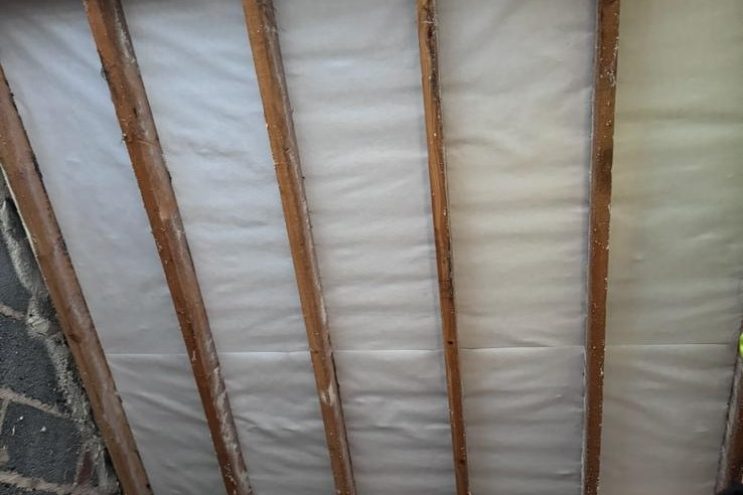
New timber structure is up and looking solid. We’ve replaced the old framework, and now we’re ready to get the underlay and tiles on. Good progress on this project in Tyne and Wear.
Newcastle's Grainger Town Heritage and the North Sea Coast: Two Further Distinct Contexts
- Newcastle's Grainger Town and Victorian Heritage
Away from the shipbuilding worker terraces, Newcastle city centre contains one of England’s finest examples of planned Victorian town design. Richard Grainger’s development of Grainsmore Street, Grey Street, and the surrounding network of streets in the 1830s created Grainger Town — a sweeping neoclassical townscape in the grey Pennine sandstone that gives Newcastle its characteristic civic colour. The Grainger Town conservation area, covering much of the city centre and its immediate surroundings, extends into the residential terraces of Jesmond, Heaton, Sandyford, and the affluent Gosforth suburb where Victorian and Edwardian housing is found in high concentrations.
Jesmond and Heaton in particular — Newcastle’s most sought-after Victorian residential areas — have a mix of long-established private ownership and a significant student and professional rental market driven by Newcastle University and Northumbria University. As in Oxford, Bristol, and Leamington, landlord-installed foam unknown to subsequent owner-occupier purchasers is a consistent pattern in these streets. Nil valuations in Jesmond carry significant financial consequences given the suburb’s property values.
- The North Sea Coast — Tynemouth, Whitley Bay, and South Shields
Tyne and Wear’s North Sea coastline — from the mouth of the Tyne at North Shields and South Shields, north to Whitley Bay and Cullercoats, and south to Roker and Seaburn — creates the same elevated coastal moisture context that applies to North Sea-facing properties throughout the series. Tynemouth’s Victorian and Edwardian resort architecture, Whitley Bay’s inter-war seaside character, and South Shields’ North Sea harbour position all carry above-average moisture considerations for spray foam assessment. Coastal properties in these areas are assessed with the North Sea exposure context documented, as the same North Sea dynamics apply here as at Bridlington and Scarborough further south.
Tyne and Wear's Housing Stock: Where Spray Foam Is Most Commonly Found
- Newcastle inner suburbs — shipbuilding worker terraces and right-to-buy estates (Wallsend, Walker, Byker, Elswick, Scotswood, Benwell, Fenham): The highest spray foam concentration in Tyne and Wear. Victorian and inter-war terraces from the shipbuilding worker community where Warm Front and Decent Homes improvement scheme foam was applied systematically. Subsequent right-to-buy transfers mean many current owners have no knowledge of the foam. Equity release refusals from long-term right-to-buy owners are the dominant discovery trigger.
- Newcastle's Victorian and Edwardian residential suburbs (Jesmond, Heaton, Sandyford, Gosforth): Higher-value Victorian and Edwardian housing with significant student and professional rental market activity. Landlord-installed foam from the 2000s is the dominant pattern. Nil valuations in Jesmond carry significant financial consequences. Newcastle University and Northumbria University drive a rental market comparable to Oxford and Bristol in its foam-during-tenancy discovery pattern.
- Gateshead (Felling, Pelaw, Heworth, Low Fell, Dunston, Birtley): Inter-war and post-war council housing on the south bank of the Tyne where right-to-buy activity has been high and improvement scheme foam prevalence is comparable to the north bank. Long-term right-to-buy owners reaching equity release are the most frequent enquiry type from Gateshead.
- Sunderland and Wearside (Sunderland city, Houghton-le-Spring, Washington): Sunderland is a separate city from Newcastle with its own identity and its own shipbuilding heritage on the River Wear. Sunderland's Victorian and inter-war housing stock has improvement scheme foam patterns similar to Newcastle's, and the right-to-buy equity release pattern is consistent across the city. Washington New Town — designated 1964 — has Development Corporation-era housing with foam prevalence similar to Telford and Redditch.
- South Tyneside (South Shields, Jarrow, Hebburn): South Shields is where the Tyne meets the North Sea, giving the town's east-facing properties North Sea coastal exposure alongside the standard Tyneside terrace improvement scheme foam pattern. Jarrow's specific Jarrow March history and industrial heritage created a distinct community housing stock. Both areas have high right-to-buy equity release rates from long-term owners.
- North Tyneside — the coast (Tynemouth, Whitley Bay, Cullercoats, North Shields): Victorian and Edwardian coastal resort housing with significant North Sea exposure. Tynemouth and Whitley Bay have both permanent residential populations and second home and holiday let activity. The north-east coast's North Sea exposure creates elevated foam urgency for coastal properties in these towns, similar to Bridlington and Filey further south.
What Tyne and Wear Lenders Require After a Spray Foam Nil Valuation
The RICS guidance applies uniformly across Tyne and Wear. For the majority of our workload — right-to-buy terraces and council-era housing across Newcastle, Gateshead, Sunderland, and South Tyneside — the standard survey and completion report process is efficient and well-understood. For Jesmond and Heaton landlord-era foam where the installation history may be poorly documented, the survey establishes the installation characteristics. For coastal North Tyneside and South Shields properties where North Sea exposure is a secondary factor, the coastal context is documented. For Washington New Town Development Corporation housing, the improvement scheme context is noted.
Our Tyne and Wear Services: Survey, Removal, and the Completion Report
- Independent Spray Foam Survey
Every project begins with a thorough independent inspection by one of our vetted specialist contractors. We identify foam type, assess extent, and examine timber condition. For improvement scheme properties, the installation context is documented. For coastal North Tyneside and South Shields properties, North Sea exposure is recorded. For Jesmond and Heaton landlord-era properties, the installation history is assessed. The survey report is written for your specific lender.
- Professional Spray Foam Removal
Our removal teams use specialist equipment to detach spray foam from roof timbers with minimum structural disruption. For standard Tyne and Wear Victorian and inter-war terraces — the large majority of our workload in the metropolitan area — removal of typical foam coverage is achievable within one to two working days on site. On completion, all debris is cleared and the completion report is issued the same day.
- Remedial Works and Roof Replacement
Where removal reveals underlying damage — more likely in coastal Tynemouth, Whitley Bay, and South Shields properties — we provide honest guidance on the remedial works needed. All qualifying works are supported by a 10-Year Insurance-Backed Guarantee.
📍 Areas We Cover Across Tyne and Wear
We provide spray foam surveys and removal across the whole of Tyne and Wear. Our teams regularly work across:
- Chelmsford
- Colchester
- Brentwood
- Basildon
- Braintree
- Witham
- Maldon
- Southend-on-Sea
- Leigh-on-Sea
- Rayleigh
- Wickford
- Harlow
- Epping
- Loughton
- Chigwell
- Saffron Walden
- Dunmow
- Clacton-on-Sea
- Frinton-on-Sea
- Walton-on-the-Naze
- Canvey Island
If your area is not listed, please contact us — our service covers the whole of the Tyne and Wear metropolitan area.
Why Tyne and Wear Homeowners Choose Spray Foam Removal UK
Tyne and Wear’s dominant pattern — improvement scheme foam in right-to-buy terraces, now surfacing at equity release for long-term owners — requires a survey process that documents the installation history clearly and a completion report that gives lenders the structural evidence to reinstate refused applications. For Newcastle’s Jesmond and Heaton rental-market foam and for North Sea coastal properties, the process adapts to the specific context. Our completion reports are always written for what your lender needs to see.
- Specialist focus — spray foam surveys and removal is our entire operation
- Vetted contractors — all field teams are Checkatrade-approved
- CORC members — contractors hold membership of the Confederation of Roofing Contractors
- Lender-aware documentation — every survey and completion report is structured around the specific requirements of mainstream lenders and equity release providers
- Tyne and Wear improvement scheme knowledge — Warm Front and Decent Homes foam application history documented in survey reports for right-to-buy properties
- Equity release experience — right-to-buy equity release refusals are among our most frequent Tyne and Wear cases; we understand what Halifax, NatWest, and equity release providers need to reinstate refused applications
- North Sea coastal survey capability — Tynemouth, Whitley Bay, and South Shields North Sea exposure documented alongside the standard foam assessment
- Sunderland and Wearside coverage — our teams serve both the Tyneside and Wearside communities across the full metropolitan area
- 10-Year Insurance-Backed Guarantee — available on qualifying removal and roof replacement projects
- Free online estimate — understand indicative costs before committing to a survey
Get a Free Online Estimate for Your Tyne and Wear Property
Whether you are a long-term right-to-buy homeowner in Gateshead or Sunderland whose equity release has been refused, a Jesmond or Heaton owner whose remortgage has been declined, a coastal Whitley Bay or Tynemouth homeowner whose sale has stalled, or a South Shields property owner dealing with a mid-conveyancing nil valuation — the starting point is always the same: an independent survey and a clear, honest picture of what you are dealing with.
Use our free online estimate tool for an early indication of costs and timescales, or contact us directly to arrange a survey. We cover the whole of Tyne and Wear and understand both the right-to-buy equity release pattern that defines most of our workload here and the specific coastal and heritage contexts that some properties present.
TESTIMONIAL
Client Feedback & Reviews
See what our customers say about us.
Absolutely spot on service. We were trying to sell our semi in Gateshead and the buyer's surveyor basically halted everything because of the spray foam in the loft. These lads came out to Newcastle the next day, gave us a fair quote, and got the job done professionally. They cleared the foam without damaging the roof and provided all the paperwork we needed for the solicitors. Can't thank them enough for saving our move!

Proper professional outfit. It’s hard to find reliable trades in Sunderland sometimes, but I’m glad we went with this team for our loft clearance. They were incredibly tidy—you wouldn’t even know they’d been in the house. They managed the extraction at our place in Washington perfectly and showed us the clean timbers afterwards. If you’re worried about your roof’s condition, give these guys a shout. First class.

FAQ's
Questions Tyne and Wear Homeowners Ask Us Most
Yes — more likely than in almost any other region of England. Tyne and Wear was one of the priority target areas for both Warm Front and Decent Homes programmes due to the North East's recognised fuel poverty rates, and spray foam was applied to significant numbers of right-to-buy terrace properties across Newcastle, Gateshead, Sunderland, and South Tyneside during the 2000s. Many current right-to-buy owners have no knowledge of the foam because it was applied during council management before the sale, and it was not disclosed or the documentation was not passed on. Our survey will establish whether foam is present, assess its condition, and produce the completion report your lender needs to reinstate a refused equity release application.
It is worth checking before any significant transaction. Jesmond and Heaton's Victorian terraces were widely managed as student and professional rental properties during the 2000s, when energy improvement scheme contractors also operated in the area targeting rented stock. The combination of landlord-arranged private installations and improvement scheme referrals means foam was applied to a number of properties in these streets without disclosure to subsequent purchasers. If you purchased your Jesmond or Heaton property from a landlord and have not inspected the loft, a check before any remortgage or sale is worthwhile.
Not by us, and not by lenders applying RICS guidance — the standard applies equally across the whole of Tyne and Wear regardless of which side of the administrative boundary a property sits on. Sunderland's Wearside community has its own distinct identity and its own shipbuilding and glass industry heritage, but the spray foam situation is structurally identical to Tyneside: improvement scheme foam in council and right-to-buy terrace housing, now surfacing at equity release and remortgage. Washington New Town's Development Corporation housing adds a further dimension specific to the Washington area, similar to the patterns we see in Redditch, Telford, and other post-war new towns.
In practical terms, yes. North-east facing coastal properties in Whitley Bay, Cullercoats, and Tynemouth receive persistent North Sea exposure — salt air, wind-driven rain, and elevated ambient humidity — that accelerates the moisture consequences of spray foam compared to the sheltered inland terraces of inner Newcastle or Gateshead. Our survey for coastal North Tyneside properties specifically documents the North Sea exposure and its relevance to the timber condition assessment, giving your lender the full picture rather than just the standard foam assessment.
Costs for Tyne and Wear properties are generally at the lower end of our national range, reflecting the region's typical property sizes. A standard Tyneside or Wearside right-to-buy terrace with typical improvement scheme foam coverage will generally fall towards the lower end of our estimate tool — these are typically compact loft spaces with straightforward access. A Jesmond or Gosforth larger Victorian semi, or a coastal Whitley Bay property requiring enhanced moisture documentation, may be costed slightly differently. Our free online estimate gives you a realistic early indication. Full itemised pricing is confirmed following the survey with no hidden charges.
Start with a Free Online Estimate for Your Tyne and Wear Property
If spray foam insulation is affecting your Tyne and Wear property — whether you are in Newcastle, Gateshead, Sunderland, South Shields, Tynemouth, Whitley Bay, or anywhere across the metropolitan area — the quickest way to understand your options and likely costs is through our free online estimate tool. You can also call or email us directly to arrange an independent spray foam survey anywhere across Tyne and Wear.