
Spray Foam Removal in Wiltshire
Spray Foam Removal in Wiltshire — Independent Surveys & Professional Removal
SALISBURY PLAIN, VALE OF PEWSEY & SWINDON SPECIALISTS
Spray Foam Surveys & Removal Across Wiltshire
We provide independent spray foam surveys, professional removal, and full remedial solutions across Wiltshire — from Swindon and Chippenham to Salisbury, Trowbridge, Devizes, and the rural downland villages. If spray foam insulation is blocking your mortgage, remortgage, or equity release, our specialist teams can help resolve it.
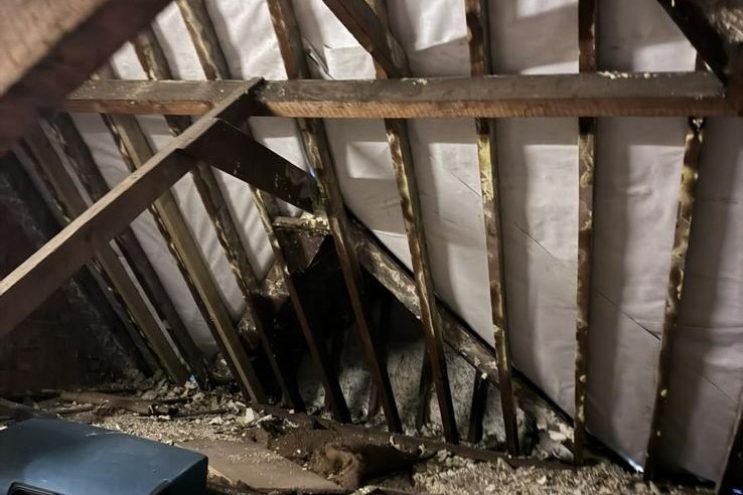
Wiltshire's Military Communities and a Spray Foam Problem That Many Homeowners Never Anticipated
Wiltshire is home to more serving military personnel and MOD establishments than any other English county. Tidworth, Bulford, Larkhill, Warminster, and Boscombe Down represent a significant presence on the Salisbury Plain and surrounding areas — and that military character has shaped the county’s housing stock in ways that create specific spray foam challenges that we encounter nowhere else in England.
For decades, the MOD managed its garrison community housing through centralised improvement programmes — repairing, upgrading, and insulating military quarters on a systematic basis. During the energy efficiency push of the 2000s, spray foam insulation was applied to many of these properties as part of area-wide thermal improvement works. When those quarters were subsequently sold — through right-to-buy schemes, MOD housing disposal programmes, or open market sale when military families relocated — the new private owners inherited the foam without always being clearly told about it.
It is only now — at the point of remortgage, sale, or equity release — that many of these Wiltshire homeowners are discovering the foam was there all along. In Tidworth, Bulford, Ludgershall, and the surrounding villages, this pattern is among the most consistent we encounter in the county. But Wiltshire’s spray foam problem extends far beyond the military communities — to Swindon’s vast railway-heritage housing stock, Salisbury’s period terraces, and the chalk downland market towns of Devizes, Marlborough, and Pewsey.
A Recent Wiltshire Case: Tidworth Homeowner, Sale Halted by Halifax — Ex-Military Quarter with Undisclosed Foam
Last year, a homeowner in Tidworth contacted us after their property sale was halted mid-conveyancing. The buyer’s lender — Halifax — had instructed a survey on the property, a former MOD quarter that the homeowner had purchased through a private sale when the military family who had rented it relocated. The survey identified closed-cell spray foam applied to the full rafter span during an MOD maintenance programme in 2011. Halifax issued a nil valuation. The homeowner had no knowledge of the foam — it was not disclosed in any documentation at the time of purchase.
We surveyed the property within four days. The report confirmed rigid closed-cell foam throughout, with no evidence of structural timber decay — the property had been maintained to a reasonable standard during its MOD period and the inland Salisbury Plain location meant moisture conditions were not severe. The survey gave the homeowner a clear, honest picture of the scope of removal required.
Removal was completed over two days. The completion report was issued the same afternoon and submitted to Halifax’s valuer via the homeowner’s solicitor. Halifax accepted the report and reinstated the valuation. The sale completed three weeks later.
The homeowner subsequently consulted their conveyancer about the non-disclosure of the spray foam at purchase. We provided a copy of our survey report to support those discussions — one of the reasons our survey documentation is structured with the detail and formality that it is. The ex-MOD quarter context meant the disclosure chain was complex, but the practical matter of the sale was resolved through the removal and completion report.
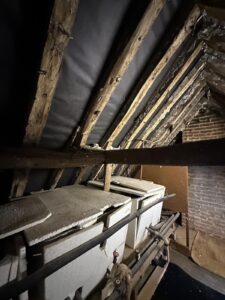
Laying the breathable membrane in this Wiltshire loft. Getting the roof lined and ready for the next stage while working around the original timber structure.
Swindon: Railway Heritage, Rapid Expansion, and a High Spray Foam Prevalence
Swindon occupies a unique position in Wiltshire. It is by far the county’s largest settlement — larger than any of the historic market towns by a significant margin — and its housing stock has a character entirely its own. The Great Western Railway established its locomotive works in Swindon in 1843, and the town grew rapidly around that industry through the Victorian and Edwardian periods, creating dense streets of railway-worker terraces in what became known as the Railway Village and the surrounding neighbourhoods of Old Town and Rodbourne.
Swindon then expanded massively in the post-war period as a planned overspill town receiving population from London — creating large estates of 1950s, 1960s, and 1970s family housing across Park North, Park South, Penhill, Walcot, and Pinehurst. This post-war housing stock was managed by Swindon Borough Council and was among the most systematically targeted by energy insulation schemes in the county. Spray foam applied during the 2000s improvement programmes is particularly prevalent in these areas and is a consistent feature of our Swindon survey work.
Swindon’s Victorian Railway Village — now a Grade II* listed conservation area — presents a different set of challenges. The tightly packed railway-worker terraces have original roof structures from the 1840s–1870s that are heritage-sensitive, and spray foam applied within these properties requires particularly careful specialist assessment before any removal approach is agreed. The conservation area designation also means external remedial works following removal may require planning consent.
TESTIMONIAL
Client Feedback & Reviews
See what our customers say about us.
Absolutely brilliant from start to finish. We had a bit of a nightmare trying to get our bungalow in Swindon ready for sale, but Spray Foam Removal UK made the whole extraction process look easy. The lads were polite, kept the dust to a minimum, and left the loft in a proper state. Can’t thank them enough for sorting it so quickly.

Found these guys online and they didn’t disappoint. Had a full loft clearance at our place in Chippenham and the standard of work was top notch. Spray Foam Removal UK was transparent about the costs from day one and didn’t leave a single bag behind. It’s rare to find such a reliable local outfit. Spot on.

Wiltshire's Housing Stock and Where Spray Foam Is Most Commonly Found
Beyond Swindon and the military communities, Wiltshire’s varied housing stock creates spray foam challenges in several distinct areas:
- Salisbury's period terraces and Victorian suburbs: Wiltshire's county city has a significant stock of Victorian and Edwardian terraced housing in Fisherton, Bemerton, and the surrounding inner suburbs. These properties were built for natural ventilation and are susceptible to moisture damage when spray foam restricts airflow. Salisbury's extensive conservation area coverage means external remedial works following removal require engagement with the city's planning requirements. The cathedral close and its surroundings present the most heritage-sensitive planning context in the county.
- Chippenham, Trowbridge, and the western market towns: The principal market towns of west Wiltshire have Victorian and post-war housing where spray foam from local energy schemes is found regularly. Trowbridge — the county town — has significant council-era housing from the mid-twentieth century that was targeted by improvement schemes. Chippenham's rapid expansion since the 1980s has created a mixed housing stock where older properties sit alongside newer development.
- Devizes, Marlborough, and the chalk downland towns: These distinctive market towns sit within or adjacent to the North Wessex Downs AONB and have significant stocks of period and traditional construction. Devizes and Marlborough both have high proportions of older properties where spray foam has sometimes been applied without adequate understanding of the implications for traditional breathable construction. Lender scrutiny in AONB-adjacent properties is heightened, and planning considerations for external works within the AONB boundary may apply.
- Bradford-on-Avon and Corsham: Two of Wiltshire's most architecturally distinctive small towns, with significant stocks of Bath stone and traditional limestone construction. These materials manage moisture differently to brick, and spray foam applied within these properties can disrupt the natural breathability of the building fabric. Both towns have extensive conservation area designations and listed building stock that creates specific planning considerations for remedial works.
- Rural downland villages across the Vale of Pewsey, the Kennet Valley, and the Plain: Period farmhouses, flint and chalk cottages, and traditional Wiltshire vernacular construction where older roof structures require specialist assessment before any removal approach is agreed.
What Wiltshire's Mortgage Lenders and Surveyors Are Looking For
The RICS guidance on spray foam insulation — adopted by Halifax, Nationwide, Barclays, Santander, NatWest, and all mainstream lenders — applies uniformly across Wiltshire regardless of whether the property is a Swindon post-war semi, a Tidworth ex-military quarter, or a Bradford-on-Avon Bath stone townhouse. The lender requires the same evidence in every case:
- Professional removal confirmed by a specialist contractor — not partial clearance, not boarding over the foam
- An independent completion report documenting the foam type and extent removed, post-removal moisture readings, timber condition, and specialist contractor credentials
- Evidence of any remedial works to structural elements revealed during or after removal — particularly relevant in Swindon's older Victorian railway terraces and the county's rural period properties
Our survey report and completion report are written specifically to provide this evidence. The documentation is the deliverable that changes the lender’s position — not just the physical removal. We structure both documents around what your specific lender needs to see based on the concerns raised in their nil valuation notice.
Our Wiltshire Services: Survey, Removal, and the Completion Report
- Independent Spray Foam Survey
Every project begins with a thorough independent inspection of the loft space by one of our vetted specialist contractors. We identify the foam type — open-cell or closed-cell — assess the full extent of coverage, and examine the condition of the underlying roof timbers. For Swindon’s Victorian Railway Village properties, we document the heritage construction characteristics specifically. For chalk downland and AONB-adjacent properties, we assess whether any likely external remedial works would engage planning controls. For former MOD properties, we note the MOD maintenance history in the report where it is relevant to the foam’s characteristics. The survey report is written to address the specific questions your lender will ask — not a generic building survey.
- Professional Spray Foam Removal
Our removal teams use specialist equipment to detach spray foam from roof timbers with minimum structural disruption. The approach depends on foam type, adhesion, and construction type — all confirmed at survey stage. For Swindon Victorian Railway Village terraces and Bradford-on-Avon Bath stone properties, the removal approach reflects the heritage sensitivity of the construction. On completion, all debris is cleared, the structure is inspected, and the completion report is issued the same day.
- Remedial Works and Roof Replacement
Where removal reveals underlying damage — decayed rafters, deteriorated felt, or structural issues the foam had been concealing — we provide honest, itemised guidance on what is needed before the lender will reinstate the valuation. For Wiltshire’s older period properties and rural chalk construction, complications are occasionally found. For standard suburban and post-war properties, they are less common. All qualifying remedial and replacement works are supported by a 10-Year Insurance-Backed Guarantee.
📍 Areas We Cover Across Wiltshire
We provide spray foam surveys and removal across the whole of Wiltshire. Our teams regularly work across:
- Amesbury
- Bradford-on-Avon
- Chippenham
- Cricklade
- Highworth
- Marlborough
- Mere
- Salisbury
- Throwbridge
- Trowbridge
- Westbury
- Royal Wootton Bassett
- Warminster
- Andover
- Calne
- Corsham
- Devizes
- Malmesbury
- Melksham
- Pewsey
- Swindon
- Tisbury
- Wilton
- Wroughton
- Tidworth
If your town or village is not listed, please contact us — our service covers the full county of East Sussex.
Why Wiltshire Homeowners Choose Spray Foam Removal UK
Wiltshire’s housing variety — from Swindon’s Victorian Railway Village to Tidworth’s MOD quarters to Bradford-on-Avon’s Bath stone terraces to the chalk downland farmhouses of the Pewsey Vale — means that a uniform removal approach does not serve the county well. Our survey-first process ensures every Wiltshire property is assessed individually, with the removal approach and any planning considerations identified before work begins. The completion report that follows is then structured specifically around what your lender needs to see.
- Specialist focus — spray foam surveys and removal is our entire operation
- Vetted contractors — all field teams are Checkatrade-approved before working on customer properties
- CORC members — contractors hold membership of the Confederation of Roofing Contractors
- Lender-aware documentation — every survey and completion report is structured around the specific requirements of mainstream lenders and equity release providers
- Wiltshire experience — our teams understand MOD quarter history, Swindon's GWR heritage stock, Salisbury's cathedral city planning context, and the North Wessex Downs AONB
- 10-Year Insurance-Backed Guarantee — available on qualifying removal and roof replacement projects
- Free online estimate — understand indicative costs before committing to a survey
- No hidden charges — full itemised pricing confirmed following survey, no obligation to proceed
Get a Free Online Estimate for Your Wiltshire Property
Whether you are dealing with a Tidworth ex-MOD quarter where spray foam was installed without your knowledge, a Swindon remortgage blocked by a nil valuation, a Salisbury sale halted mid-conveyancing, or a rural Wiltshire property where a survey has flagged foam for the first time — the starting point is always the same: an independent survey and a clear, honest picture of what you are dealing with.
Use our free online estimate tool for an early indication of costs and timescales, or contact us directly to arrange a survey. We cover the whole of Wiltshire and understand the county’s unique combination of military heritage, GWR railway history, cathedral city planning contexts, and chalk downland rural character.
FAQ's
Questions Wiltshire Homeowners Ask Us Most
This is a common situation in Wiltshire's garrison communities. Your immediate practical priority is resolving the lender issue — whether that means getting a sale across the line, unblocking a remortgage, or reinstating an equity release application. Our survey will establish the foam type, extent, and timber condition, giving you an independent assessment you can use both for the lender process and for any legal discussions about non-disclosure at purchase. If the foam was not disclosed in the property information forms when you purchased, your conveyancer can advise on whether there is a legal avenue to pursue — but the practical removal and documentation process is what needs to happen first to unblock your transaction.
The Railway Village's Grade II* listed conservation area designation does not restrict spray foam removal from inside the loft — that is internal work requiring no consent. Where it becomes relevant is if any external works to the roof are needed following removal. In a listed conservation area, works such as replacing roofing tiles, repairing ridges, or altering roof coverings may require listed building consent or planning permission that would not be required elsewhere. Our survey will identify whether any external works are likely following removal, and our contractors are experienced working within Swindon's Railway Village conservation context.
The North Wessex Downs AONB covers a significant area of north and east Wiltshire — including the areas around Marlborough, Devizes, and the Kennet Valley. AONB designation does not restrict spray foam removal from inside the property. However, if external remedial works are needed following removal, permitted development rights within the AONB are more tightly constrained than elsewhere in Wiltshire, and some works may require planning consent. Our survey will identify whether any external works are likely and flag the relevant planning considerations for your property's specific location.
Contact us immediately. For a standard Salisbury Victorian or Edwardian terrace with typical foam coverage, our expectation is: survey within four to five working days of instruction, removal within one to two weeks of survey confirmation, completion report issued on the day removal finishes. For properties near the cathedral close or within Salisbury's extensive conservation areas where any external works might be needed, we will flag the planning implications clearly at survey stage so you can manage the timeline around them. We give realistic timescales, not optimistic ones.
Costs vary across Wiltshire depending on property type, location, and foam type. A standard Swindon post-war semi with typical open-cell foam coverage will generally be costed towards the lower end of our range. A Swindon Railway Village Victorian terrace requiring heritage-sensitive handling, a Bradford-on-Avon Bath stone property with complex roof construction, or a rural downland farmhouse with non-standard access may be costed differently. Our free online estimate gives you a realistic early indication before you commit to a survey. Full, itemised pricing is confirmed following the survey with no hidden charges.
Start with a Free Online Estimate for Your Wiltshire Property
If spray foam insulation is affecting your Wiltshire property — whether you are in Swindon, Salisbury, Trowbridge, Chippenham, Devizes, a garrison community, or anywhere across the county — the quickest way to understand your options and likely costs is through our free online estimate tool. You can also call or email us directly to arrange an independent spray foam survey anywhere across Wiltshire.