
Spray Foam Removal in Greater London
Spray Foam Removal in Greater London — Independent Surveys & Professional Removal
ALL 32 LONDON BOROUGHS — SPRAY FOAM SURVEYS & REMOVAL
Spray Foam Surveys & Removal Across Greater London
We provide independent spray foam surveys, professional removal, and full remedial solutions across all 32 London boroughs — from inner East London and the Victorian terrace belt to outer suburbs, leasehold properties, and conservaton area streets. If spray foam is blocking your mortgage, remortgage, or equity release, our specialist teams can help.
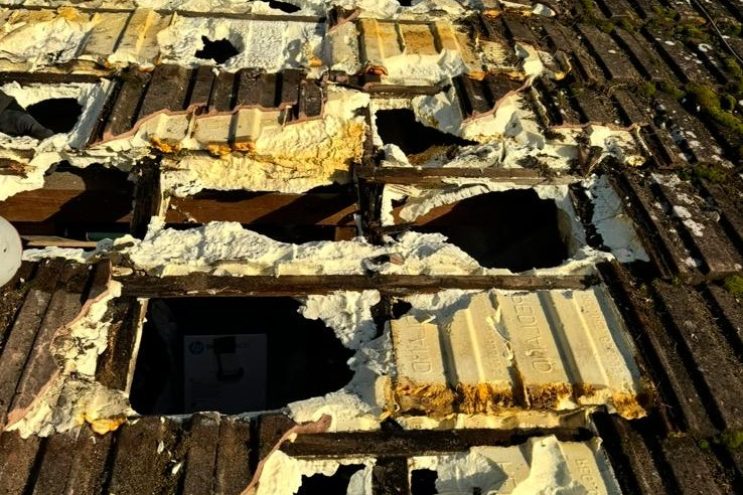
London's Property Values, Spray Foam Nil Valuations, and Why the Financial Stakes Here Are the Highest in England
Greater London has the highest residential property values of any location in England. In inner London boroughs — Hackney, Islington, Southwark, Lambeth, Hammersmith and Fulham, Wandsworth, and Tower Hamlets — Victorian and Edwardian terrace properties regularly transact at values that would be exceptional in any other English city. A spray foam nil valuation on a property in E8 or N1 that is under offer at £700,000 or more creates a financial urgency that is quantitatively different from any other location in our 44-county coverage area. The equity at stake, the transaction costs already incurred, and the buyer’s alternative options in London’s competitive market all combine to make London spray foam nil valuations the most acute resolution requirement we deal with anywhere in England.
London’s property market also moves faster than anywhere else in England. In the most sought-after inner London streets, properties receive multiple offers within days of listing. A buyer who has secured a property in competition will have a second-choice property in their mind — and if a nil valuation creates uncertainty about whether the transaction will complete, the risk that they walk away for their alternative is real and immediate. Speed of response from the point of nil valuation receipt is not merely helpful in London: it is often the decisive factor in whether a sale is saved.
Leasehold: London's Unique Spray Foam Complication — and Why It Matters for Some London Homeowners
Greater London is the only location in our 44-county coverage area where leasehold ownership of houses — not just flats — is encountered at scale. Many Victorian and Edwardian London terraces are sold on long leases rather than as freehold properties, and some are subject to lease covenants that govern what alterations can be made to the property and what improvements require freeholder consent.
In a leasehold context, spray foam removal creates two separate issues that do not arise in freehold properties elsewhere. First, the lender requires the standard removal and completion report as they would anywhere else. Second, if spray foam was applied without the freeholder’s knowledge or consent — which is common where foam was installed by a landlord investor or a previous owner — the leaseholder may face a covenant breach question in addition to the lender issue. Our survey documentation — which identifies the foam type, its estimated installation period, and its installation characteristics — can support discussions with both the freeholder and the lender simultaneously. We are experienced in working alongside solicitors managing leasehold spray foam situations in London.
A Recent London Case: Hackney Homeowner, Sale Blocked by Halifax — Victorian Terrace, One-Week Buyer Deadline
Last year, a homeowner in Hackney’s Clapton area contacted us the same morning they received Halifax’s nil valuation. The property — a Victorian through-terrace on a highly sought-after residential street in E5 — had open-cell spray foam applied to the full loft floor and lower rafter sections in 2013, during a period when it was let by the previous owner, through an energy improvement scheme coordinating improvements in a number of local streets. The current homeowner had purchased from the landlord investor four years later, with no mention of the foam. Their buyer — who had competed against two other offers to secure the property — had given a one-week deadline before they would consider withdrawing.
We surveyed within two days — faster than our usual target, because the London market does not wait. The report confirmed open-cell foam throughout with moderate moisture absorption. The timber structure was in sound condition. Removal was completed over two days. The completion report was submitted to Halifax the same afternoon.
Halifax accepted the report. The Hackney sale completed within seven days of our initial survey — inside the buyer’s deadline.
This pace — survey within two days, removal within four, report on day four, sale saved on day seven — is the London standard, not the exception. In Hackney, Islington, Stoke Newington, Dalston, Peckham, Brixton, Herne Hill, and the other inner London Victorian terrace markets where buyer demand consistently exceeds supply, the window between nil valuation and buyer withdrawal is measured in days, not weeks.
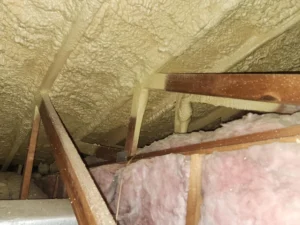
Spray foam sealing the roof rafters while fiberglass fills the floor joists. Dual-layer insulation system maximizing thermal efficiency for this London property.
Outer East London and the Warm Front Legacy: Why Some London Boroughs Have the Highest Spray Foam Prevalence in England
The Warm Front programme — the government energy improvement scheme that operated from 2000 to 2013 — specifically targeted households experiencing fuel poverty. In Greater London, fuel poverty was concentrated in the outer East London boroughs: Newham, Barking and Dagenham, Waltham Forest, Havering, and Redbridge. These boroughs received Warm Front interventions — including spray foam insulation — at rates significantly above the London average, because the combination of older housing stock and higher fuel poverty prevalence in these communities made them priority targets.
The consequence is that Newham, Barking and Dagenham, and Waltham Forest have spray foam prevalence rates — particularly in their Victorian and Edwardian terrace and post-war council housing stock — that are among the highest of any location in Greater London. Right-to-buy activity in these boroughs from the 1990s onwards has transferred much of this stock to private ownership, and long-term owners are now reaching equity release age with foam installed before the sale that they may know nothing about.
TESTIMONIAL
Client Feedback & Reviews
See what our customers say about us.
Finding a reliable team for spray foam removal in Hackney was a challenge until we found these guys. Our Victorian terrace had a survey fail due to the insulation, but the team cleared it perfectly. They were mindful of the neighbors and left the loft spotless. Most importantly, the follow-up survey passed without a hitch.

Absolutely brilliant service. We were in the process of remortgaging our home in Wandsworth when the bank's valuer flagged the foam. This team came out to SW18, explained the whole extraction process, and did a top-tier job. They provided all the necessary documentation which the mortgage lender required. Professional, efficient, and very tidy.

Greater London's Housing Stock: Where Spray Foam Is Most Commonly Found
- Inner East London Victorian terrace belt (Hackney, Tower Hamlets, Newham, Waltham Forest, Leyton, Stratford): The densest concentration of Victorian terraced housing in England. A combination of landlord-installed foam from the private rental market (Hackney, Stoke Newington, Clapton) and Warm Front improvement scheme foam (Newham, Waltham Forest) makes this the highest spray foam prevalence zone in Greater London. Market pace here means two-day survey turnaround is regularly the expectation.
- Inner South London Victorian belt (Southwark, Lambeth, Lewisham, Wandsworth, Brixton, Peckham, Herne Hill): Some of London's most competitive Victorian terrace markets. Landlord-to-owner-occupier foam transition pattern very similar to inner East London. Conservation area coverage across many south London residential streets creates planning implications for external works. Nil valuations in Brixton, Herne Hill, and East Dulwich carry six and seven-figure financial consequences.
- Inner North London (Islington, Haringey, Enfield, Camden, Hornsey, Muswell Hill): Islington's Georgian and Victorian terraces are among London's most heritage-sensitive residential streets. Haringey's Victorian inner suburbs (Hornsey, Crouch End, Wood Green) have significant improvement scheme foam from borough-coordinated programmes. Camden's conservation areas are among the most rigorously enforced in England.
- Outer East London — Warm Front zone (Barking and Dagenham, Redbridge, Havering): As described above — the highest Warm Front improvement scheme foam concentration in Greater London. Right-to-buy equity release from long-term owners is the dominant trigger. Properties in these boroughs should be inspected before any equity release application or significant transaction.
- West London (Ealing, Hounslow, Hammersmith and Fulham, Brent, Harrow): A mixed zone of Victorian terraces, 1930s suburbia, and post-war housing. Ealing and Brent's Victorian inner suburbs have improvement scheme foam from borough programmes. Hammersmith and Fulham's high property values make nil valuations here financially acute. Harrow's 1930s semi-detached housing belt has some private installation foam from the energy improvement marketing push.
- Outer South London (Bromley, Croydon, Sutton, Kingston, Merton): A large zone of 1930s–1960s semi-detached suburban housing with improvement scheme and private installation foam patterns. Croydon's Victorian inner areas and significant post-war housing estate stock have Warm Front patterns similar to outer East London at slightly lower prevalence rates. The outer South London property market is active with buyers priced out of inner South London.
What London Lenders Require — and Why Speed Is the Critical Variable
The RICS guidance applies in London as it does everywhere — Halifax, Nationwide, Barclays, Santander, and NatWest all require professional removal confirmed in writing, an independent completion report, and evidence of any remedial works. For leasehold properties, the survey documentation also supports any discussions with the freeholder and solicitor about the installation history. For conservation area properties in Islington, Camden, Southwark, or Wandsworth, our completion reports address any heritage planning implications for external works. For outer East London Warm Front properties, the scheme history is documented.
What is different in London is the time variable. Two days from first call to survey, four days from survey to completion report — this is the London pace. We treat every London case as time-critical from the moment of the first call, because in this market, the window between nil valuation and buyer withdrawal is narrow in a way that is qualitatively different from any other English market.
Our London Services: Survey, Removal, and the Completion Report
- Stage One: Independent Spray Foam Survey
Every project begins with a thorough independent inspection by one of our vetted specialist contractors. For leasehold London properties, we document the foam’s installation characteristics to support freeholder and solicitor discussions. For conservation area properties, heritage planning implications for external works are identified. For Warm Front improvement scheme properties, the installation context is noted. For all London cases, the survey is prioritised and scheduled with the buyer’s deadline as the controlling variable.
- Stage Two: Professional Spray Foam Removal
Our London removal teams are experienced working in the access conditions of London’s Victorian terrace streets — restricted parking, narrow passages, shared access arrangements, and the specific challenges of working in a high-density urban environment. For standard London Victorian terraces, removal of typical foam coverage is achievable within one to two days. On completion, the report is issued the same day. We do not delay for administrative purposes when a London buyer is waiting.
- Stage Three: Remedial Works & Roof Replacement Where Needed
Where removal reveals underlying damage, we provide honest guidance on remedial works. For conservation area London properties, external works are planned with the relevant planning constraints in mind. All qualifying works are supported by a 10-Year Insurance-Backed Guarantee.
📍 Areas We Cover in London
We provide spray foam surveys and removal across all 32 London boroughs and the City of London:
- Central London
- North London
- South London
- East London
- West London
- Barking and Dagenham
- Barnet
- Bexley
- Brent
- Bromley
- Camden
- City of London
- Croydon
- Ealing
- Enfield
- Greenwich
- Hackney
- Hammersmith and Fulham
- Haringey
- Harrow
- Havering
- Hillingdon
- Hounslow
- Islington
- Kensington and Chelsea
- Kingston upon Thames
- Lambeth
- Lewisham
- Merton
- Newham
- Redbridge
- Richmond upon Thames
- Southwark
- Sutton
- Tower Hamlets
- Waltham Forest
- Wandsworth
- Westminster
Why London Homeowners Choose Spray Foam Removal UK
London requires a spray foam specialist who understands the pace of the market, the leasehold complexity that is unique to the capital, the conservation area heritage planning environment of inner London, and the Warm Front legacy of outer East London’s housing stock. Our survey-first process, rapid scheduling, and completion reports written for what London lenders need to see are built around these specific requirements.
- Specialist focus — spray foam surveys and removal is our entire operation
- Vetted contractors — all field teams are Checkatrade-approved
- CORC members — contractors hold membership of the Confederation of Roofing Contractors
- Lender-aware documentation — every survey and completion report is structured around the specific requirements of mainstream lenders and equity release providers
- London market pace — we treat every London case as time-critical from the first call; two-day survey and four-day total resolution is our London target for standard properties
- Leasehold expertise — our survey documentation supports freeholder discussions and solicitor advice alongside the standard lender evidence
- Warm Front and outer East London history — Newham, Barking, Waltham Forest, Havering improvement scheme documentation
- Inner London conservation area awareness — Islington, Camden, Southwark, Wandsworth, Hackney conservation area planning implications identified at survey stage
- International buyer support — we can provide clear guidance on UK spray foam lender requirements for international buyers unfamiliar with the process
- Access expertise — London's Victorian terrace access conditions, restricted parking, and shared access arrangements handled by experienced London teams
- 10-Year Insurance-Backed Guarantee — available on qualifying removal and roof replacement projects
- Free online estimate — understand indicative costs before committing to a survey
Get a Free Online Estimate for Your London Property
Whether you have a mid-sale Hackney nil valuation with a one-week buyer deadline, a Newham equity release refused after decades of ownership, a leasehold Islington property where spray foam creates both a lender and a freeholder question, a Southwark remortgage declined, or a Waltham Forest sale halted — the starting point is the same: call us immediately, and we will treat your case with the urgency London requires.
Use our free online estimate tool for an early indication of costs and timescales, or contact us directly. We cover all 32 London boroughs and the City of London, and we understand that in this market, the pace of our response is as important as the quality of our work.
FAQ's
Questions London Homeowners Ask Us Most
It can. In a leasehold property, spray foam installed without the freeholder's knowledge may constitute a breach of the lease covenant that governs alterations to the property. This is separate from the lender issue but may need to be addressed alongside it. Our survey documentation — identifying the foam type, installation period, and installation characteristics — provides evidence that can support your solicitor's discussions with the freeholder. In most cases, demonstrating that the foam has been professionally removed and the roof restored to its pre-foam condition resolves both the lender concern and any freeholder covenant question simultaneously. We recommend engaging your solicitor early in the process to manage both threads in parallel.
Call us the same day you receive the nil valuation notice — not the following morning, the same day. For a standard London Victorian through-terrace with typical foam coverage, our target is: survey within two working days, removal within four, completion report issued on day four. The Hackney case above completed on day seven from our initial survey. We understand that in London's market, each day's delay increases the risk of buyer withdrawal, and we schedule London cases immediately on receipt of the instruction.
UK mortgage lenders apply RICS guidance that treats spray foam insulation in loft spaces as a standard risk — if a surveyor identifies it at valuation, the lender will issue a nil valuation and decline to lend until professional removal has been completed and a specialist completion report submitted. This applies regardless of when the foam was installed or who installed it. The process is clear and manageable: our survey establishes the position, our contractors remove the foam, and our completion report provides the lender evidence they need. If you are buying in London and your survey has flagged spray foam, or if you are concerned about a property you are viewing, contact us — we can explain the process and timeline clearly.
Yes — significantly. Outer East London boroughs (Newham, Barking and Dagenham, Waltham Forest) have above-average prevalence from Warm Front improvement scheme targeting. Inner East London (Hackney, Tower Hamlets) has high landlord-era private installation foam from the extensive buy-to-let rental market in the 2000s. Inner South London (Southwark, Lambeth, Lewisham) has similar landlord-era patterns. Outer West and South West London (Ealing, Hounslow, Bromley) has lower but not negligible prevalence from private installations and 1960s–1980s improvement schemes. If you own or are buying a property built before 1985 in any inner or outer East London borough, a loft inspection before any significant transaction is strongly advisable.
London costs reflect London rates — access conditions, parking constraints, congestion charge and ULEZ zone working costs, and the premium associated with rapid-response London scheduling all feature. A standard inner London Victorian through-terrace with typical open-cell or closed-cell foam coverage will generally sit towards the mid range of our estimate tool rather than the lower end applicable to similar properties in northern cities. For a London property worth £600,000 or more where the alternative to resolving the foam is a failed or collapsed transaction, the removal cost represents a very small fraction of the value at stake. Our free online estimate gives you a realistic London-specific indication before you commit to a survey.
Start with a Free Online Estimate for Your London Property
If spray foam insulation is affecting your London property — whether you are in Hackney, Islington, Southwark, Lambeth, Ealing, Newham, Waltham Forest, or any of the 32 London boroughs — the quickest way to understand your options and likely costs is through our free online estimate tool. You can also call or email us directly. We treat London cases as time-critical from the first call.