
If spray foam in your loft has stalled a sale, blocked a remortgage or been flagged on a survey, we can put it right — anywhere in Wales. We’re spray foam removal specialists working with homeowners the length and breadth of the country, from the Victorian terraces of Cardiff and Swansea to the coastal towns of the north and the stone cottages of rural Mid and West Wales. Independent survey, careful removal, and the lender-ready documentation you need to move forward.
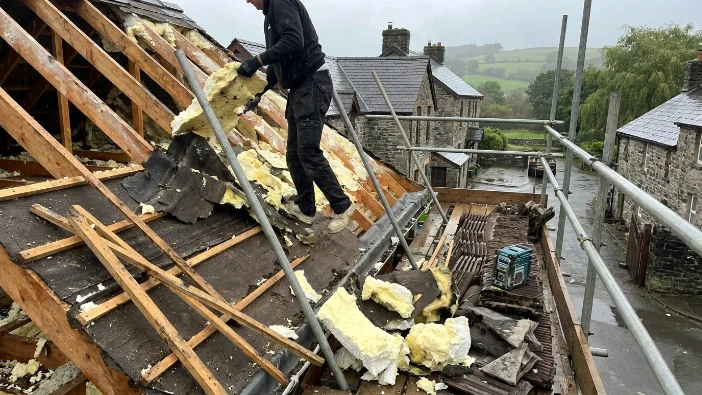
It’s one of the most common calls we take from Welsh homeowners. A surveyor finds spray foam, the lender holds back, and a sale or remortgage that looked straightforward suddenly stalls. We come out wherever you are in Wales, tell you plainly what’s in your roof, remove the foam back to clean timber, check the structure beneath, and give you a written report that lenders, surveyors and conveyancers will accept. Independent advice, clear pricing, no obligation.
Wales has the oldest housing stock of any nation in the UK: more than a quarter of Welsh homes were built before 1919. These older houses — solid-stone cottages, brick-built Victorian terraces, chapels and farmhouses — were designed to breathe. Their walls and naturally ventilated roofs manage moisture by allowing it to move in and out, keeping the timbers dry across generations. Spray foam works against that entirely: bonded to the underside of the rafters, it seals the roof, traps moisture against the wood, and stops the structure drying the way it was built to. On Wales’s older roofs in particular, that mismatch can cause real damage.
There’s also a reason foam is so widespread here. Welsh homes are, on average, harder and more expensive to heat than those elsewhere — more solid-walled, more rural, and more likely to be off the gas grid, relying on oil or electric heating. That has made Wales a focus for two decades of energy-efficiency effort, from the Welsh Government’s Warm Homes schemes, Nest and Arbed, to UK-wide programmes. Against that backdrop, spray foam was widely marketed to homeowners as a quick way to insulate an ageing, hard-to-heat roof — often on the very houses least suited to it.
Whatever the age of the house, the consequence at sale is the same. With the timbers hidden, a surveyor can’t inspect them, and a lender won’t lend against a roof it can’t assess. In practice that means a valuation cut by roughly 15 to 20 per cent under RICS guidance, or refused outright. With the Great British Insulation Scheme closed since March 2026 and no public funding for removals, the cost of putting things right falls to the homeowner — and across Wales, it’s a problem surfacing on more sales and remortgages every month.
Wales’s wet, exposed climate only raises the stakes. High rainfall and driving winds mean moisture management matters more here than almost anywhere, and a sealed, non-breathing roof gives trapped damp nowhere to go. Because the risk depends so much on the age of the house, the type of foam and how long it’s been in place, we always begin with an independent survey rather than assume a roof is fine.
We work across all of Wales’s cities, and each has its own housing character:
See what our customers say about us.
We were incredibly stressed about the spray foam in our loft after it caused an issue with our equity release application in Cardiff. Thankfully, this company was outstanding. The workers arrived exactly on schedule, explained the extraction process clearly, and worked tirelessly to clear every trace of the insulation. They left the property immaculate and provided the certification we needed for the lender the very next day. Brilliant service.

A highly professional and straightforward team to deal with. We needed a complete foam extraction at our property near Wrexham following a difficult structural survey. The crew was fantastic—they took great care to protect our carpets, systematically removed the foam from the rafters, and vacuumed the entire landing before leaving. No hidden costs and total peace of mind. I highly recommend them.

Foam found partway through a sale usually ends the same way: a broken chain and a rushed fix under pressure, with the house back on the market and new buyers asking questions. Getting ahead of it keeps everything in your hands:
Beyond the cities, we survey and remove spray foam in towns and villages right across Wales. A selection of the areas we cover, by region:
That’s on top of full coverage of all 22 Welsh counties — from Monmouthshire and the Vale of Glamorgan across to Gwynedd, Powys, Ceredigion and Pembrokeshire.
Derbyshire’s internal diversity — from Peak District gritstone farmhouses to former coalfield semi-detacheds to Derby city Victorian terraces to Dales limestone market town properties — means that a single standard removal approach does not serve the county well. Our survey-first process ensures every Derbyshire property is individually assessed. The completion report that follows is written specifically around what your lender needs to see — not as a generic description of what was done on site.
Our free online estimate gives you an early sense of the likely cost and what’s involved, wherever your property is in Wales. Would rather talk first? Get in touch and we’ll arrange an independent survey to suit you. We’re used to working around live sales, conveyancing deadlines and remortgage dates, so foam needn’t be what holds your move up.
Potentially, yes. Older Welsh homes were built to breathe, with roofs and walls that manage moisture naturally. Spray foam seals that up and traps damp against timbers that may be a century old or more, so the risk of hidden deterioration is higher than in a modern trussed roof. It doesn’t mean there’s definitely damage — only that it needs checking — which is exactly what our independent survey is for.
Not for the removal itself, which is the same wherever the house is and however it’s heated. It simply means these homes were often insulated heavily, sometimes with spray foam, to make them cheaper to heat. We cover rural Wales as well as the cities and larger towns — we’ll travel to you and give you a clear timescale after the survey.
No. Taking foam out of the loft is internal work and needs no consent, even for a listed building or a home in Eryri (Snowdonia), Bannau Brycheiniog (the Brecon Beacons) or the Pembrokeshire Coast National Park. Consent only becomes relevant if external roof repairs are needed afterwards, where listed-building or National Park rules and matching materials may apply — we’ll flag anything like that at survey stage.
Yes. We work right across the Valleys, and we have a dedicated South Wales Valleys page covering the coalfield terraces and the CF and NP communities in detail. For anywhere else in Wales — the cities, the coast, the rural counties — this is the page, and the process is the same wherever you are.
It depends on the size of the property, the type and spread of the foam, and how the roof is built; for more remote rural properties, travel can be a small factor. Our free online estimate gives you a realistic figure before you commit, with full itemised pricing confirmed after the survey — nothing hidden, and no obligation to proceed.
Send us a few details on the form and we’ll get straight back to you, wherever you are in Wales. If it’s urgent — a sale or mortgage in the balance — call us now on 07846 196539.
Helping homeowners remove problematic spray foam insulation from lofts and roofs so you can sell, remortgage, release equity and protect your home’s structure.