
Spray Foam Removal in Norfolk
Spray Foam Removal in Norfolk — Independent Surveys & Professional Removal
NORFOLK BROADS, NORTH SEA COAST & NORWICH CITY SPECIALISTS
Spray Foam Surveys & Removal Across Norfolk
We provide independent spray foam surveys, professional removal, and full remedial solutions across Norfolk — from Norwich and King’s Lynn to Cromer, Great Yarmouth, Dereham, Fakenham, and the Broads. If spray foam is blocking your mortgage, remortgage, or equity release, our specialist teams can help.
The Norfolk Broads and a Freshwater Moisture Environment Found Nowhere Else in England
The Norfolk Broads — England’s largest protected wetland — sits in the heart of the county’s eastern parishes, covering a network of navigable rivers, lakes, and reed beds that stretches from Norwich eastwards to the coast at Great Yarmouth. The properties that border the Broads — in villages such as Wroxham, Hoveton, Horning, Potter Heigham, Hickling, Stalham, and Ludham — sit within a freshwater wetland environment unlike anything else in England, and one that creates specific moisture conditions for building structures that have no direct parallel among the other counties we cover.
The distinction matters. Essex’s Thames Estuary creates tidal salt air humidity. Cambridgeshire’s fens create peat-soil groundwater moisture. Cornwall’s Atlantic coast creates salt-laden marine air. The Broads creates something different again: freshwater evaporation from thousands of acres of open water and reed bed, producing a persistent above-average humidity that is highest in summer — when temperatures drive evaporation — and that works on building structures differently to either salt air or tidal moisture. Properties immediately adjacent to the Broads network face an ambient moisture loading that inland Norfolk properties simply do not.
When spray foam is present in a Broads-adjacent property, this freshwater humidity accelerates the moisture consequences — open-cell foam absorbs the ambient moisture load, and closed-cell foam traps it against timbers that cannot dry out in the high-humidity environment. Properties on or immediately adjacent to the Broads waterway should be treated as elevated priority when spray foam is discovered. Our survey process specifically documents the Broads moisture context for properties in these parishes.
A Recent Norfolk Case: Norwich Homeowner, Sale Halted by Nationwide — Golden Triangle Period Semi, Foam Installed During Tenancy
Earlier this year, a homeowner in Norwich’s Golden Triangle area contacted us after their property sale was halted mid-conveyancing. The buyer’s lender — Nationwide — had instructed a survey on the Edwardian semi-detached and identified open-cell spray foam applied across the loft floor and lower rafter sections. The foam had been applied in 2011 during a period when the property was let to tenants, coordinated by Norwich City Council’s energy efficiency programme. The homeowner had purchased the property from the landlord investor two years later, with no mention of the foam in the property information forms. Nationwide issued a nil valuation. The buyer had a deadline of three weeks.
We surveyed within four days. The report confirmed open-cell foam throughout, with moderate moisture absorption consistent with the foam’s age. The underlying timbers were in structurally sound condition — the Golden Triangle’s sheltered urban Norwich location had protected the structure from significant deterioration. The survey gave Nationwide’s valuer the evidence they needed.
Removal was completed over two days. The completion report was issued the same afternoon and transmitted to Nationwide immediately. Nationwide accepted the report and the Norwich sale completed within seventeen days of our initial survey — four days inside the buyer’s deadline.
Norwich’s Golden Triangle — the affluent residential area between Newmarket Road, Unthank Road, and Earlham Road — has a high concentration of Edwardian terraces and semis that were widely targeted by energy improvement schemes during landlord tenancy periods in the 2000s. The pattern of landlord-installed foam unknown to subsequent purchasers is one we encounter consistently in this part of the city.

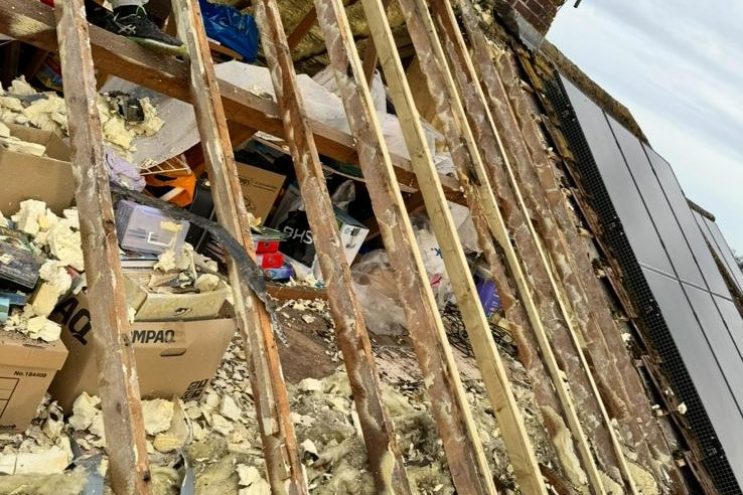
Mid-renovation progress: crew stripping the old roof and preparing the timber structure in Norfolk. Essential groundwork before the new installation begins.
Norfolk Flint Construction and the North Sea Coast: Two Distinct Specialist Challenges
- Norfolk Flint Construction
Flint — the hard siliceous stone found in the chalk beds underlying much of Norfolk — is the county’s most distinctive traditional building material. The flint knapped cottages and terraces of north Norfolk in particular, from Holt and Sheringham westwards through Wells-next-the-Sea to Hunstanton, represent a building tradition found nowhere else in England at the same concentration. Flint construction has specific breathability characteristics that differ from both brick and from the stone types found in other counties — the material manages moisture through the building fabric in ways that depend on the roof void being correctly ventilated.
Spray foam applied within a flint-built Norfolk cottage or terrace disrupts this moisture management at the roof level. Combined with the North Norfolk coast’s significant ambient moisture from North Sea exposure, the consequences in flint properties can develop faster than in standard brick construction. Our survey process for flint-built properties documents the construction type specifically, assesses the foam’s interaction with the traditional building fabric, and identifies any planning considerations for external remedial works — many north Norfolk flint properties sit within conservation areas or are listed buildings where external works require consent.
- The North Sea Coast (Cromer, Sheringham, Wells-next-the-Sea, Hunstanton)
Norfolk’s north coast faces the North Sea directly, with persistent north and north-easterly exposure and the characteristic salt air environment of an open North Sea coastline. Cromer, Sheringham, Holt, Wells-next-the-Sea, and Hunstanton all have significant residential populations alongside their tourist economies, and the period and traditional properties in these towns face the same elevated moisture urgency from North Sea exposure as the Kent and Lincolnshire coasts — but with the added characteristic that north Norfolk is one of England’s most active second home and holiday cottage markets, creating the same absentee owner discovery patterns as Cornwall.
TESTIMONIAL
Client Feedback & Reviews
See what our customers say about us.
A very tidy and professional service. We had the spray foam extracted from our Victorian semi in Norwich and the workers were incredibly respectful of our home. They made sure to cover the carpets and cleared all the debris once the job was finished. It’s a relief to see the roof timbers in their original state again without any of the mess I was dreading. Highly professional outfit.

Massive weight off my mind. We were concerned about potential damp issues in our cottage near Cromer because of the insulation. This team didn't disappoint—they worked through the day and had every bag of foam removed and the site cleared by the afternoon. They even provided the paperwork for our records immediately. If you need a reliable crew in Norfolk, these are the ones.

Norfolk's Housing Stock: Where Spray Foam Creates the Most Problems
Norfolk’s considerable geographic variety means spray foam affects different parts of the county in meaningfully different ways:
- Norwich city (Golden Triangle, Lakenham, Earlham, Mile Cross, Heartsease): Norwich's Victorian and Edwardian inner suburbs — particularly the highly sought-after Golden Triangle — have a high concentration of period terraces where energy scheme foam was applied during landlord tenancy periods, often unknown to subsequent owners. Norwich's significant student population creates high rental market activity and associated foam installation history. The city's extensive conservation area coverage and the Cathedral Quarter's heritage planning context create considerations for external remedial works.
- The Norfolk Broads parishes (Wroxham, Hoveton, Horning, Potter Heigham, Hickling, Stalham, Ludham): Freshwater wetland moisture environment as described above. Holiday let and leisure property ownership is widespread across the Broads, and absentee owners discovering foam for the first time when they seek to sell or release equity are a consistent feature of our Norfolk workload in these parishes.
- North Norfolk coast and flint-built villages (Cromer, Sheringham, Holt, Wells-next-the-Sea, Hunstanton, Fakenham): North Sea exposure combined with flint construction creates the highest moisture urgency in the county. Second home and holiday cottage market is substantial. Conservation area and listed building coverage is extensive across the north Norfolk flint village belt, creating planning considerations for external works.
- Great Yarmouth and the east coast: Great Yarmouth's former seaside resort and fishing industry heritage produced a dense housing stock of Victorian and inter-war terraces. The town has significant housing association and former council stock where energy improvement scheme foam is found at higher rates than in more rural Norfolk. Great Yarmouth's Caister and Gorleston suburban areas have post-war family housing with similar insulation scheme histories.
- King's Lynn and the Wash: King's Lynn sits at the mouth of the Great Ouse where it enters the Wash — a large tidal estuary on the west side of Norfolk that creates its own moisture environment distinct from the North Sea coast. The town has significant Victorian and Georgian heritage housing stock, and its position at the tidal Wash creates specific humidity conditions relevant to foam assessment in directly waterside and low-lying properties.
- Mid and south Norfolk market towns (Dereham, Swaffham, Wymondham, Attleborough, Diss): Inland market towns with Victorian and post-war housing. Sheltered from coastal moisture but not from the county's generally above-average humidity. Local authority energy scheme foam is found regularly in these towns' post-war family housing stock.
What Norfolk Lenders Require After a Spray Foam Nil Valuation
The RICS guidance applies uniformly across Norfolk — Halifax, Nationwide, Barclays, Santander, and NatWest all require professional removal confirmed in writing, an independent completion report, and evidence of any remedial works. For Broads-adjacent properties where freshwater humidity is documented, for north Norfolk flint properties where North Sea exposure and heritage construction both feature, and for King’s Lynn Wash estuary properties — our surveys and completion reports address the specific environmental context that lenders applying coastal or heritage scrutiny will require.
- Our Norfolk Services: Survey, Removal, and the Completion Report
- Independent Spray Foam Survey
Every project begins with a thorough independent inspection by one of our vetted specialist contractors. We identify foam type, assess extent, and examine timber condition. For Broads-adjacent properties, the freshwater moisture environment is specifically documented. For north Norfolk flint properties, the construction type and North Sea exposure are assessed. For Great Yarmouth and King’s Lynn period properties, the coastal or tidal context is noted. For Norwich conservation area properties, any likely external remedial works and their planning implications are flagged. The survey report is written for your specific lender’s requirements.
- Professional Spray Foam Removal
Our removal teams use specialist equipment appropriate to the foam type and construction. For flint-built properties with irregular roof structures, the removal approach is confirmed individually at survey stage. For standard Norfolk suburban and market town properties, removal of typical foam coverage is achievable within one to two working days on site. On completion, all debris is cleared, the structure is inspected, and the completion report is issued the same day.
- Remedial Works and Roof Replacement
Where removal reveals underlying damage — more likely in coastal, Broads-adjacent, or older flint-built Norfolk properties — we provide honest, itemised guidance on the remedial works needed. For north Norfolk listed and conservation area properties, external works are planned with the relevant planning constraints in mind. All qualifying works are supported by a 10-Year Insurance-Backed Guarantee.
📍 Areas We Cover Across Norfolk
We provide spray foam surveys and removal across the whole of Norfolk. Our teams regularly work across:
- Norwich
- King’s Lynn
- Great Yarmouth
- Thetford
- Dereham
- Fakenham
- Cromer
- Sheringham
- Holt
- North Walsham
- Wymondham
- Attleborough
- Downham Market
- Swaffham
- Hunstanton
- Aylsham
- Diss
If your town, village, or Broads parish is not listed, please contact us — our service covers the full county of Norfolk.
Why Norfolk Homeowners Choose Spray Foam Removal UK
Norfolk’s internal diversity — from the Broads’ unique freshwater wetland moisture environment to the North Sea coast’s salt air exposure to Norwich’s high-value Golden Triangle to Great Yarmouth’s housing association stock to the county’s distinctive flint construction — requires a genuinely survey-first approach where every property is assessed individually. Our completion reports are written to address the specific environmental and heritage concerns that Norfolk’s varied contexts raise for lenders.
- Specialist focus — spray foam surveys and removal is our entire operation
- Vetted contractors — all field teams are Checkatrade-approved
- CORC members — contractors hold membership of the Confederation of Roofing Contractors
- Lender-aware documentation — every survey and completion report is structured around the specific requirements of mainstream lenders and equity release providers
- Norfolk Broads moisture expertise — the freshwater wetland environment is specifically documented in surveys for Broads-adjacent properties
- Flint construction experience — specialist assessment for Norfolk's distinctive flint-built properties including north Norfolk coastal flint villages
- North Norfolk second home and holiday let experience — absentee ownership and holiday let occupancy history taken into account in coastal survey assessments
- 10-Year Insurance-Backed Guarantee — available on qualifying removal and roof replacement projects
- Free online estimate — understand indicative costs before committing to a survey
Get a Free Online Estimate for Your Norfolk Property
Whether you are dealing with a mid-conveyancing nil valuation in Norwich’s Golden Triangle, a Broads holiday cottage sale complicated by foam, a north Norfolk flint property where a survey has flagged foam for the first time, a Great Yarmouth remortgage declined, or a King’s Lynn equity release refused — the starting point is always the same: an independent survey and a clear, honest picture of what you are dealing with.
Use our free online estimate tool for an early indication of costs and timescales, or contact us directly to arrange a survey. We cover the whole of Norfolk — from the Broads to the North Sea coast, from Norwich city to the rural market towns — and our survey process is built around the county’s genuinely distinctive environmental and construction variety.
FAQ's
Questions Norfolk Homeowners Ask Us Most
In practical terms, yes — but the mechanism is different from coastal salt air exposure. The Broads creates above-average ambient humidity from freshwater evaporation, particularly in summer. This humidity acts on open-cell foam by increasing its moisture absorption rate and acts on closed-cell foam by maintaining the moisture level of the trapped environment behind it. Properties immediately adjacent to the Broads waterway — on riverside plots, alongside dykes, or within a few hundred metres of open water — experience this most acutely. Our survey will document the specific environmental context and assess the current timber condition accurately, giving you and your lender a clear picture of the actual risk rather than a generalised concern.
It affects the assessment stage most significantly. North Norfolk flint cottages often have older and irregular roof structures — non-standard rafter spacings, sometimes original pantile or plain clay tile boarding — where spray foam has bonded differently to how it bonds on standard brick-built rafters. The removal approach is confirmed individually at survey stage based on what we find. If the property is listed or in a conservation area — which many north Norfolk flint properties are — we also identify whether any external remedial works following removal would require consent before any works are agreed.
This is a common situation in the Broads parishes. Contact us as soon as the foam is identified — ideally before you have a buyer whose lender has issued a nil valuation, but if you are already mid-transaction, immediately. For a Broads area holiday cottage, we would recommend surveying before marketing if you have any reason to think foam may be present — resolving it before going to market means you can offer the full buyer pool access to the property, including those requiring mortgages, rather than being restricted to cash buyers. Our free online estimate gives you an early cost indication with no commitment.
For a standard Norwich city Edwardian or inter-war semi with typical foam coverage, our expectation is: survey within four to five working days, removal within one to two weeks of survey confirmation, completion report issued on the day removal finishes. The Golden Triangle case above completed seventeen days from our first survey. We discuss your specific buyer deadline at the first call and plan scheduling around it. Norwich's competitive property market — where buyers may walk away for another property rather than wait — makes acting immediately on the nil valuation notice the only rational approach.
Costs vary across Norfolk's diverse housing stock. A standard Norwich city semi or market town terrace with typical foam coverage will generally fall in the lower-to-mid range of our estimate tool. A north Norfolk flint cottage requiring specialist assessment, a Broads-adjacent property with freshwater humidity documentation, or a King's Lynn period property may be costed differently. Our free online estimate gives you a realistic early indication before you commit to a survey. Full itemised pricing is confirmed following the survey with no hidden charges.
Start with a Free Online Estimate for Your Norfolk Property
If spray foam insulation is affecting your Norfolk property — whether you are in Norwich, King’s Lynn, Great Yarmouth, Cromer, the Broads, or anywhere across the county — the quickest way to understand your options and likely costs is through our free online estimate tool. You can also call or email us directly to arrange an independent spray foam survey anywhere across Norfolk.