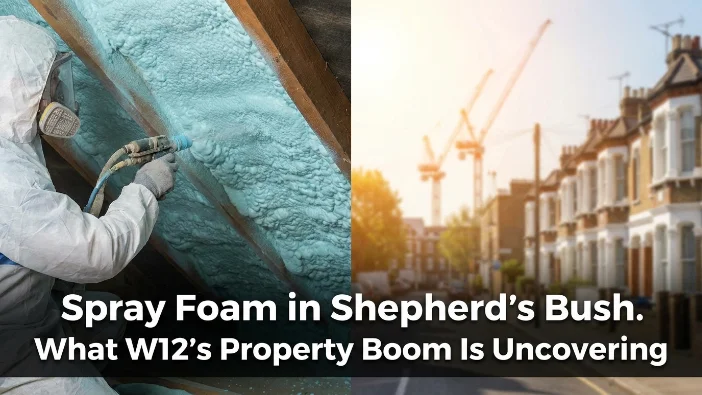
You have spray foam insulation in your loft. You have heard it might be a problem for your mortgage. But nobody told you there was a one in three chance that foam is hiding something far more serious underneath.
In May 2025, the Property Care Association published the results of the most comprehensive independent survey of spray foam properties ever carried out in the UK. Fifteen registered surveyors submitted findings from more than 500 property inspections. The results stopped the industry in its tracks.
Thirty-five percent of those homes had a hidden defect caused by the spray foam. And in more than a quarter of those cases, the damage was severe enough that surveyors recommended either replacing the insulation in full or replacing the entire roof.
This is not an estimate. It is not a worst-case scenario. It is what trained, independent surveyors found when they got into the lofts of real UK homes and looked properly.
What the PCA Survey Actually Found
The Property Care Association is the UK’s leading trade body for property care professionals. In January 2024, it established a register of qualified spray foam surveyors and began collecting independent findings from inspections across the country. By May 2025, fifteen of the twenty-one registered companies had submitted their results, covering more than 500 properties.
The headline figures are as follows.
In 79% of properties inspected, surveyors identified at least one divergence from the PCA’s Sprayed Foam Inspection Protocol. This means the foam had not been installed to the expected technical standard in four out of every five homes examined.
In 35% of properties, surveyors identified at least one actual defect caused by the spray foam installation. This is not a minor discrepancy from a checklist. This is damage to the property caused by the foam being present.
In 27% of cases, surveyors recommended major works. Either the spray foam itself needed to be removed in full, the roof structure required substantial repair, or in the most serious cases the roof needed to be replaced entirely.
Sarah Garry, Chief Executive of the PCA, stated that this survey is, as far as the PCA is aware, the only type of independent questioning on this topic to have happened in the UK to date. The scale of the findings prompted the PCA and the HomeOwners Alliance to write jointly to the Minister for Energy Consumers and the Parliamentary Under Secretary for Housing, urging government intervention on behalf of affected homeowners.
What These Defects Actually Look Like
The defects surveyors found across those 500 properties fall into consistent categories. Understanding what they are matters because most of them are invisible from inside the home until the foam is removed.
Timber rot and decay. Spray foam removes the natural ventilation that keeps roof timbers dry. Moisture builds up against the timber surface behind the foam. Over months and years, that moisture causes rot. The foam covers it completely. It looks fine from inside the loft. It is not fine underneath.
Condensation damage. A sealed foam layer creates the conditions for condensation to form at the interface between the foam and the roof structure. This condensation is persistent and concentrated. It does not dry out the way moisture in a ventilated loft would. It sits against timber and fixings continuously.
Corrosion of metal components. Roof structures contain metal fixings, clips, straps, and in some cases structural metal members. Persistent moisture accelerates corrosion. Corroded fixings compromise the structural integrity of the roof in ways that are again invisible until the foam is cleared.
Inadequate or blocked ventilation. Spray foam applied without correct attention to eaves ventilation can block the airflow paths that BS 5250 requires for a healthy roof structure. Once blocked, moisture accumulates across the entire roof space rather than being drawn out.
Incorrect foam application. In a significant number of the inspected properties, the foam had been applied over existing damaged felt, over timber that already showed signs of moisture, or in ways that did not match the product’s installation specification. Problems that existed before the foam was applied are now sealed behind it with no possibility of inspection.
Why 250,000 UK Homeowners Need to Take This Seriously
Around 250,000 UK homes have spray foam insulation. The PCA survey covered 500 of them. If the 35% defect rate holds across the full 250,000, that represents approximately 87,500 UK homes with a defect caused by spray foam that the owner may have no idea exists.
Many of those homeowners are not currently trying to sell or remortgage. They are living in their properties, not thinking about the loft, and unaware that moisture is working on their roof structure behind a layer of foam. The defect is not creating any visible symptom inside the home. It is simply getting worse.
Paula Higgins, Chief Executive of the HomeOwners Alliance, described the situation as getting worse, not better, and stated that many of those most affected are elderly and vulnerable homeowners who were encouraged by government grants to install the product in the first place.
You can read the full consumer guidance produced jointly by the PCA, the Residential Property Surveyors Association, the Insulation Manufacturers Association, and Bangor University at the PCA spray foam consumer guide. It sets out concerns and practical options for homeowners who already have spray foam installed.
What the 27% Roof Replacement Recommendation Actually Means
The most serious finding in the PCA survey is the 27% major works figure. One in four properties where a defect was found required either full foam removal or complete roof replacement.
Roof replacement is not a minor cost. Depending on property size, roof complexity, and material choice, a full roof replacement on a standard UK terraced or semi-detached property typically costs between £5,000 and £15,000. For larger detached homes or properties with complex roof structures, the cost can be significantly higher.
This is the hidden financial risk that spray foam creates beyond the mortgage problem. A zero valuation from a lender is painful. Discovering after removal that the roof timbers are so badly damaged that the entire structure needs replacing is a different order of problem entirely.
The critical point is timing. Timber damage that requires a limited repair today becomes structural damage that requires full rafter replacement in two years if left in place. The foam does not stop the damage from progressing. It covers it and continues trapping the moisture that drives it forward.
A free online estimate for your specific property takes about two minutes and gives you the removal cost before any decision is made. For many homeowners, knowing that figure is the starting point for deciding whether to address the problem now or wait until a transaction forces the issue.
What the PCA Protocol Means for Removal
The PCA published its Sprayed Foam Inspection Protocol in March 2023, giving surveyors a standardised framework for assessing spray foam in pitched roofs. The protocol covers foam type identification, coverage assessment, ventilation evaluation, timber condition assessment where accessible, and documentation requirements.
The same protocol informs what a lender-compliant post-removal certificate needs to contain. When spray foam is professionally removed by accredited specialists, the post-removal inspection follows the same protocol framework. The certificate confirms that all foam is cleared, timbers have been fully inspected and their condition documented, ventilation meets BS 5250 requirements, and any damage found has been addressed.
This is the document that reverses a zero valuation and restores full mortgage eligibility. It is not produced by every removal company. It is produced by those working to the standards that mortgage valuation panels actually require.
What to Do if You Have Spray Foam in Your Home
If your property has spray foam insulation, the PCA survey results suggest a meaningful probability that a defect exists underneath it that you cannot see. That probability increases with the age of the foam and the coastal or high-humidity exposure of the property.
The options available to you are the same regardless of the survey findings. You can arrange a specialist spray foam survey to assess the foam type, coverage, and visible timber condition before any removal is agreed. You can arrange professional removal and receive a full post-removal report covering timber condition and lender requirements. Or you can wait until a sale, remortgage, or equity release application forces the issue.
The PCA survey data suggests that waiting until a transaction forces the issue carries a higher risk of discovering major works requirements under time pressure than addressing it now.
Our spray foam survey and removal service follows the PCA Inspection Protocol and produces post-removal documentation that meets mortgage lender and equity release provider requirements as standard.
Frequently Asked Questions
Does a 35% defect rate mean my home definitely has a problem?
No. It means that across 500 independently inspected properties, 35% had a defect. Your specific property may or may not be among them. The only way to know is a specialist survey that can assess the foam type, installation quality, and visible timber condition.
What is the most common defect found in the PCA survey?
Timber moisture damage, condensation effects, and inadequate ventilation were the most consistently reported categories. In 27% of cases, the damage was severe enough to require major works including full foam removal or roof replacement.
Does the PCA survey mean removal is always necessary?
Not always. The PCA’s own consumer guidance states that spray foam may not require removal where the risk is low or where other remedial measures are more appropriate. A specialist independent survey gives you the information needed to make that assessment for your specific property.
Can I arrange an independent survey before committing to removal?
Yes, and in many cases this is the recommended first step, particularly for older installations where timber damage is a realistic concern. An independent assessment gives you a clear picture before any removal cost is committed.
What happens if major timber damage is found during removal?
Any damage discovered is discussed and documented before additional work is agreed. You will not face unexpected costs without your approval. The extent of any repair needed is assessed once the foam is cleared and the full timber structure is visible.
The Survey Said One in Three. Make Sure You Know Which Side You Are On.
The PCA’s findings are the clearest independent evidence yet of what spray foam does to UK homes over time. The defect rate is not a worst case. It is what independent surveyors found in real properties across the country.
For homeowners with spray foam, the question is straightforward. Would you rather find out now, under your own terms, or during a transaction when time is short and options are limited?