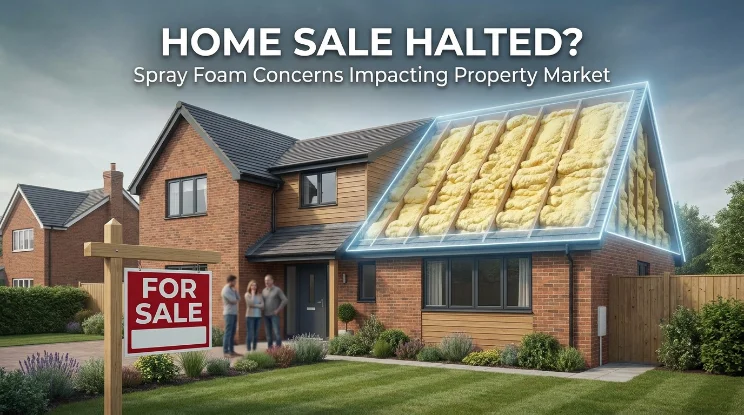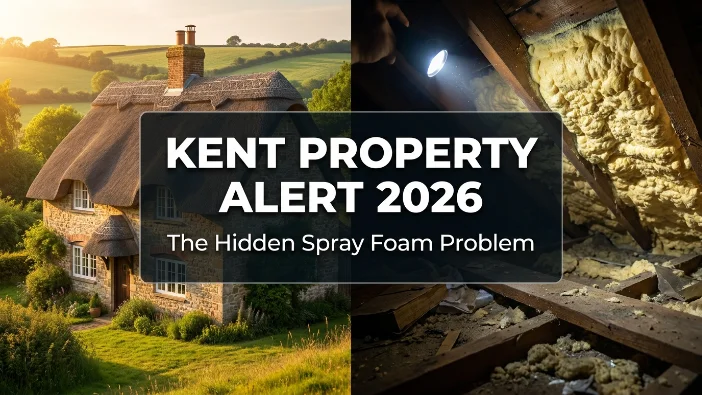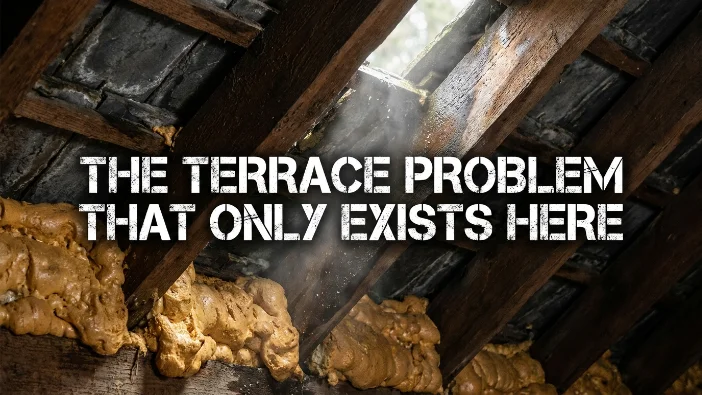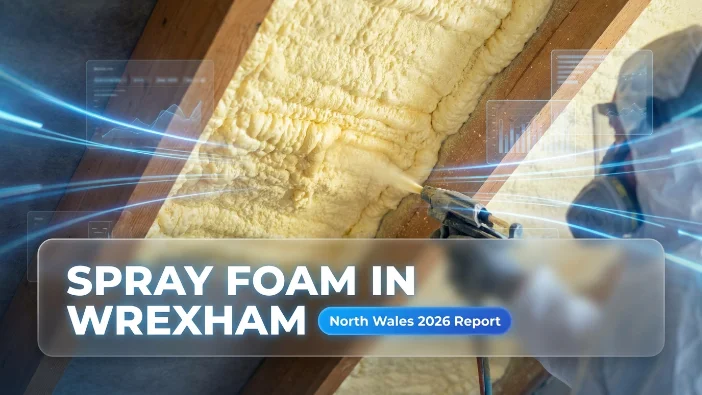
The property had been on the market for four months. A buyer came in with an offer. The survey was instructed. The report flagged spray foam in the loft.
The buyer’s lender paused the application. Three weeks later, the buyer found another property. The Wrexham seller went back to square one.
This sequence is not unusual here. Properties in Wrexham already take an average of 179 days to sell, with 5.9 months of inventory on the market. Spray foam discovered on survey does not just delay a transaction that was already moving slowly. It derails it. And in a market where asking prices have fallen 1.7% in the past six months and buyers have genuine choice, a seller with an unresolved foam problem is in a weaker position than they may realise.
Why Wrexham Has This Problem
Wrexham is the largest town in North Wales and the principal urban centre of northeast Wales. Its history is one of industrial growth and contraction. The north Wales coalfield, which stretches across the LL11 to LL14 postcodes and into the surrounding villages, generated the terrace rows and colliery housing that still define much of the town’s residential character today.
Victorian and Edwardian terraces were built rapidly across Wrexham and the surrounding former mining villages to house workers from the collieries at Bersham, Hafod, Llay, and Gresford, and from the ironworks and steel plants that operated across the Dee Valley corridor. Rhosllannerchrugog, known locally as Rhos, was once described as the largest village in Wales on the strength of its mining population. Cefn Mawr, Ruabon, Johnstown, and Chirk all carry the dense terrace stock of industrial-era North Wales.
That same terrace stock was targeted by government energy efficiency schemes during the 2000s and early 2010s. The Welsh Housing Monitor confirms that ECO4 was actively running in Wrexham until March 2026, with the Energy Company Obligation funding insulation improvements for lower-income households across exactly the kind of older, lower-EPC-rated terrace stock that dominates the LL postcodes. Spray foam was among the measures applied, and the homeowners who accepted it were not told what it would mean for their mortgage options when they came to sell.
The 179-Day Market Problem
Wrexham is not a fast-moving property market. The average time to sell is 179 days, with 5.9 months of inventory available to buyers at any given time. That means buyers have choice and time. They are not competing in a tight market where decisions are made in days.
In a market structured this way, a spray foam discovery on survey gives a buyer every reason to walk away rather than wait. The alternative property they viewed last month is probably still available. The one they will view next week will also be available. There is no urgency forcing them to stay with a complicated purchase when straightforward alternatives exist.
For Wrexham sellers, this market structure makes spray foam more dangerous than it would be in a fast-moving urban market where buyers have fewer choices. A buyer who finds foam on a survey in London or Cardiff has to weigh up whether to walk away from a market with limited supply. A buyer who finds foam in Wrexham with 5.9 months of supply on the market has almost no reason to wait.
Our spray foam removal Wales team covers the full Wrexham area and treats every instruction as time-sensitive precisely because of this market dynamic.
What the Lender Does When Spray Foam Is Found
The mechanism is the same in Wrexham as it is anywhere in the UK. The surveyor cannot inspect the roof timbers because the foam covers them. They cannot confirm structural condition. The lender cannot proceed.
According to the RICS spray foam consumer guide, spray foam creates a genuine structural inspection limitation that cannot be resolved by reassurance or supplementary paperwork while the foam remains in place. Over 90% of UK mortgage lenders will either decline or pause applications on spray foam properties. This includes Principality Building Society, one of the most significant lenders in North Wales, which operates an outright refusal policy on spray foam properties.
For first-time buyers targeting Wrexham’s most affordable terraces, a declined mortgage application produces a collapsed purchase and a return to saving and searching. For sellers, it produces a relisting into a market where the foam problem is now disclosed and where buyers who search the property history will see the previous sale fell through.
The Former Mining Village Dimension
Wrexham’s spray foam concentration is not limited to the town centre. The former mining villages that ring the town carry the same industrial-era terrace stock and the same ECO scheme foam installation history.
Rhosllannerchrugog (LL14) retains the dense terrace rows built for its mining population and is one of the most consistently affected areas for spray foam in North Wales. The close-knit rows of two-storey terraces here were targeted by ECO scheme contractors in large numbers and survey flags in Rhos property transactions are a regular feature of the local market.
Cefn Mawr and Acrefair (LL14) sit along the Dee Valley and include terrace stock built for both mining and ironworks families. The Pontcysyllte Aqueduct UNESCO World Heritage Site sits adjacent to this area, bringing visitor and second-home interest to a housing stock that also carries spray foam from the scheme period.
Ruabon (LL14) has Victorian terrace rows that were built for workers at the Wynnstay Colliery and the Ruabon brickworks. These properties are among the older terrace stock in the Wrexham area and carry a higher timber age risk in the context of foam-related moisture damage than newer post-war stock.
Johnstown and Rhostyllen (LL14) are residential communities on the southern edge of Wrexham town with a high density of post-war and interwar semis alongside older terrace stock. Both were covered by ECO scheme activity and spray foam discovery in transactions here is consistent with the wider Wrexham pattern.
Wrexham town centre (LL11, LL12, LL13) includes the older Victorian terrace streets around the town centre itself, along with post-war housing estates on the town’s edges. The Victorian streets carry the highest concentration of spray foam from the scheme period. Post-war estates carry lower but not negligible risk depending on the specific scheme activity in each area.
The Right to Buy Story in Wrexham
A significant number of Wrexham’s terrace properties were social housing stock managed by Wrexham County Borough Council and registered social landlords including Tai Calon and Clwyd Alyn Housing Association. Many of these properties were sold under Right to Buy during the 1980s and 1990s.
Insulation improvements were applied to properties in this stock during the ECO scheme period, often when they were still social housing tenancies. The new Right to Buy owners inherited the foam without being party to the insulation decision and without documentation that would meet current lender requirements.
These homeowners, many of whom are now approaching retirement and considering selling or accessing equity, are discovering that foam installed on their home by a social landlord is now blocking the financial options they planned around.
What Removal Costs for a Wrexham Property
Most affected properties in Wrexham and the surrounding former mining villages are Victorian terraces or post-war semis with standard pitched roofs. These are straightforward to access and typically take one to two days to clear.
| Property Type | Typical Cost Range |
|---|---|
| Terraced house | £2,800 to £4,000 |
| Semi-detached house | £3,200 to £4,800 |
| Detached house | £3,500 to £5,500+ |
Closed-cell foam adds approximately £500 to these figures. Timber repairs found during removal are assessed and agreed separately before any additional work begins.
In the context of Wrexham’s market, where the average house price is £191,168 and detached homes average £365,013, the removal cost represents a small but meaningful proportion of the sale price. Getting the figure for your specific property before any negotiation is the move that keeps you informed.
Getting a cost figure for your specific Wrexham property starts with a free online estimate that takes about two minutes, requires no phone call, and comes with no obligation.
Frequently Asked Questions
How do I know if my Wrexham home has spray foam?
Open your loft hatch and look at the underside of the roof timbers. Spray foam appears as a thick layer, typically cream or yellow, bonded directly to the wood. If the timber surface is not visible, spray foam is present. A specialist survey will confirm the type and coverage before any removal is agreed.
Does Principality Building Society accept spray foam properties in Wrexham?
No. Principality Building Society operates an outright refusal policy on spray foam properties and is one of the most significant lenders across North Wales. This means a Principality-backed buyer cannot proceed on a spray foam property regardless of the agreed price or the buyer’s financial profile.
Can I sell my Wrexham home without removing the foam?
You can attempt to, but most buyers in Wrexham rely on standard mortgage finance and most lenders will not proceed on a spray foam property. In a market with 5.9 months of inventory and 179-day average selling times, a buyer who finds foam on survey has every practical reason to move to a competing property rather than wait. Most Wrexham sellers who try this route end up removing the foam anyway, under more time pressure and at greater overall cost.
Does this service cover Rhosllannerchrugog, Cefn Mawr, and the surrounding villages?
Yes. The full LL11, LL12, LL13, and LL14 postcode areas are covered, including Wrexham town, Rhosllannerchrugog, Cefn Mawr, Ruabon, Johnstown, Chirk, and all surrounding North Wales areas.
How quickly can removal be arranged in Wrexham?
Removal can typically be arranged and completed within a week when a transaction is at risk. Getting your estimate in place as soon as a survey flags foam gives you the best chance of resolving the issue before a buyer makes the decision to withdraw.
179 Days Is Already a Long Time to Wait. Spray Foam Makes It Longer.
The Wrexham property market does not reward delay. Properties already spend an average of six months finding a buyer. A spray foam discovery that adds weeks or months to that timeline, or loses a buyer entirely, is a cost that compounds in a market already testing seller patience.