One in every 29 properties in Wandsworth changed hands in the past twelve months. That makes it the most active property market in London right now, ahead of every other borough in the capital.
In a market moving at that pace, a spray foam survey flag does not just delay a sale. It threatens to lose the buyer entirely. In Wandsworth, where Victorian terraces in Clapham are changing hands at a typical price of £1,175,000 and Brixton recorded 500 transactions in ten months alone, the financial consequence of a stalled transaction is as severe as anywhere in the country outside prime central London.
This guide covers why Wandsworth’s most traded streets carry significant spray foam risk, which areas are most affected, and what to do the moment a survey flags it.
Why Wandsworth Is London’s Highest-Stakes Spray Foam Market Right Now
The transaction data for summer 2026 is unambiguous. Wandsworth, Lambeth, and Bromley are the three most active housing markets across all 33 London boroughs, with Wandsworth leading on the key metric of properties changing hands relative to total stock.
Within Wandsworth, the activity is concentrated in specific areas. Brixton recorded 500 transactions in the ten months to February 2026. Clapham recorded 360 sales in the same period. These are not modest numbers for inner London streets. They reflect genuine, sustained buyer demand for the Victorian and Edwardian terrace stock that defines both areas.
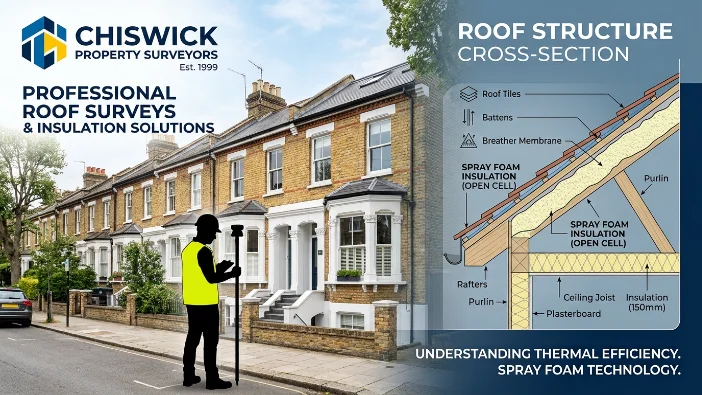
That same Victorian and Edwardian terrace stock is exactly the property type most likely to carry spray foam insulation from government energy efficiency schemes of the 2000s and early 2010s. The combination of the highest transaction volume in London and the highest spray foam risk property type in a single borough creates a specific and urgent problem for Wandsworth homeowners and buyers in 2026. Our spray foam removal London team covers the full SW postcode belt and treats every Wandsworth call as time-critical from the first contact.
What the Survey Finds and What the Lender Does Next
When a mortgage surveyor opens the loft hatch on a Wandsworth Victorian terrace and finds spray foam, the report that goes back to the lender carries a material inspection limitation. The foam covers the roof timbers completely. The condition of the timber underneath cannot be confirmed. The lender cannot proceed on that basis.
According to the RICS spray foam consumer guide, spray foam creates a genuine structural inspection limitation that cannot be resolved by reassurance or additional documentation while the foam remains in place. Over 90% of UK mortgage lenders will either decline or pause applications on spray foam properties. TSB and Skipton Building Society moved to outright refusal in 2026. Halifax and Barclays apply restrictions consistently across all London property types including Wandsworth’s Victorian terraces.
For a buyer who has offered £1,175,000 on a Clapham terrace or £549,000 on a Brixton property, a declined mortgage application does not produce a slight delay. It produces a decision point. The buyer either waits for the seller to resolve the foam or moves on to one of the many competing properties Wandsworth’s active market offers. In a borough where 1 in 29 properties is changing hands, the alternatives are there.
The Wandsworth Streets Where Spray Foam Is Most Commonly Found
Brixton (SW2, SW9) sits on the boundary between Lambeth and Wandsworth and its Victorian terrace rows are among the most consistently affected in south London. The dense streets between Acre Lane, Effra Road, and Coldharbour Lane carry Edwardian and Victorian terraces that were targeted heavily by energy scheme contractors during the 2000s. With 500 transactions in ten months and a typical sale price of £549,000, spray foam discovered here has a direct and immediate financial consequence. The area average of £665,576 reflects the premium that well-presented Brixton terraces command, a premium that evaporates the moment foam is found on survey.
Clapham (SW4, SW11) carries the highest typical property price of any area covered by the south west London market data. Victorian terraces here recorded 87 transactions at a typical price of £1,175,000 in the ten months to February 2026. A spray foam flag on a Clapham terrace at that price point creates financial urgency that is quantitatively different from almost anywhere else in the UK. The Victorian streets around Clapham Common, Abbeville Road, and the Old Town carry high ECO scheme foam concentration from the 2000s and early 2010s.
Tooting (SW17) has dense Victorian terrace stock across both Tooting Broadway and Tooting Bec. The streets running between the two tube lines carry some of the highest-density ECO scheme foam installation in south London, reflecting both the age of the housing stock and the fuel poverty rates in the area at the time the schemes ran. Tooting’s strong buyer demand from young professionals priced out of Clapham and Balham means transactions here are brisk and buyers do not wait.
Balham (SW12) bridges the gap between Clapham’s premium market and Tooting’s more affordable offer. Victorian semis and terraces on the streets around Balham High Road were included in energy scheme activity, and survey flags here have increased as more of this stock changes hands from original or long-term owners who have lived in properties since the scheme period.
Battersea and Nine Elms (SW8, SW11) include a mix of Victorian terraces in the older Battersea streets and newer development around the Nine Elms regeneration zone. The older Battersea terraces west of Clapham Junction carry comparable spray foam risk to Clapham and Brixton. The newer Nine Elms development is not at risk, but buyers who have viewed properties across both areas should be clear on which category their target property falls into.
Tooting Bec and Streatham border (SW16) extend the Victorian terrace belt southward into streets where spray foam installation during energy scheme periods was widespread. Properties here sit at price points accessible to first-time buyers stretching for south London entry points, making a refused mortgage application particularly damaging for a buyer who has few alternatives at that budget.
Why Clapham Specifically Has More to Lose
The Clapham terrace market represents the highest concentration of financial risk from spray foam of any single area in south London. With 87 terrace transactions at a typical price of £1,175,000 and an area average of £1.4 million when premium completions are included, the numbers involved in a stalled Clapham sale are exceptional.
A buyer financing 80% of a £1,175,000 Clapham terrace is borrowing £940,000. At the lending levels involved in a transaction of this scale, mortgage providers apply scrutiny to every aspect of the valuation. A spray foam flag does not produce a polite pause and a request for more information. It produces a declined application at a level of lending that no mainstream lender will approve on a property with an unresolved inspection limitation.
The sellers of these properties are typically experienced London homeowners who have lived in the terrace for years, seen significant value appreciation, and are expecting a clean, professional transaction. A spray foam discovery mid-sale disrupts that expectation at the worst possible moment. Resolving it quickly and professionally is the only route that keeps the sale on track.
What Removal Costs for a Wandsworth Property
Most affected properties in Brixton, Tooting, and Balham are Victorian terraces with standard pitched roofs. Clapham’s Victorian stock includes larger terraces and occasional semi-detached properties with more substantial roof spaces.
| Property Type | Typical Cost Range |
|---|---|
| Victorian terrace (Brixton, Tooting, Balham) | £3,500 to £5,500 |
| Larger Victorian terrace (Clapham, Battersea) | £4,500 to £7,000+ |
| Converted flat with shared roof | £3,000 to £5,000 per unit |
London access complexity, parking restrictions, and conservation area requirements in parts of Clapham and Battersea may affect the total cost. These factors are identified and discussed before any work is agreed.
Getting an accurate cost for your specific Wandsworth property starts with a free online estimate that takes about two minutes, requires no phone call, and comes with no obligation.
Frequently Asked Questions
Is Wandsworth’s spray foam problem worse than other London boroughs?
In terms of the financial consequence of a discovery, yes. The combination of the highest transaction volume in London and some of the highest Victorian terrace prices in south London means that spray foam discovered during a Wandsworth sale carries more financial risk than the same issue in most other boroughs.
How quickly can removal be arranged for a live Wandsworth transaction?
When a sale is under offer and at risk, removal can often be arranged and completed within a week. In a market where 1 in 29 properties is actively changing hands, a buyer who loses confidence in a stalled sale has immediate access to alternatives. Acting on the day a survey flags spray foam is the move that keeps a live deal intact.
Does this cover converted flats in Brixton and Clapham?
Yes. Converted Victorian terraces with shared roof structures are covered across the full SW postcode area. Removal from a shared roof requires coordination between flat owners and the freeholder or managing agent, which accredited London specialists manage as standard.
Does this service cover the full Wandsworth and SW postcode area?
Yes. The full SW2, SW4, SW8, SW9, SW11, SW12, SW17, and SW18 postcode areas are covered, including Brixton, Clapham, Tooting, Balham, Battersea, and all surrounding streets.
London’s Most Active Market Does Not Wait for Foam to Be Resolved
The pace that makes Wandsworth London’s most active borough in 2026 is the same pace that makes spray foam so dangerous here. Buyers move on. Competing properties appear. A buyer who is waiting for a foam issue to be resolved in a market with this level of activity will not wait indefinitely.
Acting immediately when a survey flags spray foam is what keeps a Wandsworth sale alive.