Every other county in England solved its back-to-back problem decades ago. Birmingham demolished them. Manchester cleared them. Sheffield replaced them.
West Yorkshire kept them. And improved them. And then insulated them with spray foam.
That decision, made with good intentions during the energy efficiency schemes of the 2000s and early 2010s, is now creating a mortgage problem that is specific to West Yorkshire in a way that no other county in England has to deal with at the same scale. The back-to-back terrace with spray foam in the loft is not a universal problem. It is a West Yorkshire problem.
What a Back-to-Back Actually Is
A back-to-back terrace is a house that shares its rear wall with the property directly behind it. There are no back gardens between the two rows. The back wall of one house is the back wall of the house in the street behind. Windows and doors exist only on the front, and in some cases one side, of the property.
The design originated in West Yorkshire in the late eighteenth century. The Bradford Historical Society records back-to-back cottages being built in Leeds as early as 1787. The housing form spread rapidly through the textile mill towns and valleys of West Yorkshire as the wool, worsted, and textile industries drove explosive population growth through the nineteenth century. Leeds, Bradford, Huddersfield, Halifax, Dewsbury, and Batley all built back-to-backs at scale to house the workers of the mills that defined the industrial era.
By 1900, Leeds had more back-to-back houses than any other city in England. As the twentieth century progressed, the rest of England pulled them down. In Leeds they were renovated. In Bradford they were retained. In Huddersfield, Dewsbury, and Batley the rows survive intact. Today, West Yorkshire contains more surviving back-to-back houses than anywhere else in the country, and they represent a meaningful proportion of the housing stock in the inner areas of every major West Yorkshire city and town.
Why Back-to-Backs Became Spray Foam Targets
Back-to-back houses have structural characteristics that make them highly energy-inefficient by modern standards. Three of the four external walls are shared with the adjacent houses to either side and the house directly behind. This limits the surfaces available for insulation and makes cavity wall insulation impossible in the traditional form.
Roof insulation was one of the few practical routes to improving the energy performance of a West Yorkshire back-to-back, and spray foam was promoted during the ECO scheme and Warm Front programme as a fast and effective solution. Government-backed contractors could move through entire back-to-back rows applying foam to the underside of roof timbers at speed, and the density of back-to-backs in West Yorkshire’s inner areas made the economics highly efficient.
Leeds City Council’s TIBB project, the Transformation Insulation to Back-to-Back programme, insulated 750 council-owned back-to-back properties in five ward areas across Armley, Beeston and Holbeck, Burmantofts and Richmond Hill, Gipton and Harehills, and Hunslet and Riverside between 2022 and March 2023. A further scheme in Cedars, Armley, covering 100 back-to-back properties, followed in October 2024 at a cost of £4.4 million. These council-funded programmes applied external wall insulation and roof measures. Private and ECO scheme installations in the same streets used spray foam.
Our spray foam removal West Yorkshire team covers the full county and is one of the few teams in the UK with specific experience of the compact roof void access conditions that make back-to-back removal different from standard terrace work.
The Back-to-Back Roof Void Problem
This is what makes spray foam in a back-to-back different from spray foam in any other property type.
A standard Victorian terrace has a pitched roof with a full loft space. The surveyor can enter through a loft hatch, stand upright, walk the length of the roof, and inspect the timbers systematically. The removal team can access all areas of the foam from inside the loft space with appropriate equipment.
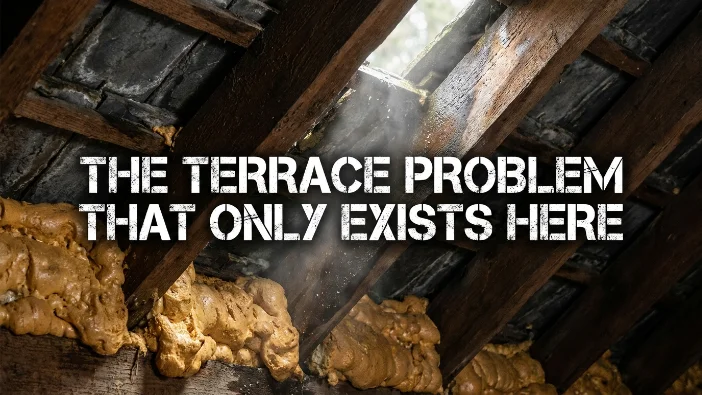
A back-to-back terrace has a much shallower roof structure. The back wall of the property forms part of the roof junction. The roof pitch is typically lower than in a standard terrace, and the available void space between the ceiling joists and the roof timbers is significantly smaller. In many back-to-backs, the loft space is too restricted to stand in. Inspection is carried out by torch and mirror through the hatch opening.
Spray foam applied to the underside of a back-to-back roof sits in a space that a surveyor cannot properly enter. They cannot confirm the condition of the timbers behind the foam. They cannot give the lender the assurance the lender requires.
According to the RICS spray foam consumer guide, spray foam creates a genuine structural inspection limitation that cannot be resolved while the foam remains in place. In a back-to-back, that limitation is compounded by the physical constraints of the roof space itself. The inspection problem is harder to resolve even after removal, because the confined space makes full timber assessment more difficult. Post-removal documentation for a back-to-back needs to confirm not just that the foam is gone but that the compact roof void has been fully inspected and that the specific structural characteristics of the back-to-back have been addressed in the certificate.
Where Back-to-Backs With Spray Foam Are Most Concentrated
Armley and Bramley (LS12, LS13) sit on the western edge of Leeds inner city and contain dense concentrations of back-to-back housing. The TIBB project and the Cedars Armley scheme both operated here, and private ECO scheme foam installations in the same streets are a consistent finding in survey reports. Spray foam discovery in Armley back-to-back transactions is among the most frequent in West Yorkshire.
Harehills and Gipton (LS8, LS9) have some of the highest fuel poverty rates in West Yorkshire, with ECO4 active across both areas. The combination of fuel poverty eligibility, high density of back-to-back housing, and active scheme coverage makes Harehills one of the most intensively foam-affected postcodes in Leeds.
Beeston and Hunslet (LS10, LS11) represent the southern inner city. Back-to-back rows here were included in both the TIBB project and private scheme activity. Spray foam in Beeston and Hunslet back-to-backs is a consistent survey finding in property transactions across LS10 and LS11.
Bradford inner city (BD1, BD3, BD4, BD5) has the largest concentration of surviving back-to-backs outside Leeds. Manningham, Lidget Green, Bowling, and Great Horton all carry dense back-to-back stock where ECO4 was actively used according to the Yorkshire eco homes data. Long-term owner-occupiers in Bradford’s inner city, many from the city’s established South Asian heritage community, are a consistent part of the equity release refusal pattern across BD postcodes.
Dewsbury, Batley, and the Heavy Woollen District (WF12, WF13, WF17) have their own distinct back-to-back character rooted in the wool scouring and dyeing industries. Spray foam in the back-to-back rows of Ravensthorpe, Thornhill, and the older Batley streets is found regularly during surveys in this part of West Yorkshire.
Halifax and the Calder Valley (HX1, HX2, HX3) sit in a geography that adds a moisture dimension to the back-to-back problem. Western areas of Calderdale receive notably higher rainfall than eastern West Yorkshire towns, and back-to-back properties in Halifax’s mill worker terrace streets are exposed to both the standard spray foam moisture trap and the elevated ambient humidity of the Calder Valley corridor.
The Removal Challenge in a Back-to-Back
Standard spray foam removal involves specialist technicians accessing the full roof space, working systematically across the foam coverage, and producing a post-removal report that a mortgage lender can rely on.
In a back-to-back, that process must be adapted for a roof void that in many cases cannot be entered fully. Removal techniques must be appropriate for confined space working. The equipment used must be suitable for low-headroom environments. And the post-removal report must specifically address the compact roof void conditions of the back-to-back, not simply produce the standard lender certificate format that was designed with full loft spaces in mind.
This is why choosing an accredited removal specialist with documented back-to-back experience matters more in West Yorkshire than anywhere else in the UK. A standard removal company experienced only in conventional loft spaces may not be equipped for the specific access conditions of a back-to-back, and a certificate produced without addressing those conditions may not satisfy the mortgage lender’s valuation panel.
What Removal Costs for a West Yorkshire Back-to-Back
The compact roof void and access complexity of a back-to-back terrace affects removal cost compared with a standard terrace of similar footprint.
| Property Type | Typical Cost Range |
|---|---|
| Back-to-back terrace (standard) | £2,800 to £4,500 |
| Back-to-back with very restricted roof void | £3,500 to £5,500 |
| Standard Victorian terrace (comparison) | £2,800 to £4,200 |
Closed-cell foam adds approximately £500 to these figures. Access complexity in confined roof voids occasionally adds further to the base cost, which is confirmed and agreed before any work begins.
Getting a cost figure for your specific West Yorkshire back-to-back starts with a free online estimate based on your property details. This takes about two minutes, requires no phone call, and comes with no obligation.
Frequently Asked Questions
Is spray foam removal from a back-to-back covered by standard removal companies?
Not always. Many removal companies are experienced only with standard loft spaces and have not worked in the confined roof void conditions of a back-to-back. The post-removal certificate for a back-to-back needs to address the specific structural characteristics of the property type. Always confirm that a potential removal company has documented back-to-back experience before agreeing any work.
Does the TIBB project insulation cause the same problem as spray foam?
The TIBB project applied external wall insulation rather than spray foam. External wall insulation does not create the same roof timber inspection limitation as spray foam. However, private ECO scheme spray foam installations in the same streets as TIBB properties are a separate and distinct problem affecting those specific properties.
Can a back-to-back with spray foam get a mortgage at all?
Not from any mainstream lender while the foam remains in place. The compact roof void that defines the back-to-back makes the inspection limitation more complete than in a standard terrace, because even what is visible of the roof structure is less accessible than in a property with a full loft space.
Does this service cover all West Yorkshire back-to-back areas?
Yes. Leeds, Bradford, Huddersfield, Halifax, Dewsbury, Batley, Wakefield, and all surrounding West Yorkshire areas are covered, including all LS, BD, WF, and HX postcodes.
How quickly can removal be arranged for a live West Yorkshire transaction?
Removal can typically be arranged and completed within a week when a transaction is at risk. Back-to-back jobs are planned carefully before work begins to ensure the confined access conditions are properly addressed and the post-removal documentation meets lender requirements.
The Problem Was Built Into the House in 1890. The Solution Is Available Now.
The West Yorkshire back-to-back has survived because it is a genuinely good housing form for the communities it was built to serve. It is dense, efficient, and remarkably resilient. The spray foam applied to it during the energy efficiency scheme era was not malicious. It was a reasonable response to a real problem.
The mortgage problem it has created is also real, and it requires a removal approach specific to the back-to-back rather than a standard loft removal job adapted for a confined space.