You found out your property has spray foam. Now you want to know exactly which lenders will refuse it and which ones, if any, will not.
This article gives you the full 2026 picture. Not a general warning. Not a vague caution. The actual lender positions, what changed this year, and what the only working solution looks like for homeowners who need their property to be mortgage-ready again.
Why 2026 Is Different From Every Year Before It
The spray foam mortgage problem is not new. Lenders have been cautious about spray foam properties since the early 2010s. What changed in 2025 and accelerated into 2026 is the speed and completeness of the policy hardening.
Before September 2025, some lenders would consider a property with spray foam if accompanied by an installer’s warranty or a specialist inspection report. That flexibility has largely disappeared. In November 2024, the BBC reported that a quarter of the UK’s biggest mortgage providers and all equity release lenders surveyed would not lend against homes with spray foam. By early 2026 that figure had grown further, with over 50 major lenders now known to restrict or refuse lending on spray foam properties outright.
The government acknowledged the scale of the problem in March 2026 when ministers met with the Property Care Association, the HomeOwners Alliance, Citizens Advice, and mortgage lenders to discuss the crisis. The House of Commons Library confirmed the discussions took place and noted that homeowners are increasingly facing mortgage restrictions due to spray foam insulation. No funded removal scheme was announced. The policy direction from lenders has continued to tighten.
The Full 2026 Lender List
Outright Refusal — These Lenders Will Not Proceed
Halifax will not lend on properties with spray foam applied to roof timbers or the underside of tiles. Applications are declined at valuation stage. Halifax accounts for roughly one in five UK mortgages, making this the single most impactful lender policy in the market. The bank will only reconsider once foam is professionally removed and the roof structure is certified as sound.
Nationwide will not lend on properties where spray foam has been applied directly to roof timbers. Their surveyors are instructed to flag it as a material concern and the application is declined.
Barclays rejects applications where spray foam is present in the roof space. Removal and certification are required before any application can be reconsidered.
NatWest and RBS apply a standard policy of declining spray foam properties. Both brands operate under the same parent group and apply the same criteria.
HSBC refuses lending where spray foam prevents adequate roof inspection. The inspection limitation is treated as an unacceptable risk to the lender’s security.
Santander will not proceed where spray foam is identified in a survey. The policy applies regardless of the age or type of foam present.
TSB implemented a complete ban on spray foam properties in 2026. This is one of the most absolute positions of any mainstream lender and was widely reported as a significant policy shift.
Skipton Building Society followed with an outright refusal policy, joining TSB as one of the lenders with the clearest and most unambiguous positions in 2026.
Virgin Money restricts lending on spray foam properties. Applications are declined pending removal.
Leeds Building Society will not lend on properties with spray foam applied to roof timbers.
Principality Building Society takes an outright refusal position. This particularly affects buyers and sellers in Wales, where Principality is one of the most significant regional lenders.
Equity Release — Every Provider Without Exception
No equity release providers in the UK will consider lending against a property with retrofit spray foam insulation. Spray foam must be removed before any application and valuation can proceed. This applies to Aviva, Legal and General, Pure Retirement, Canada Life, and every other equity release provider operating in the UK market. There are no exceptions.
Conditional Lenders — Proceed With Caution
A very small number of specialist lenders may consider spray foam properties under specific conditions. These conditions typically include a detailed surveyor report on the foam installation, confirmation that timbers are accessible for some level of inspection, and an agreement to remove the foam within a defined period. Even if you find a lender willing to proceed, your future buyer will face the same restriction when you eventually sell. Most homeowners in this situation remove the foam anyway, usually under more time pressure and at greater overall cost.
Specialist lending rates are also significantly higher than standard products. The premium paid over a standard five-year fixed rate across a mortgage term frequently exceeds the one-off cost of professional removal, which means specialist lending is rarely the financially sensible route even when it is technically available.
What Changed Specifically in 2026
Three things shifted noticeably in 2026 compared with previous years.
TSB and Skipton moved to outright bans. In previous years, both lenders had cautious rather than absolute policies. The 2026 update removed the ambiguity entirely. If your property has spray foam and you want a TSB or Skipton mortgage, that conversation is over until the foam is gone.
Surveyors began classifying spray foam as non-standard construction risk. In 2026, mortgage lenders are paying even closer attention to spray foam insulation and surveyors are increasingly classifying it as a non-standard construction risk, which requires additional checks before mortgages can be approved. This classification change means that even lenders without an explicit spray foam policy are now declining more applications than they did in previous years because the surveyor’s classification triggers automatic referral or refusal at the underwriting stage.
The government confirmed no removal funding. The government confirmed in early 2026 that it will not fund spray foam removal even for homeowners who had foam installed under a government-backed scheme. This removed any remaining expectation that a funded solution was coming and pushed homeowners toward self-funded removal as the only practical route.
Why Every Lender Has the Same Underlying Reason
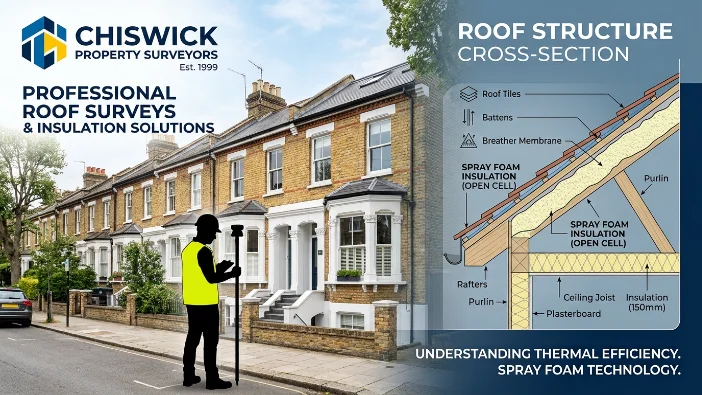
The specific policies differ between lenders but the underlying reason is identical across all of them. Spray foam covers roof timbers completely. A surveyor cannot see what is underneath it. They cannot confirm the structural condition of what they cannot inspect. Without that confirmation, no lender can treat the property as adequate security for a mortgage.
According to the House of Commons Library research briefing on spray foam and mortgages, the HomeOwners Alliance has explained that because spray foam covers a roof’s structure, surveyors appointed by mortgage lenders find it difficult or impossible to inspect the condition of individual roofs and identify risks. This is the inspection problem that underlies every lender policy on this list, regardless of how each lender has chosen to frame their individual position.
The Only Thing That Restores Full Lender Eligibility
There is one route that works across every lender on the list above. Professional removal of all spray foam, carried out by accredited specialists, followed by a lender-compliant post-removal certificate.
Once the foam is removed and the certificate is in place, the surveyor can return. The roof timbers are fully visible and inspectable. The structural condition can be confirmed. The lender receives the assurance they need and the application can proceed on standard terms.
The certificate must come from an accredited contractor. A certificate from an unaccredited company, or a DIY removal attempt, will not satisfy a lender’s valuation panel. If foam residue remains on the timbers after a poor removal, a surveyor with a borescope will identify it and the zero valuation or refusal will stand.
You can start by finding out what removal will cost for your specific property. A free online estimate based on your property details takes about two minutes, requires no phone call, and comes with no obligation.
What Happens After Removal
Most homeowners who arrange professional removal and receive a compliant certificate find that the lender they originally applied to will reconsider the application on standard terms. The follow-up valuation confirms the roof is now fully inspectable, the structural condition is documented, and the lender’s security concern is resolved.
The timeline from arranging removal to having a lender-ready certificate is typically one to two weeks for a standard property. Our spray foam removal service produces documentation that meets the specific requirements of mortgage valuation panels, covering all the elements lenders need to reinstate full eligibility.
Frequently Asked Questions
Does the lender list change frequently?
Yes. Lender policies on spray foam have been moving in one direction since 2021 and the pace of change accelerated in 2025 and 2026. The list above reflects positions as of mid-2026. Always confirm the current position with a whole-of-market mortgage broker before applying.
Will my current lender refuse to renew my mortgage because of spray foam?
When a fixed rate expires and you need to remortgage, your lender will instruct a new valuation. If spray foam is identified, most lenders will decline to offer a new product. This leaves many homeowners stuck on a standard variable rate, often paying significantly more per month than they would on a competitive fixed deal.
Can I just disclose the spray foam and accept a cash buyer?
You can, but cash buyers who will take on an undocumented spray foam property typically offer 25 to 40 percent below market value. The removal cost is almost always less than the discount a cash buyer will demand.
Will any high street lender consider spray foam in 2026?
In almost all cases, no. The direction of travel has been consistent tightening since 2021. The practical position in mid-2026 is that no mainstream high street lender will proceed on a spray foam property without removal and certification.
Does an improved EPC rating help with lenders?
No. Spray foam often improves a property’s EPC rating because it is thermally effective. But lenders assess mortgage eligibility based on the surveyor’s structural report, not the EPC. An improved EPC rating does not override the surveyor’s inspection limitation.
The List Is Getting Longer. The Solution Stays the Same.
The direction of travel in the UK mortgage market is consistent and has been for four years. Every update brings more lenders tightening their position, not relaxing it. The solution that works across every lender on the list has not changed either.
Professional removal. Compliant documentation. Full lender eligibility restored.