The average terraced house in Hammersmith and Fulham sells for £1,132,205. That figure, from the Land Registry index for April 2026, makes this borough the place in London where spray foam found on a mortgage survey carries the highest financial consequence of almost anywhere in the country.
A sale stopped by a spray foam flag in Fulham or Hammersmith is not a £300,000 problem. It is a seven-figure problem. And in a market where prices have already fallen 7.6% in the past year, losing a buyer because of foam that has been sitting in a Victorian loft since 2008 is a cost that compounds in ways most sellers do not calculate until it is too late.
Why Hammersmith and Fulham Has This Problem at All
The borough sits fifth in the London house price table with an average of £742,000 as of April 2026. It is known for its Victorian and Edwardian terrace stock, particularly the bay-fronted two-storey terraces south of the river in Fulham, Parsons Green, and Sands End, and the larger Edwardian properties around Ravenscourt Park and Brook Green to the north.
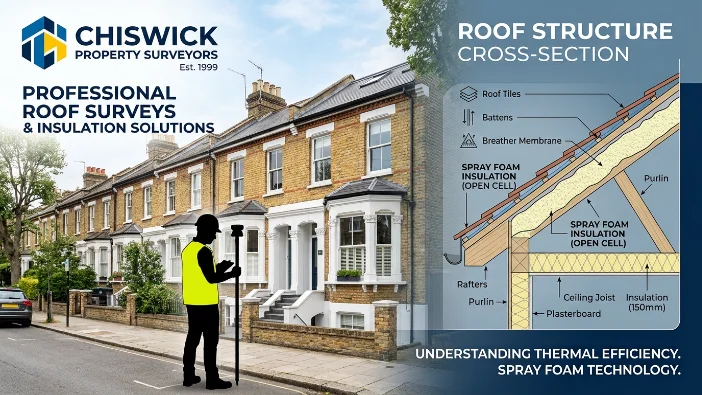
These are not cheap properties. They have not been cheap properties for a long time. But they share the same construction logic as every other Victorian and Edwardian terrace in London: naturally ventilated roof structures, cut rafter construction, and roof timbers designed to breathe and stay dry through airflow rather than through any sealed insulation layer.
When government energy efficiency schemes moved through London during the 2000s and early 2010s, the Warm Front programme and the ECO scheme targeted properties at EPC D to E ratings across the capital. In Hammersmith and Fulham, those properties included a significant number of Victorian terraces where tenants or owner-occupiers accepted insulation improvements without fully understanding what was being applied.
The result is spray foam in the lofts of properties that now carry seven-figure asking prices. Our spray foam removal West London team covers the full borough and sees this pattern in W6, W14, and SW6 transactions consistently throughout the year.
What the Lender Sees and Why the Market Makes It Worse
A surveyor instructed on a Fulham Victorian terrace opens the loft hatch and finds spray foam. The report goes back to the lender with a material inspection limitation. The timber cannot be seen. The structural condition cannot be confirmed. The lender declines or pauses the application.
According to the RICS spray foam consumer guide, spray foam insulation creates a genuine structural inspection limitation that cannot be resolved by reassurance, additional documentation, or installer warranties while the foam remains in place. Over 90% of UK mortgage lenders will either decline or pause applications on spray foam properties. At the lending levels typical of Hammersmith and Fulham transactions, where buyers are borrowing £700,000 or more in many cases, lenders apply the most thorough scrutiny in the market to any survey limitation.
The market context makes the consequences sharper. Prices in Hammersmith and Fulham have fallen 7.6% year-on-year, a steeper decline than the London average fall of 2.1%. SW6 Fulham has fallen 9.8% in the same period. Buyers in a falling market have leverage that they do not have when prices are rising. A spray foam discovery gives them additional leverage on top of the market position they already occupy. A seller who cannot resolve the foam quickly either accepts a reduced price or loses the buyer entirely and relists into a market that has been moving against them.
The Conservation Area Complication
Hammersmith and Fulham has 45 designated conservation areas and active Article 4 Directions restricting permitted development across many of the borough’s most sought-after streets. The Victorian and Edwardian terrace stock is heaviest in Fulham’s SW6 at 24.6% of total property type, and a significant proportion of those terraces sit within conservation areas.
This adds a dimension to spray foam removal in this borough that is not present in most other parts of the country. The removal of foam from inside the roof structure does not require planning permission. However, if any access works, scaffolding, or roof surface repairs are needed alongside the removal, these may require notification or consent under the specific conservation area conditions that apply to the property.
Accredited West London specialists familiar with Hammersmith and Fulham’s conservation framework are aware of these requirements and factor them into removal planning before work begins. An accredited company producing a lender-compliant post-removal certificate in a conservation area property understands that the documentation must address both the lender’s structural requirements and the planning authority’s heritage considerations.
Where Spray Foam Is Found Across the Borough
Fulham and Parsons Green (SW6) carry the highest concentration of Victorian terrace stock in the borough and the most consistent spray foam discovery rate. The bay-fronted terraces on the residential streets between the King’s Road and Fulham Broadway were among those targeted by energy scheme contractors working through SW6 during the 2000s. With average prices down 9.8% year-on-year, a seller who loses a buyer to a foam discovery in SW6 is relisting into one of the most challenging pricing environments in West London.
Hammersmith and Brook Green (W6) have Victorian and Edwardian terrace streets running north and south of the Hammersmith Road. The streets around Brook Green and the residential areas east of Ravenscourt Park carry period housing where ECO scheme activity took place. W6 is the highest-yielding postcode in the borough for buy-to-let at 4.9%, meaning a significant proportion of affected properties are landlord-owned and face remortgage complications alongside the sales market problem.
Barons Court and West Kensington (W14) sit at the eastern edge of the borough with good transport connections to central London. Victorian and Edwardian properties here are predominantly mansion blocks and period flats, where foam in a shared or communal roof structure creates the additional complication of coordinating removal across multiple units before any lender can proceed on any of them.
Shepherd’s Bush and White City (W12) sit on the northern edge of the borough boundary and include a mix of Victorian terraces and post-war housing. The White City regeneration zone has brought significant investment and buyer interest into properties adjacent to the new development, where older period housing in the same streets is now carrying spray foam foam from scheme activity into a market that has changed dramatically around it.
Sands End and Fulham Broadway (SW6) are among the most actively traded streets in the borough. The Victorian terraces and Edwardian conversions in this part of SW6 have a consistent pattern of spray foam discovery during surveys, and the brisk market here means buyers have plenty of competing properties available if a sale stalls.
The Converted Flat Complication in Hammersmith and Fulham
The borough’s housing stock is predominantly flats, not houses. Flats account for 67.2% of the stock in SW6 and 81.1% in W14. Most of those flats are conversions of Victorian and Edwardian period properties, where the original terrace has been divided into two, three, or four separate units.
Spray foam in a converted Hammersmith or Fulham terrace creates a specific and more complex problem than foam in a single-dwelling house. The foam sits in the shared roof space above all the converted flats in the building. A surveyor valuing any one of those flats will find the foam and flag it for the entire structure. The lender for that flat cannot proceed. But nor can any lender for any other flat in the same building until the foam is removed from the entire shared roof space.
This means one flat in a converted Fulham terrace with spray foam can block mortgage applications on every other flat in the building simultaneously. Coordinating removal in this situation requires engagement with the freeholder, the managing agent, and the leaseholders of all affected units. Accredited London specialists manage this coordination as standard, producing individual post-removal certificates for each flat in the building.
What Removal Costs for a Hammersmith and Fulham Property
Removal costs in this borough reflect both the property complexity and the access constraints typical of West London terrace streets with parking restrictions and conservation area conditions.
| Property Type | Typical Cost Range |
|---|---|
| Victorian terrace (single dwelling) | £3,800 to £6,000 |
| Converted flat (single unit, shared roof) | £3,200 to £5,000 per unit |
| Large Edwardian period home | £5,000 to £8,000+ |
Conservation area properties or those requiring coordination across multiple converted flats may carry additional costs. All such requirements are identified and discussed before any work is agreed.
Getting an accurate cost for your specific Hammersmith or Fulham property starts with a free online estimate that takes about two minutes, requires no phone call, and comes with no obligation.
Frequently Asked Questions
Does spray foam in a converted Fulham flat affect all flats in the building?
Yes. The foam sits in the shared roof space above all the flats. A surveyor valuing any single flat will find it and flag it for the whole structure. Removal must cover the entire shared roof space before any lender can proceed on any individual flat. Coordinated removal across all units is the only route that resolves the situation for every affected flat simultaneously.
Does conservation area status add cost to removal in Hammersmith and Fulham?
It can, depending on whether access works or roof surface repairs are needed alongside the removal. The removal of foam from inside the roof structure itself does not require planning permission. Accredited specialists familiar with the borough’s 45 conservation areas factor this into removal planning before any cost is committed.
How quickly can removal be arranged in SW6 or W6?
When a transaction is live and time-sensitive, removal can typically be arranged and completed within a week. Given the pace of buyer decision-making in a falling market, where buyers have leverage and alternatives, acting on the day a survey flags foam is the move that keeps a live sale intact.
Does this service cover all Hammersmith and Fulham postcodes?
Yes. The full W6, W12, W14, SW6, and SW10 postcode areas are covered, including Fulham, Parsons Green, Hammersmith, Brook Green, Barons Court, West Kensington, Sands End, and Shepherd’s Bush.
A Seven-Figure Problem With a Four-Figure Solution
The removal cost for a standard Hammersmith or Fulham Victorian terrace sits between £3,800 and £6,000. The terraced house it is sitting in transacts at an average of £1,132,205. The proportion of that value represented by the removal cost is under 0.5%.
The proportion of that value at risk from a buyer who walks away after a foam discovery is considerably larger.