If you own a property in Mansfield, Kirkby in Ashfield, or Sutton in Ashfield, your home is statistically more likely to contain spray foam insulation than almost anywhere else in Nottinghamshire. This article explains exactly why that is, what it means for your mortgage or property sale, and what resolves it.
Why These Three Towns Have the Highest Spray Foam Concentration in Nottinghamshire
The answer lies in the coal mining history of this part of Nottinghamshire.
Mansfield, Kirkby in Ashfield, and Sutton in Ashfield grew up as mining communities. The housing built across these towns through the 1940s, 1950s, 1960s, and 1970s was designed to house mining families and was owned and managed by collieries, housing associations, and local councils for generations.
When the Nottinghamshire coalfield contracted through the 1980s and 1990s, this housing stock passed to local authorities and housing associations who became responsible for maintaining large numbers of older properties across Mansfield, Kirkby in Ashfield, Sutton in Ashfield, Hucknall, Shirebrook, and the surrounding villages.
In the late 1990s and 2000s, these housing associations and councils took part in large-scale energy efficiency improvement programmes funded by central government. Spray foam insulation was one of the primary measures used. Contractors working across Mansfield, Kirkby in Ashfield, and Sutton in Ashfield installed spray foam into thousands of properties across these communities, often working street by street through former council and colliery estates.
Many homeowners who had purchased their properties through Right to Buy schemes received spray foam insulation without being consulted. Others received it without understanding what was being installed or what the long-term consequences would be for future mortgage applications and property sales.
The result is that a very high proportion of the post-war semi-detached and terraced housing stock across Mansfield, Kirkby in Ashfield, and Sutton in Ashfield now contains spray foam insulation in the roof space. And the homeowners who are now trying to sell or remortgage are running directly into lender refusals.
What Mortgage Lenders Are Doing in Mansfield and Kirkby in Ashfield
When a mortgage surveyor visits a property in Mansfield, Kirkby in Ashfield, or Sutton in Ashfield and identifies spray foam in the roof space, the outcome is consistent across all mainstream lenders.
Halifax, Nationwide, Barclays, NatWest, Santander, TSB, Skipton Building Society, and Leeds Building Society all flag or refuse spray foam properties. TSB has the strictest position of any mainstream lender and refuses outright regardless of foam type, age, or condition. Because these lenders cover the vast majority of mortgage applicants in Mansfield, Kirkby in Ashfield, and Sutton in Ashfield, a spray foam refusal effectively removes most buyers from the market for that property.
According to UK Parliament’s research on spray foam and mortgages, this problem continues to affect thousands of homeowners across the UK as more properties with spray foam come to market. In former mining communities like Mansfield, Kirkby in Ashfield, and Sutton in Ashfield, the concentration of affected properties means the problem is encountered far more frequently than in other parts of England.
Why Closed-Cell Foam in These Properties Creates the Biggest Problem
Not all spray foam creates the same level of lender concern, and the mining community housing stock across Mansfield, Kirkby in Ashfield, and Sutton in Ashfield has a specific characteristic that makes the problem more serious.
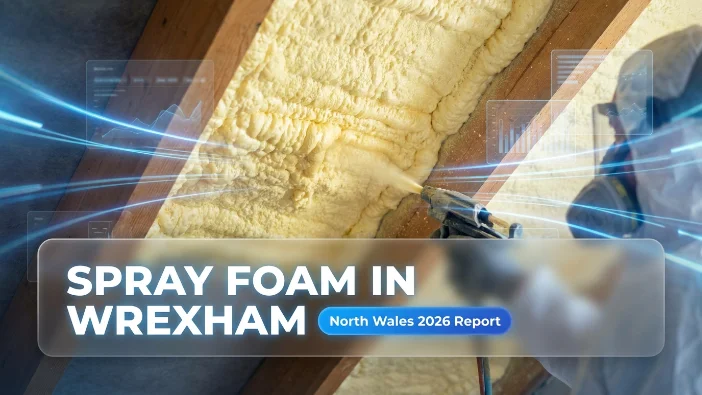
The foam installed through the housing association programmes of the 2000s across these towns was predominantly closed-cell spray foam. This type of foam is rigid, dense, and completely impermeable. It bonds directly to the roof timbers and tiles, creating a hard shell that completely covers the roof structure.
Closed-cell foam gives mortgage lenders greater concern than open-cell foam for a simple reason. Because it is completely impermeable, it creates a sealed environment around the roof timbers with no ventilation and no moisture escape route. Over time, any moisture present in the timber has no way out. The conditions for condensation, damp, and timber decay develop silently underneath the foam, invisible to any surveyor without physical removal.
This is why lenders refuse to proceed. They cannot see the condition of the timber structure that is securing their loan.
What This Means if You Are Trying to Sell in Mansfield, Kirkby in Ashfield or Sutton in Ashfield
If spray foam is present in your property and you are trying to sell, your buyer pool is significantly reduced. Any buyer using a mainstream mortgage lender will face a refusal once the surveyor reports the foam. You are effectively limited to cash buyers unless the foam is removed before sale.
Cash buyers who purchase spray foam properties in Mansfield, Kirkby in Ashfield, and Sutton in Ashfield know what they are buying. They price accordingly, typically offering well below the open market value to account for removal costs and risk.
Addressing the foam before listing puts your property back on the open market at full value. The difference between a cash buyer offer and an open market sale consistently exceeds the cost of professional removal by a significant margin.
What the Removal Process Involves for These Properties
Most of the affected housing stock in Mansfield, Kirkby in Ashfield, and Sutton in Ashfield is post-war semi-detached housing from the 1950s, 1960s, and 1970s. These properties have straightforward roof structures compared to Victorian or Edwardian period homes, which keeps removal times and costs manageable.
A standard three-bedroom semi-detached in Mansfield, Kirkby in Ashfield, or Sutton in Ashfield with closed-cell foam coverage is typically completed within one to two days. Because closed-cell foam bonds more rigidly to surfaces than open-cell foam, it requires specialist equipment and more careful extraction than softer foam types.
The survey confirms foam type, coverage area, moisture readings, and timber condition before any removal commitment is made. This means you know exactly what you are dealing with before any work begins. For full details of our survey and removal process across Nottinghamshire, visit our spray foam removal Nottinghamshire service page.
After removal, a formal completion certificate is issued confirming all foam has been removed, the structural condition of the roof timbers has been assessed, and photographic evidence of the cleared roof space has been recorded. This certificate is what clears the lender flag and allows mortgage applications to proceed.
How to Find Out if Your Property Is Affected
If your property is a former council or housing association property in Mansfield, Kirkby in Ashfield, or Sutton in Ashfield and it was built before 1980, the likelihood of spray foam being present is high.
You can check yourself if you have loft access. Spray foam in these properties typically presents as a rigid, hard layer covering the underside of the roof tiles and the surface of the rafters. It is usually grey, cream, or off-white in colour and feels solid when pressed.
If you are unsure, or if you are preparing to sell or remortgage and want a professional assessment before committing to anything, the quickest starting point is our free online estimate for Nottinghamshire homeowners which gives you an early indication of costs and options before any survey commitment is required.
Frequently Asked Questions
Is my Mansfield property definitely affected if it was formerly council housing?
Not definitely, but the probability is significantly higher than for other property types. Former council and housing association properties in Mansfield, Kirkby in Ashfield, and Sutton in Ashfield were the primary targets of the foam installation programmes of the 2000s. A loft inspection before any mortgage application or sale is strongly advisable if your property was formerly social housing.
Why does closed-cell foam cause more lender concern than open-cell foam?
Closed-cell foam is completely impermeable. It seals the roof space entirely with no ventilation. Any moisture present in the timber has no escape route, which creates conditions for decay that develop invisibly beneath the foam. Lenders cannot accept this level of uncertainty about the condition of the structure securing their loan.
How long does spray foam removal take in Kirkby in Ashfield or Sutton in Ashfield?
Most standard post-war semi-detached properties in Kirkby in Ashfield and Sutton in Ashfield are completed within one to two days. The completion certificate is issued the same day removal finishes. Full timeline is confirmed at the estimate and survey stage.
Can I remortgage my Mansfield property after spray foam removal?
Yes. Once removal is complete and a lender-accepted completion certificate is issued, mainstream lenders including Halifax, Nationwide, Barclays, NatWest, and Santander will consider the application without the spray foam flag. Most Mansfield remortgage applications proceed without further conditions after professional removal with full documentation.
Will spray foam removal reveal additional problems with my Sutton in Ashfield property?
Sometimes. Where moisture has been trapped against the roof timbers for an extended period, early-stage timber decay can be present beneath the foam. This is identified at survey stage before removal begins and discussed openly before any commitment is made. In many cases the timbers are sound despite the moisture, particularly where foam was installed more recently.
Ready to find out if your Mansfield, Kirkby in Ashfield, or Sutton in Ashfield property is affected? Get a free online estimate with no commitment and no obligation.