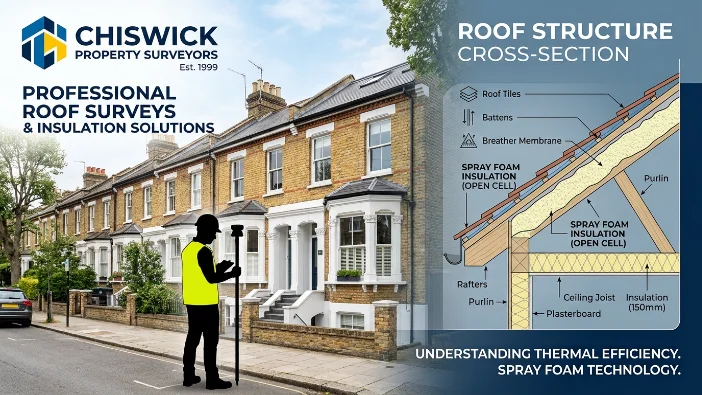
If you own a Victorian or Edwardian property in Surrey, your home belongs to the category most consistently flagged by mortgage surveyors for spray foam insulation problems. This article explains exactly why and what to do about it.
Why Victorian and Edwardian Roof Construction Creates the Highest Spray Foam Risk
Victorian and Edwardian properties were built with what surveyors call a cold roof construction. The roof space sits above the insulated ceiling, separated by a ventilated loft. This design was intentional. It allows air to circulate around the roof timbers, carrying away moisture and keeping the structure dry and sound.
Spray foam insulation applied to this type of roof does the opposite. It seals the underside of the roof tiles and covers the timber rafters completely, eliminating the ventilation that cold roof construction depends on. Moisture that previously escaped through air movement is now trapped directly against the timber surface. Over time this creates the conditions for condensation, damp, and timber decay, developing silently behind a layer of foam that conceals everything underneath.
This is precisely why mortgage surveyors flag spray foam in Victorian and Edwardian properties more consistently than any other property type. The structural risk is real, the foam prevents inspection, and lenders cannot accept that combination.
Why Surrey Has a Higher Concentration of Affected Victorian and Edwardian Properties
Surrey has one of the highest densities of Victorian and Edwardian housing stock outside London. The county’s commuter belt expansion through the late 19th and early 20th centuries produced large numbers of detached and semi-detached properties across Reigate, Dorking, Farnham, Guildford, Godalming, and the surrounding villages. These are exactly the property types most commonly affected.
Many of these properties received spray foam insulation during the energy efficiency grant schemes of the late 1990s and 2000s. Surrey’s high proportion of longer-term owner-occupiers means many received foam through government-backed schemes without fully understanding what was being installed or what the long-term consequences would be for future mortgage and equity release applications.
As of March 2026, the HomeOwners Alliance confirmed that around 250,000 UK homes are affected by spray foam mortgage problems and that all equity release lenders surveyed refuse properties where spray foam is present in the roof. Surrey’s concentration of Victorian and Edwardian stock means the county represents a disproportionate share of that number.
What Surrey’s High Property Values Mean for the Spray Foam Problem
Surrey consistently ranks among the highest property value counties in England outside London. In Reigate, Farnham, Guildford, and Dorking, detached Victorian and Edwardian properties regularly sell well above the national average.
At these price points the financial consequences of spray foam problems are more severe than in lower-value markets. A cash buyer discount of 25 to 40 percent on a Surrey Victorian detached valued at £650,000 represents between £162,500 and £260,000. Professional removal for a Surrey period property represents a fraction of that discount even at the higher end of the cost range.
The calculation is straightforward. Surrey homeowners with Victorian and Edwardian properties have more financial incentive than almost anyone else in England to address spray foam before attempting to sell or remortgage.
What Mortgage Lenders Do When They Find Spray Foam in a Surrey Victorian Property
Halifax, Nationwide, Barclays, NatWest, Santander, TSB, Skipton Building Society, and Leeds Building Society all flag or refuse spray foam properties. TSB refuses outright regardless of foam type, age, or condition.
When a surveyor visits a Surrey Victorian or Edwardian property and identifies spray foam, the report flags it. The lender issues a retention or refusal. The buyer cannot proceed with their mortgage. The sale stalls.
For Surrey’s higher-value Victorian stock, lenders apply greater scrutiny. The larger loan amounts involved mean lenders are even less willing to accept any uncertainty about the structural condition of the security.
According to UK Parliament’s research on spray foam and mortgages, the scale of this problem continues to grow as more affected properties come to market.
The Specific Challenges of Spray Foam Removal From Victorian and Edwardian Roofs
Victorian and Edwardian roof structures present specific challenges that differ from post-war semi-detached properties.
Complex Roof Geometry
Surrey’s Victorian and Edwardian properties frequently have more complex roof geometry than post-war housing. Multiple pitches, hipped sections, dormer additions, and original valley details all increase removal time and cost compared to a straightforward rectangular post-war loft.
Older Timber Construction
Victorian and Edwardian roof timbers are typically cut timber rather than the engineered truss construction used in post-war properties. Individual rafters, purlins, and ridge boards all need to be carefully cleared of foam without damage. Where foam has been applied heavily, extraction around these structural elements requires specialist care.
What the Survey Reveals
For Surrey Victorian and Edwardian properties specifically, the survey is particularly important. Foam applied in the 1990s or 2000s to timber that was already 80 to 100 years old at the time of installation has had 20 to 30 years to cause damage. Our survey confirms the foam type, coverage, moisture readings, and timber condition, giving you an honest picture before any removal commitment is made.
What Removal Costs for a Surrey Victorian or Edwardian Property
For a standard Surrey Victorian three-bedroom semi-detached with open-cell foam and straightforward loft access, removal typically falls between £3,000 and £4,800.
Surrey’s larger Victorian and Edwardian detached properties in Reigate, Dorking, Farnham, and the Surrey Hills villages have significantly larger roof spaces and more complex geometry. These jobs typically fall between £4,500 and £7,000 depending on foam type and roof complexity.
Closed-cell foam costs 20 to 30 percent more to remove than open-cell for the same area. Where timber damage is identified at survey, repair costs are confirmed before removal begins. Full itemised pricing is confirmed after survey with no hidden charges and no obligation to proceed.
For a clear picture of what removal involves for your specific Surrey property, visit our spray foam removal Surrey service page.
Frequently Asked Questions
Are Victorian properties in Surrey more likely to have spray foam than newer properties?
Yes. Victorian and Edwardian properties were the primary target of the grant schemes that installed spray foam in the late 1990s and 2000s because their original construction offered poor thermal performance. Surrey’s high density of this property type means a higher proportion of affected properties per postcode than most English counties.
Does spray foam always cause timber damage in Victorian Surrey properties?
Not always but the risk is higher than in post-war properties because the timbers are older and have had longer to be affected. Our survey confirms whether damage is present before any commitment is made. Where timbers are sound, removal is straightforward. Where decay is identified, remedial work is required and confirmed in advance.
How do I know if my Surrey Victorian property has spray foam?
The most reliable way is a professional survey. If you can access your loft, spray foam is usually visible as a solid layer coating the underside of the roof tiles and the surfaces of the rafters. It looks like hardened foam or rigid insulation material rather than loose or roll insulation. If you are unsure, our free online estimate for Surrey homeowners is the starting point.
Will Guildford and Reigate Victorian properties face higher removal costs than post-war semis?
Generally yes. Larger roof spaces, more complex geometry, and older timber construction all increase removal time and cost compared to a standard post-war semi. The survey confirms the exact scope and cost for your specific property before you commit.
Can I sell my Surrey Victorian property after spray foam removal?
Yes. Professional removal with a lender-accepted completion certificate restores full mortgageability. Halifax, Nationwide, Barclays, NatWest, Santander, and Skipton Building Society will all consider the application once a completion certificate confirming professional removal and timber assessment is provided.
Ready to get a clear picture of what spray foam removal involves for your Surrey Victorian or Edwardian property? Start with a free online estimate, no commitment, no obligation.