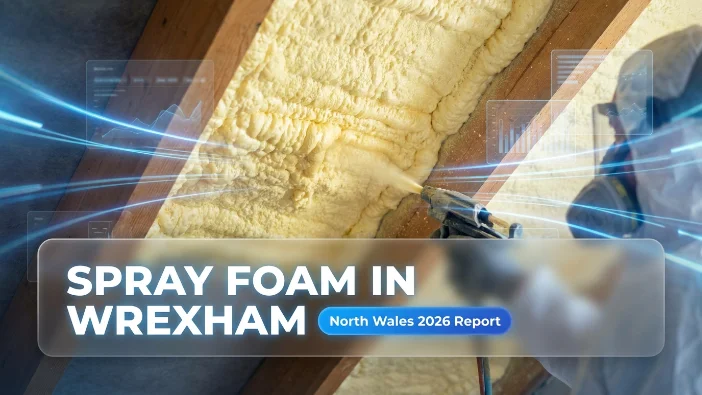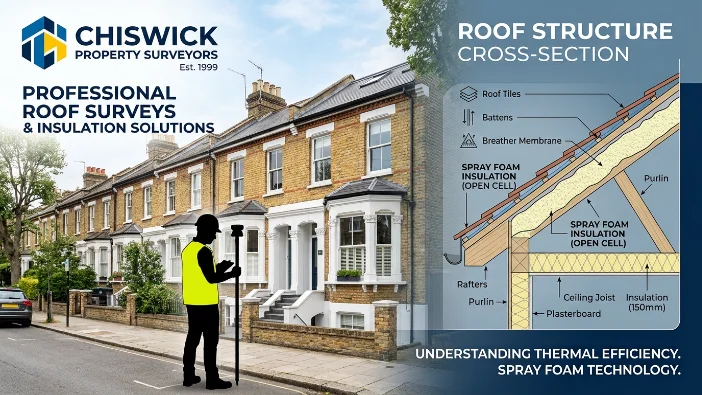
If spray foam insulation is sitting in your loft right now, you are probably here for one reason: your mortgage lender, surveyor, or estate agent has flagged it as a problem.
You are not alone. Thousands of UK homeowners are in the same situation — and most of them have the same first question: how much is this going to cost me?
This guide gives you real numbers, explains why prices vary, and tells you exactly what you should get for your money.
How Much Does Spray Foam Removal Cost in the UK?
Here are the typical spray foam removal costs in the UK for 2026
| House Type | Open-Cell Foam | Closed-Cell Foam |
|---|---|---|
| Terraced | £2,500 – £3,000 | £3,000 – £3,500 |
| Semi-Detached | £3,000 – £3,500 | £3,500 – £4,000 |
| Detached | £3,500 – £4,200 | £4,200 – £5,000+ |
At Spray Foam Removal UK, our prices start from £2,800 for a terraced house, £3,300 for semi-detached, and £3,800 for a detached property — with a £500 surcharge for closed-cell foam. See our full pricing here.
These prices include:
- Initial assessment
- Professional spray foam survey
- Controlled removal by vetted contractors
- Dust protection and safety setup
- Full clean-up and debris disposal
- Documentation for your surveyor or lender
Open-Cell vs Closed-Cell: Why It Changes the Price
Not all spray foam is the same — and the type you have is one of the biggest factors affecting your cost.
Open-cell foam is soft and spongy. You can press it with your finger and it springs back. It is easier to cut away and remove, which means less labour time and a lower overall cost.
Closed-cell foam is rigid and dense, like hard plastic. It bonds tightly to roof timbers and tiles. Removing it takes more time, more specialist equipment, and more care to avoid damaging the structure underneath. That is why it costs more.
If you are not sure which type you have, a quick visual check can help — or book a professional survey and they will confirm it for you.
What Actually Affects the Final Price?
There is no single fixed price because every loft is different. Here are the main things that push costs up or down:
1. Size of the loft More surface area means more time and labour. A compact terraced loft takes less time than a sprawling detached property.
2. Foam type and thickness Thicker layers of closed-cell foam are much harder to remove cleanly. Thin open-cell applications are quicker jobs.
3. Access difficulties Tight loft hatches, low roof pitches, or obstructions make the work slower and more physically demanding — which adds to the price.
4. Timber condition If the foam has trapped moisture over the years, the timber underneath may be damp or starting to rot. If timber repairs or treatment are needed, this is an additional cost outside the basic removal quote.
5. Whether a survey is needed first Some properties need a full spray foam survey before a removal quote can be confirmed. At Spray Foam Removal UK, we include a survey in our process where required.
Why Are UK Homeowners Paying to Have It Removed?
Spray foam was sold as a cheap, quick way to insulate a loft. Many installations took place under government energy efficiency schemes — including the Green Homes Grant — between 2016 and 2022.
The problem? It caused far more problems than it solved.
Here is what is happening to homes with spray foam right now:
- Mortgage refusals. Lenders including TSB, Halifax, Nationwide, Skipton Building Society, and 50+ others now flag or refuse mortgages on properties with spray foam in the loft.
- Equity release blocked. If you were planning to release equity from your home, most equity release providers will decline if spray foam is present.
- Failed property sales. Buyers’ solicitors and surveyors are now routinely flagging spray foam — causing transactions to collapse at the last minute.
- Hidden damage. Spray foam can block natural ventilation in a roof space, causing moisture to build up against timber rafters. Surveyors cannot inspect what they cannot see — which is exactly why lenders object to it.
According to the Property Care Association and the Home Owners Alliance, 35% of properties inspected had at least one defect caused by spray foam insulation.
In early 2026, the government confirmed that there is no financial assistance available to help homeowners cover removal costs. You are paying for it yourself — which makes choosing the right company at a fair price very important.
What Is Included in a Professional Removal?
A proper removal job is not just ripping out foam with a scraper. Here is what qualified specialists actually do:
- Survey and assessment — checking the foam type, coverage, thickness, and the condition of the roof structure underneath.
- Safety setup — respiratory protection, dust containment, and proper ventilation of the loft space.
- Controlled removal — using manual tools, scrapers, and extraction equipment to remove the foam carefully without damaging rafters, tiles, or breathable membrane.
- Full clean-up — all foam debris, dust, and waste is removed from the property. Spray foam is treated as hazardous waste and must be disposed of correctly under UK environmental regulations.
- Post-removal check — inspection of exposed timbers for any signs of moisture or damage.
- Documentation — a completion certificate and written confirmation that removal has been carried out. This is what your surveyor and lender will ask for.
At Spray Foam Removal UK, all work is completed by qualified specialist contractors.
Can You Remove Spray Foam Yourself?
Short answer: no — and it is worth explaining why.
Spray foam bonds to roof timbers, tiles, and breathable membranes. Forcing it off without the right technique breaks tiles, tears membranes, and can crack or split timber rafters. The repair costs for that kind of damage — new roof felt, tile replacement, timber repairs — can easily reach £2,000 to £5,000 on top of what you would have paid for professional removal.
Beyond the structural risks, spray foam dust and particles contain hazardous chemicals including isocyanates. Without proper respiratory protection and containment, you are creating a health risk for yourself and anyone in the house.
DIY removal also will not produce the documentation your lender or surveyor needs. A handwritten note saying “I removed it myself” is not enough. You need a completion certificate from a qualified specialist.
What Happens After Removal?
Once the spray foam has gone, you will likely need to think about two things:
1. Re-insulation Your loft will need new insulation. The good news is that lender-approved alternatives — mineral wool rolls, PIR boards, or blown cellulose — are cheaper than spray foam was to install, and they are all breathable and mortgage-friendly.
2. Timber repairs (if needed) If the foam had trapped moisture and caused damp or early-stage rot, exposed timbers may need treatment or replacement before re-insulation.
Ready to Get Your Loft Cleared and Your Mortgage Back on Track?
Most of our customers get a quote within 24 hours. No obligation, no pushy sales calls – just a clear number so you know where you stand.
Get Your Free Online Estimate →
FAQs
Does spray foam removal restore my mortgage eligibility?
Yes in most cases, professional removal with the correct documentation allows lenders to reconsider your application. We provide completion certificates that are accepted by major lenders.
How long does spray foam removal take?
Most jobs take between 2 and 5 days, depending on loft size, foam type, and access. We give you a time estimate as part of the initial assessment.
Do I need a survey before removal?
Sometimes yes, sometimes no. Our team will advise based on your property. For complex cases or where a lender specifically requests a survey report, we can arrange a professional spray foam survey as a separate service.
Will removal damage my roof?
Not when carried out properly by qualified specialists. Our contractors are experienced in protecting roof structures during removal.
Is the removal cost tax deductible?
This depends on your circumstances. For primary residences, it is generally not deductible. If the property is a rental, you may be able to treat it as a repair or maintenance expense — consult a qualified accountant for advice specific to your situation.