Most Hampshire homeowners with spray foam in their loft have no idea what is happening underneath it. The foam sits there, looking solid and permanent, while moisture quietly builds up against the timber behind it. By the time the damage becomes visible, it has often been building for years.
This is the part of the spray foam problem that does not get talked about enough. Mortgage refusals and blocked sales get attention. The structural damage happening silently in lofts across Southampton, Portsmouth, Basingstoke, Winchester, Fareham, and every other corner of Hampshire gets far less.
This article explains exactly what is happening, what to look for, and what to do about it before the problem gets worse.
Why Spray Foam Traps Moisture Against Your Roof Timbers
Roof timbers need airflow to stay dry and healthy. In a properly ventilated loft, warm humid air from inside the home rises into the roof space and is drawn out through eaves and ridge vents. This constant movement keeps the timber dry and prevents moisture from settling.
Spray foam stops that process entirely. When it is applied to the underside of roof timbers, it creates a sealed environment with no airflow. Warm humid air from inside the house rises and has nowhere to go. It meets the cold surface of the foam and the surrounding timber and turns into condensation. That condensation soaks into the wood and stays there, with no airflow to dry it out.
Closed-cell foam creates a completely airtight seal and is particularly effective at trapping moisture. Open-cell foam absorbs moisture directly into its structure, which keeps the timber permanently damp. Both types cause the same end result. The timber gets wet and stays wet, and wet timber rots.
How Quickly Does the Damage Happen
This is where the problem becomes serious for Hampshire homeowners. Timber rot can begin developing within one to three years of spray foam installation in the UK climate. Hampshire’s coastal influence, particularly across Portsmouth, Gosport, Fareham, and Havant, means higher average humidity than many inland counties, which accelerates the process.
The damage is hidden throughout. The foam covers everything it is touching, so there is no visible sign of what is happening underneath. Homeowners go about their lives while the structure of their roof quietly deteriorates behind a layer of insulation.
By the time the damage becomes apparent through ceiling staining, damp patches, or musty smells in the loft, the rot is usually already well established. Around 40% of professional spray foam removals across the UK uncover some level of hidden timber damage. In Hampshire properties where foam has been in place for a decade or more, the proportion is higher.
Warning Signs to Look For in Your Hampshire Loft
If you have spray foam insulation and want to assess the situation before commissioning a full removal, there are several things you can check yourself.
Musty or damp smell in the loft. A persistent musty smell is one of the earliest indicators of moisture in timber. If your loft space smells damp when you open the hatch, moisture is present.
Dark staining on visible timber near the foam edges. Where timber is exposed at the edges of the foam application, dark discolouration or moisture marks indicate that water is moving through the structure.
Soft or spongy timber at the foam boundary. If you can press your finger against an exposed timber at the edge of the foam and it gives way or feels soft, rot has likely taken hold in the timber behind the foam too.
Damp patches or staining on upper floor ceilings. By the time moisture damage shows on your ceilings from above, the structural damage in the roof space is likely significant.
Sagging or deformed sections of foam. Foam that has changed shape or appears to be pulling away from the timber can indicate movement in the structure beneath it.
None of these signs require the foam to be removed to check. If you notice any of them in your Hampshire property, getting a proper assessment arranged quickly is the right move.
What Gets Damaged and What It Costs to Repair
The damage caused by spray foam moisture accumulation in Hampshire lofts typically affects the following structural elements.
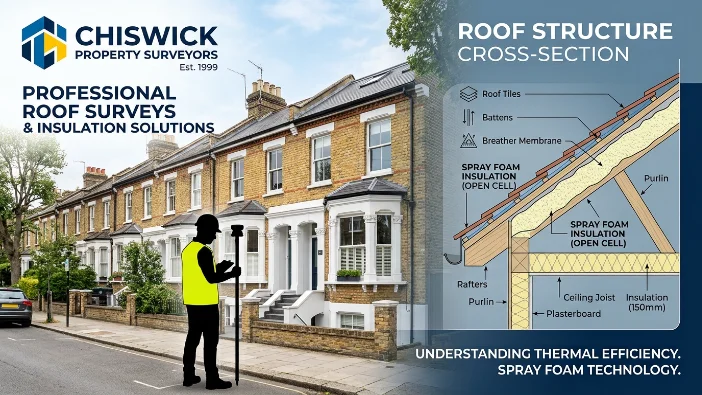
Rafters. These are the angled timbers that form the main frame of your roof slope. They run from the ridge down to the eaves and carry the weight of the roof covering. When rafters rot, the structural integrity of the roof is compromised. Rafter replacement is the most significant repair that can follow spray foam removal.
Purlins. These horizontal timbers span between rafters to provide additional support. They are frequently in direct contact with the foam and are among the first timbers to show damage.
Roof felt. In older Hampshire properties, the roofing felt behind the foam is often in poor condition before the foam is even added. Foam conceals deteriorating felt and prevents it from being replaced. Once the foam is removed, felt replacement is often needed alongside timber repairs.
Ceiling joists. In some installations, foam has been applied lower down into the roof space and makes contact with ceiling joists. Moisture damage here can affect not just the roof but the structure of the floors and ceilings below.
In terms of cost, minor moisture treatment on early-stage damaged timber typically adds £300 to £800 to a removal job. Moderate rot requiring individual rafter sections to be cut out and replaced typically adds £1,000 to £2,500. Extensive structural damage affecting multiple timbers across a large roof space can add considerably more, though this level of damage is less common and tends to occur in properties where foam has been in place for fifteen or more years without any intervention.
Why Hampshire Properties Are at Higher Risk
Hampshire’s geography increases the moisture risk for properties with spray foam. The county’s extensive coastline and tidal estuaries mean that humidity levels in Portsmouth, Gosport, Fareham, Havant, and Southampton are consistently higher than inland areas. Higher ambient humidity means more moisture in the air that circulates into loft spaces and more condensation forming against foam and timber surfaces.
Older housing stock adds to the risk. Victorian and Edwardian terraces in Portsmouth and Southampton, and post-war semis across Fareham, Basingstoke, and Andover, were built with roof structures designed to breathe. Sealing them with spray foam removes the ventilation those structures rely on and accelerates deterioration compared with a modern property designed with sealed insulation systems in mind.
Hampshire homeowners with older properties and coastal or estuary-adjacent locations face the highest risk of hidden timber damage and the most urgent case for getting their loft inspected.
What RICS Says About Timber Inspection and Spray Foam
The structural concern around spray foam is not just a lender policy issue. According to RICS in their official spray foam consumer guide, spray foam insulation creates a genuine inspection problem because it prevents surveyors from assessing the condition of the structural timbers it covers. Their position is clear: a surveyor cannot give assurance about the structural integrity of a roof they cannot inspect, and spray foam makes inspection impossible.
This is why the problem does not go away simply by reassuring a lender. The foam physically prevents the inspection that would confirm whether the timber beneath it is structurally sound.
What to Do If You Have Spray Foam in Your Hampshire Loft
If you have spray foam in your loft and have not had it assessed, the right step is to find out what you are dealing with before it becomes a crisis during a sale, remortgage application, or structural survey.
A specialist spray foam survey gives you an honest assessment of the foam type, coverage, and visible timber condition before any removal work is agreed. This puts you in an informed position rather than discovering the full extent of the damage mid-removal.
If removal is the right course of action, a professional removal by accredited specialists includes a full timber inspection once the foam is cleared. Any damage found is discussed and agreed before any additional repair work begins. A post-removal report is produced for your surveyor or mortgage lender as standard.
For an initial cost indication, you can get a free online estimate based on your property details without a phone call or any obligation.
Frequently Asked Questions
Does all spray foam cause timber damage?
Not all, but a significant proportion does. Around 40% of professional removals across the UK uncover some level of hidden damage. Closed-cell foam carries the highest risk due to its airtight seal. Open-cell foam absorbs and retains moisture directly. Both types can contribute to timber deterioration over time.
Can timber damage be repaired once the foam is removed?
Yes. Once the foam is cleared and the source of moisture is removed, damaged timber can be treated or replaced. Early-stage damage is far cheaper to address than extensive rot. This is why acting sooner rather than later reduces the overall cost.
Will my insurance cover timber damage caused by spray foam?
Most standard home insurance policies do not cover damage caused by spray foam insulation. The foam is typically considered a deliberate modification to the property. Check your specific policy, but do not rely on insurance to cover these costs.
How do I know what type of foam is in my Hampshire loft?
Open-cell foam is soft and can be pressed with a finger. It is usually cream or yellow in colour. Closed-cell foam is rigid and dense. A specialist survey will confirm the type and coverage before any work is agreed.
Can a general builder remove spray foam and repair the timber?
Professional removal and the documentation that follows must be carried out by accredited specialists. Partial removal or work that does not produce recognised lender documentation will not satisfy mortgage requirements and may not address the structural problem properly.
Do Not Wait for the Damage to Show Itself
The defining characteristic of spray foam timber damage is that it is invisible until it is significant. Hampshire homeowners who wait for a visible sign are often waiting until the damage is already expensive to fix.
Getting a survey arranged now costs nothing and takes no commitment. It tells you what is in your loft, what condition the timber is in, and what the sensible next step looks like for your specific property.